I have now lived in Mexico for a little over 9 years and, honestly, I am running out of new things to post. There are only so many times I can post about Christmas, Easter, Mexican culture, daily village life, etc., etc., so I will be starting to write about other aspects of life in general. And given that I can be long-winded, I will probably break this up into two or three posts
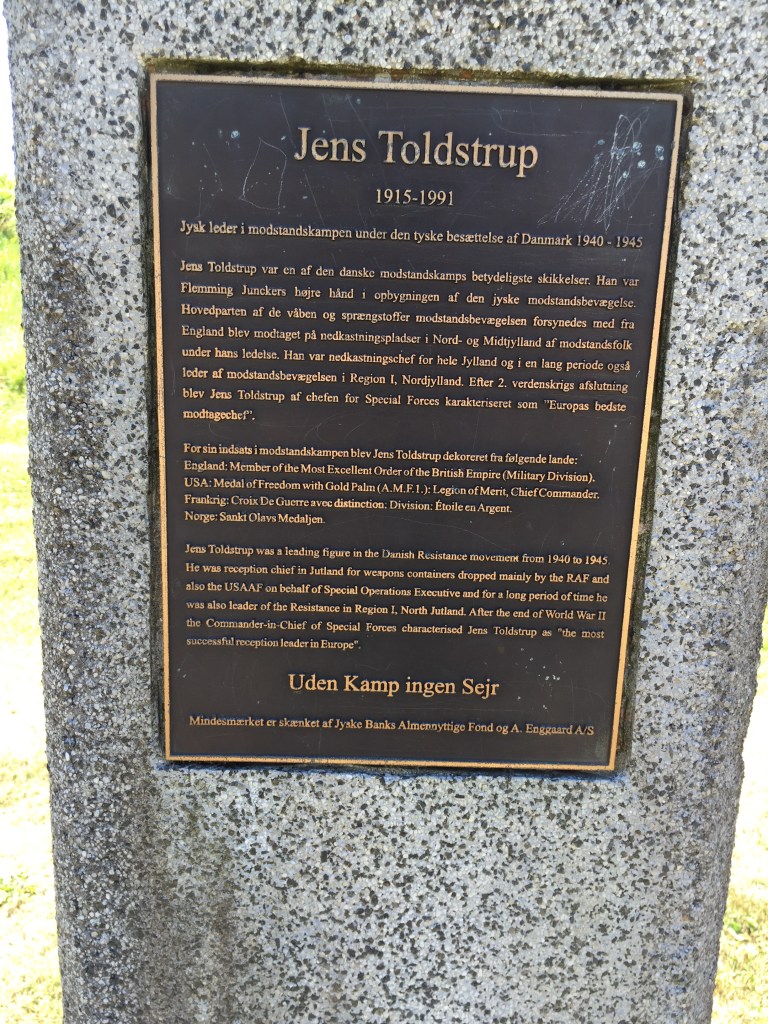
I’ll begin with expanding your horizons through chance meetings with strangers. Many years ago, on one of my flights, I met a Danish-American woman and we had a very nice conversation. She told me about the Danish American Society and how the town of Rebild, Denmark holds the only authentic American Independence Day celebration outside of the United States. I was intrigued by this and vowed one day to attend.
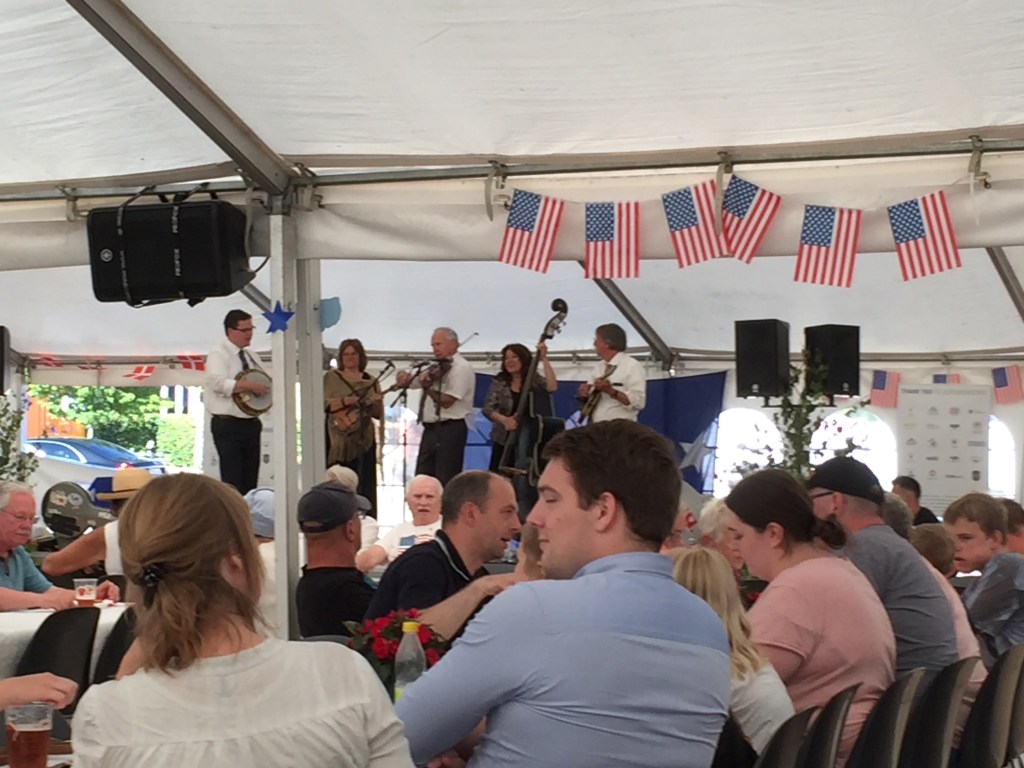
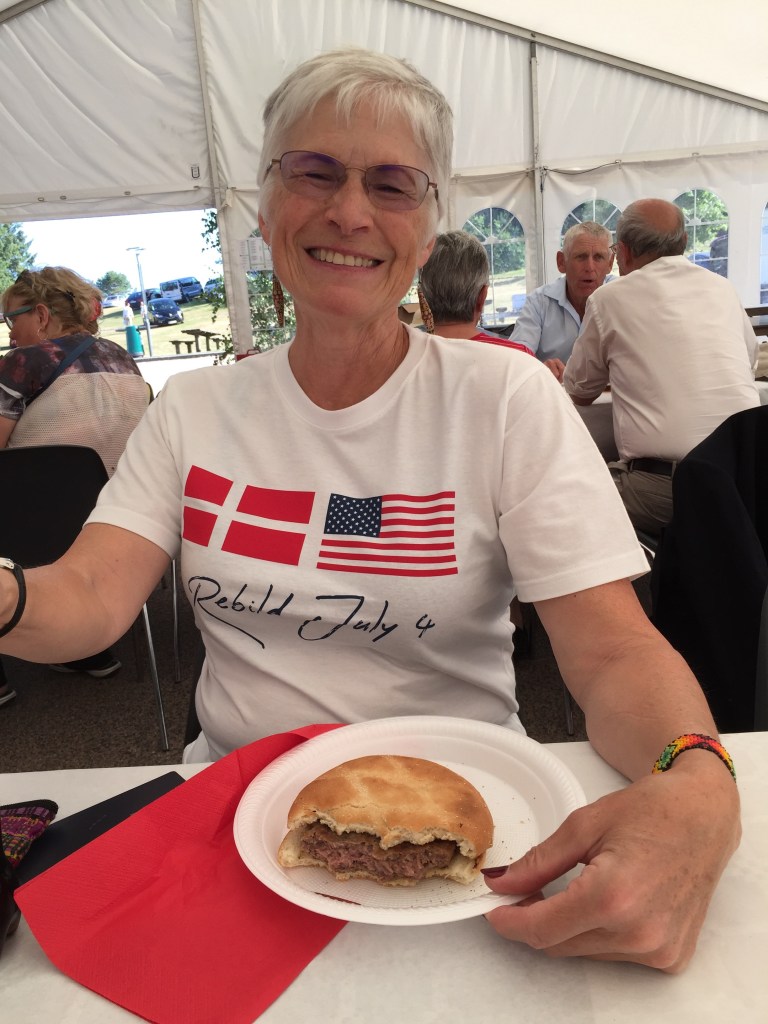
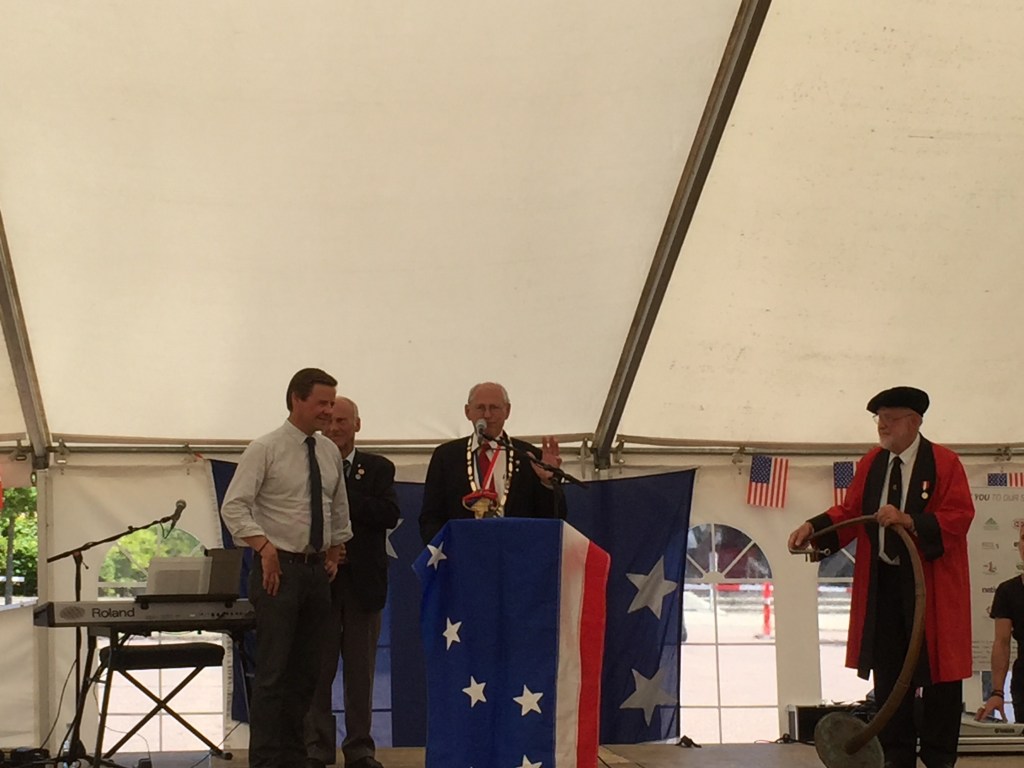
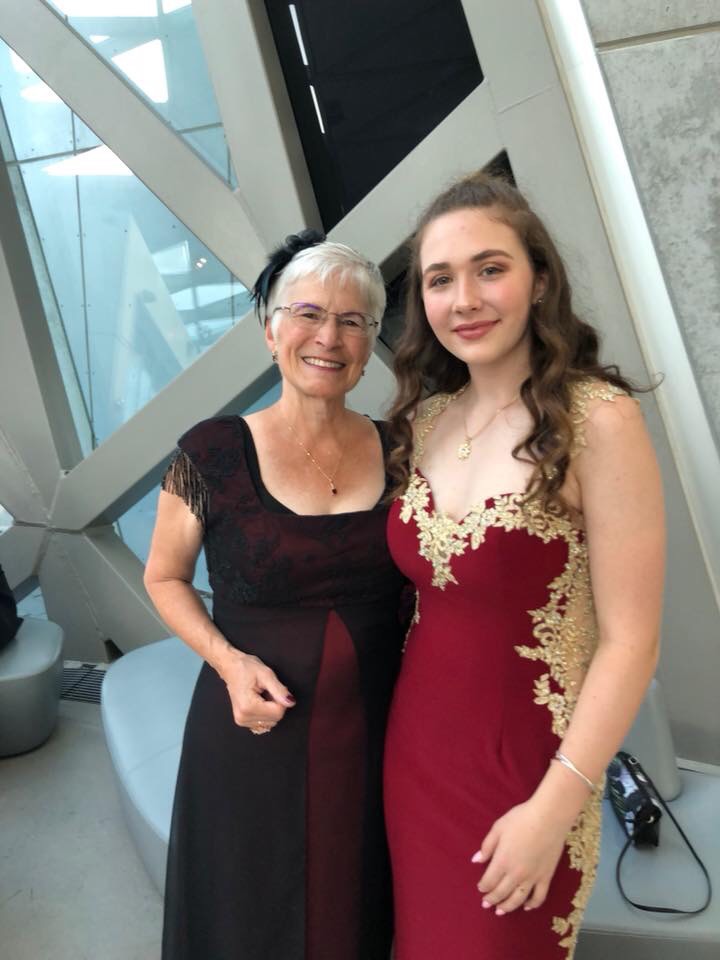
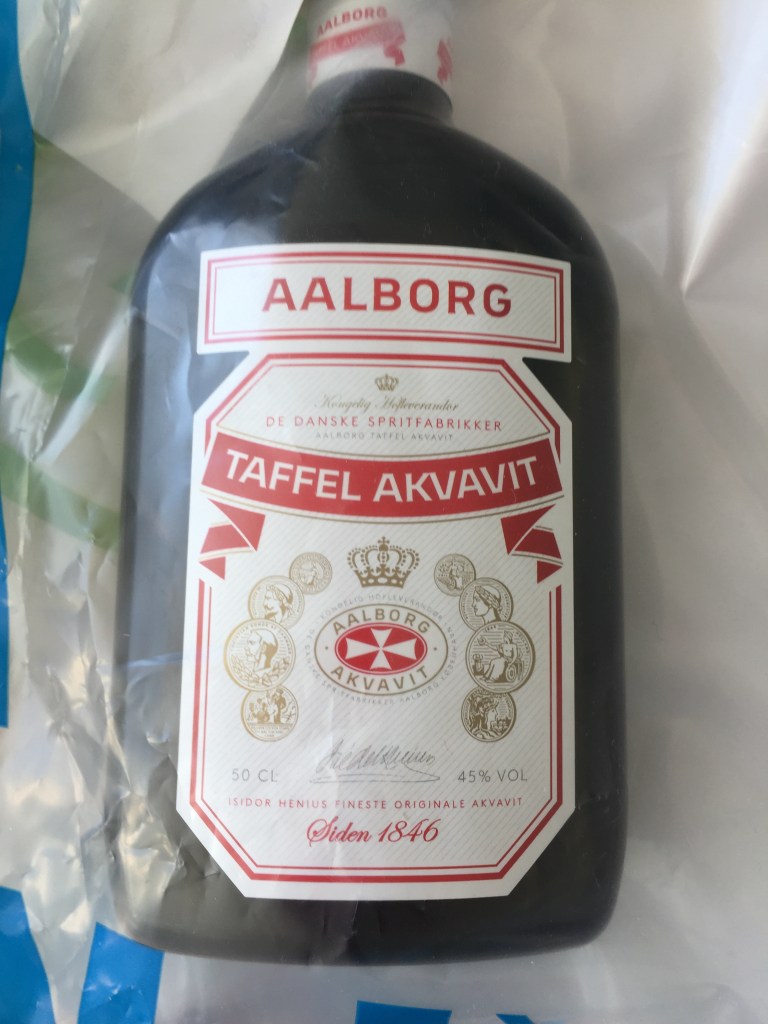
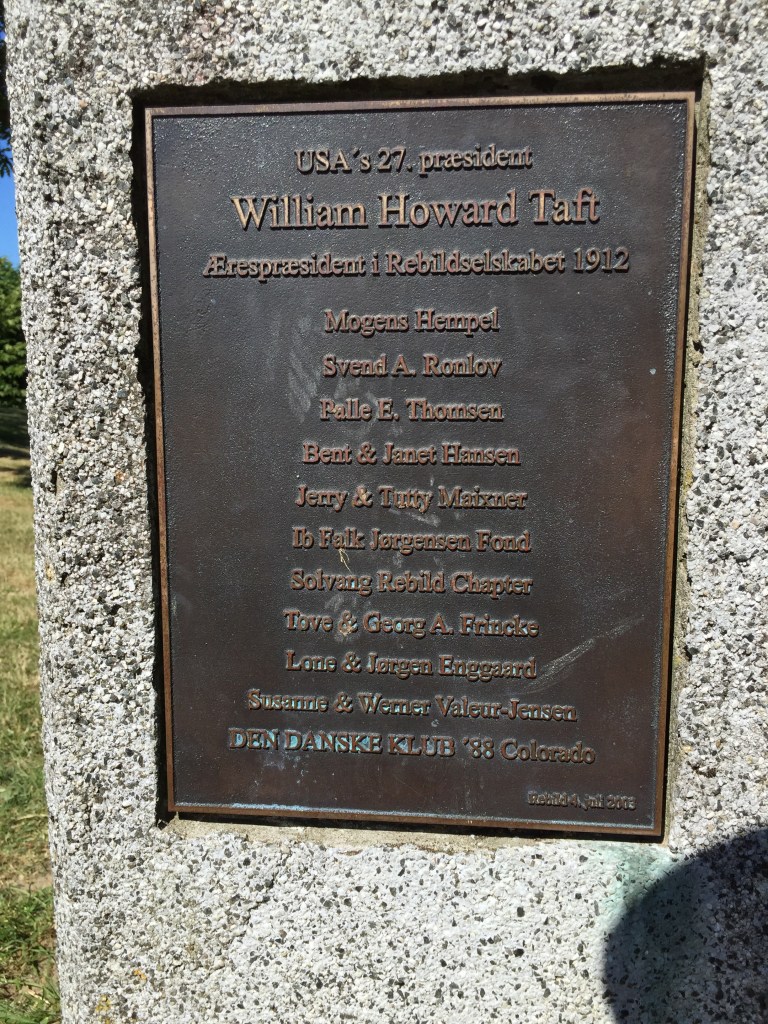
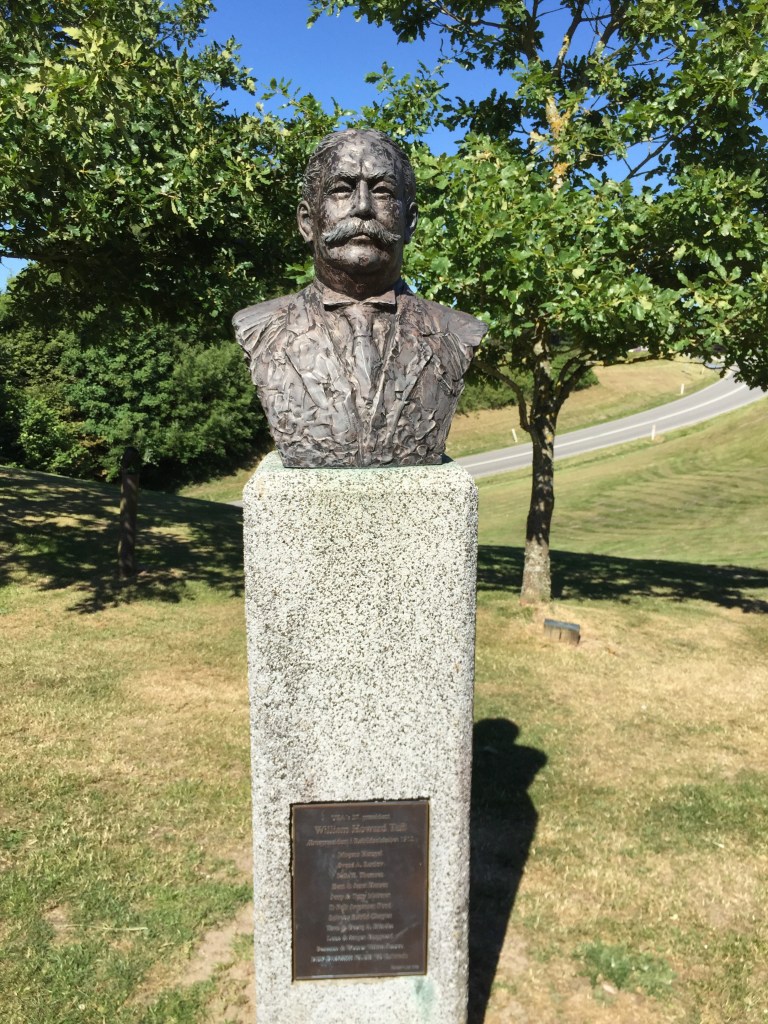
Fast forward to 2018, and I would be going on a trip with my granddaughter Brenna. I asked her parents’ permission to include the 4th of July on our trip. Permission granted. And so we spent that 4th of July in Denmark, with celebrations over several days, ending with a fancy dinner and fireworks over the water in Aalborg (I believe). We met many wonderful people and tried the Danish cuisine – except for hot dogs and hamburgers on the 4th.
We also learned a lot about the history of Denmark in general and Rebild in particular.
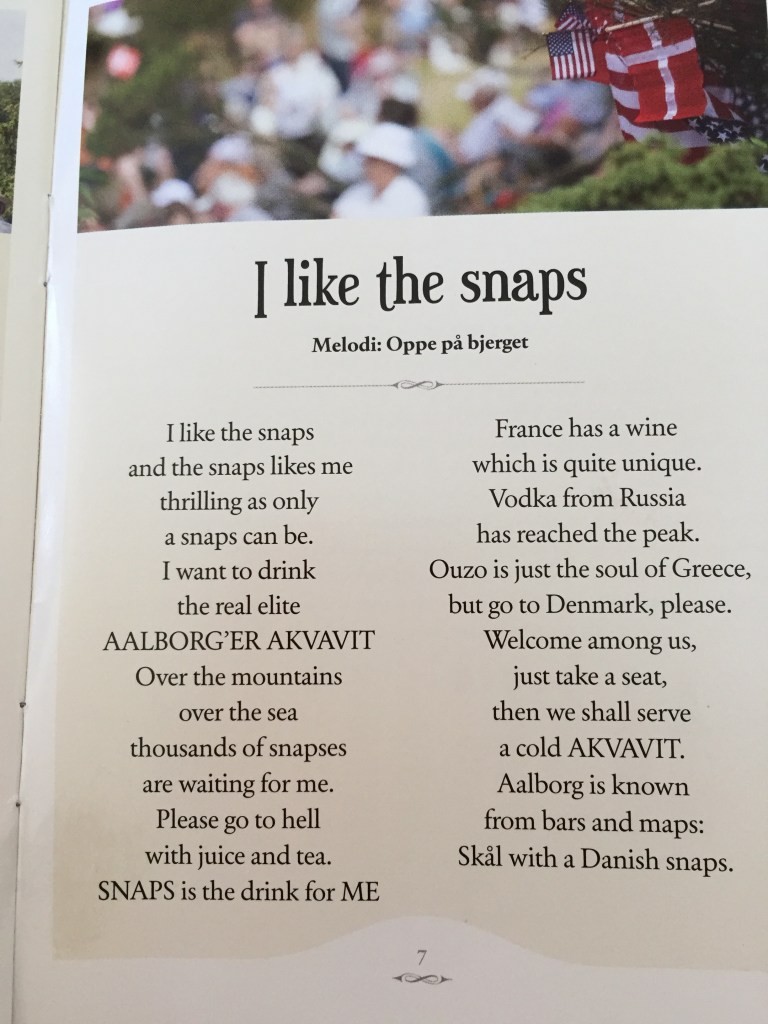
stairway in the very health-conscious hoteldrinking song. Every so often, we would start singing and then take a swallow of Akvavit – heavily flavored with anise
The people we met were surprised that we have not a drop of Danish blood, and they wondered how we had come to be there. I explained to them how I had met a Danish woman on one of my trips and that is how we learned about the festival and decided to come,
For my second meeting-with-strangers story, last month I went to visit my son in the U.S. While waiting at the gate to board, I sat next to a woman who needed to charge her phone. I offered the use of my portable charger, and we began talking. As it turned out, she was the author Norma Alicia Gallegos.
Throughout her life, she had become progressively deaf and wrote a book about it – “Voces en el Silencio, Pensamientos de Amor” (Voices in the Silence, Thoughts about Love). It is also available in English – I’m not sure if it is available in other countries in other languages.
She has also co-written with two other women a book titled “Resilientes” (Resilient). The three women tell their histories each one dealing with her individual challenges. I would recommend this book to anyone facing serious challenges.
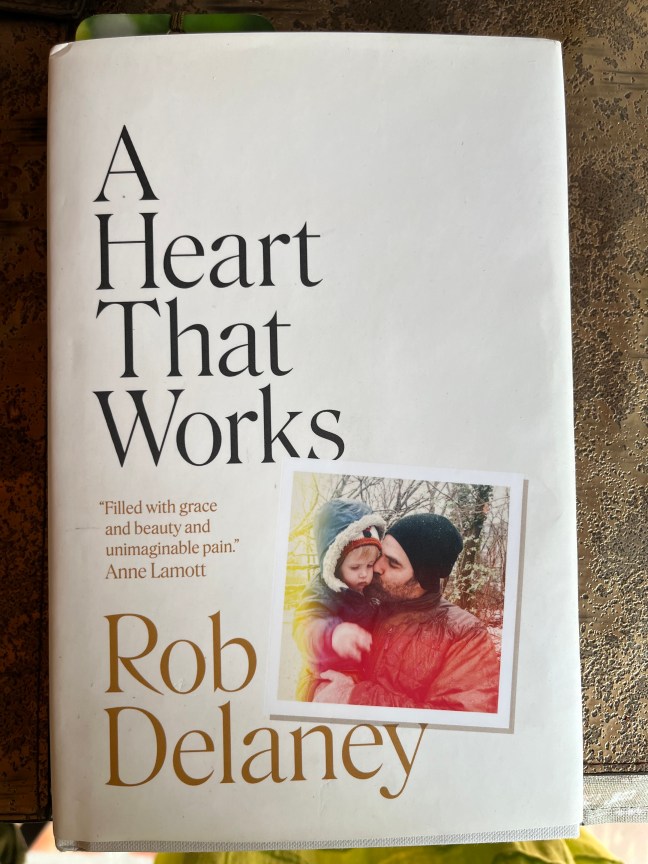
I would recommend Voices in the Silence to anyone who is experiencing, or knows someone who is experiencing, various degrees of hearing loss. And while I am promoting books, I would also recommend a book I am currently reading – “A Heart that Works” by Rob Delaney. He tells in great and honest detail the story of their lives after his one-year-old son Henry was diagnosed with a brain tumor. I would recommend this book for anyone working in hospice or any person who is dealing with a serious illness of a child. I learned about this book when I was listening to interview he gave online.
So I think I will end this post here, as I don’t want it to be overly long and become boring. More in the next post about expanding your horizons. Take care.
Everyone needs to eat to live. That is a basic truth. Now, what you eat depends on what is available and that varies from country to country and even region to region within a country. The local variety of fruits, vegetables, meats, poultry, fish and spices all affect what you will eat and how it is prepared. Through the wonders of refrigeration and modern transportation methods, you can enjoy foods from other regions without having to travel there.
When I was taking classes at the New York University Language School in Manhattan, I would leave home early so that I could have a meal at different restaurants in different ethnic neighborhoods before class, with cuisines from Italy, India, Ukraine and Afghanistan, among others. When I gave my son my car, we drove it together from Maryland to his home in Denver and enjoyed many foods typical in The Southern States.
Living in Mexico, I get to enjoy Mexican food. However, because I am intolerant to chili peppers, I need to be careful when eating out. When I am in my own home, I prepare the local produce according to my own taste.
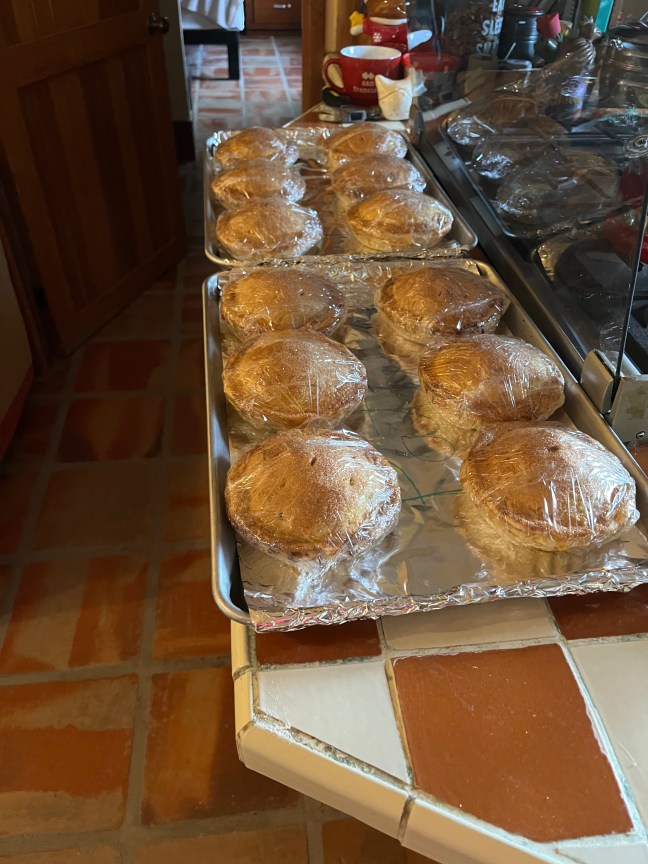
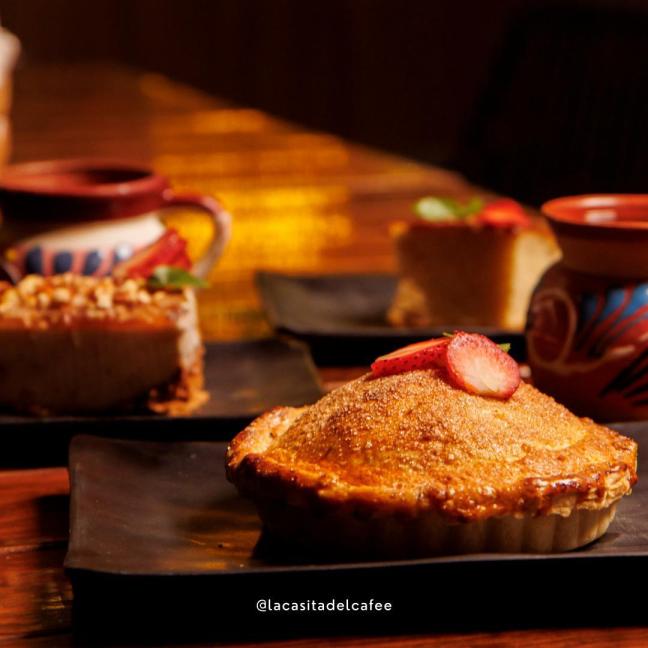
Recipes for baking are often configured to yield enough food for many people, not just a single person. Since I love to bake, I have often shared the resulting meals with my neighbors, and one of the first things I shared was my apple pie.
Freshly made apple pies for the weekend crowd
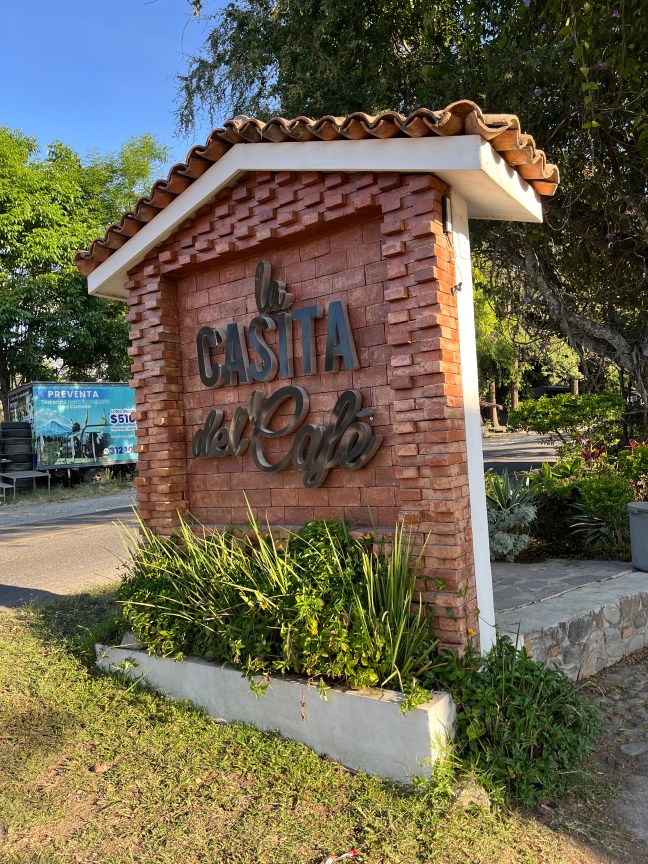
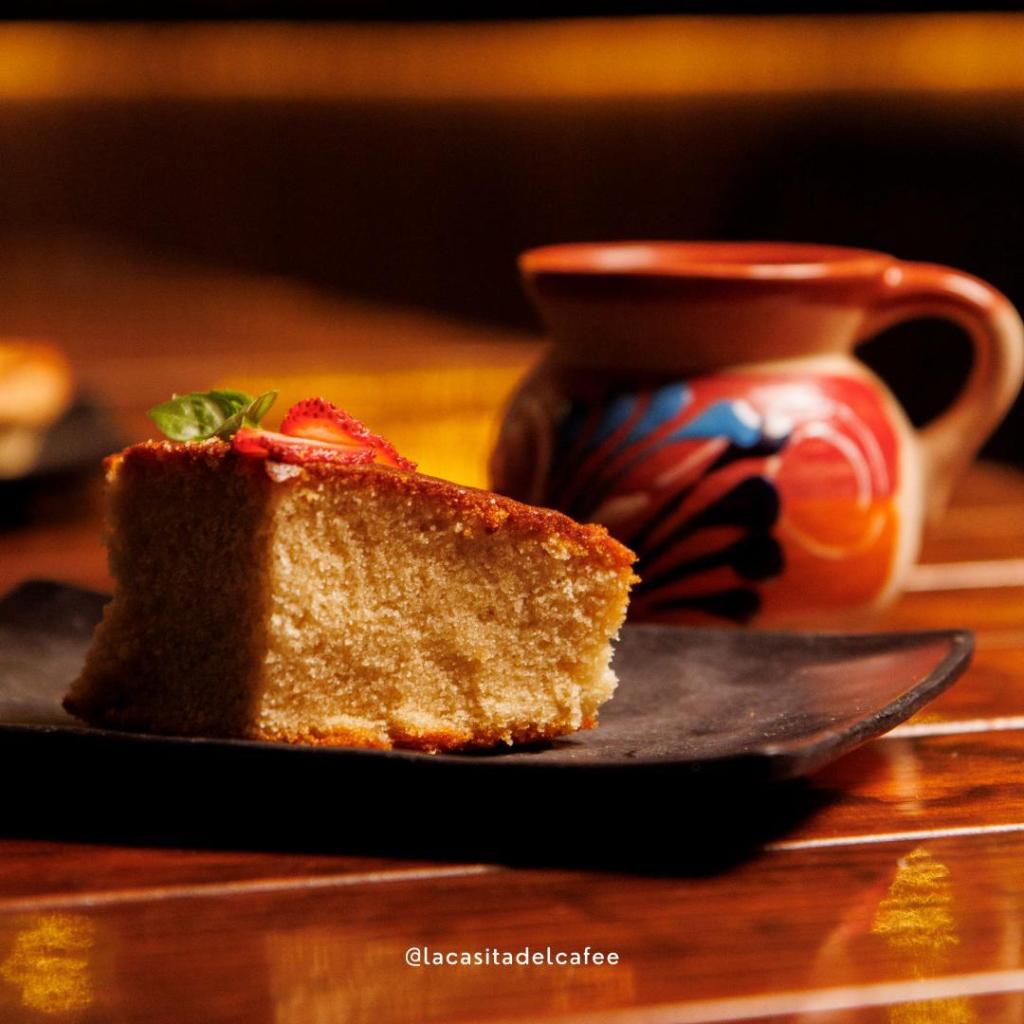
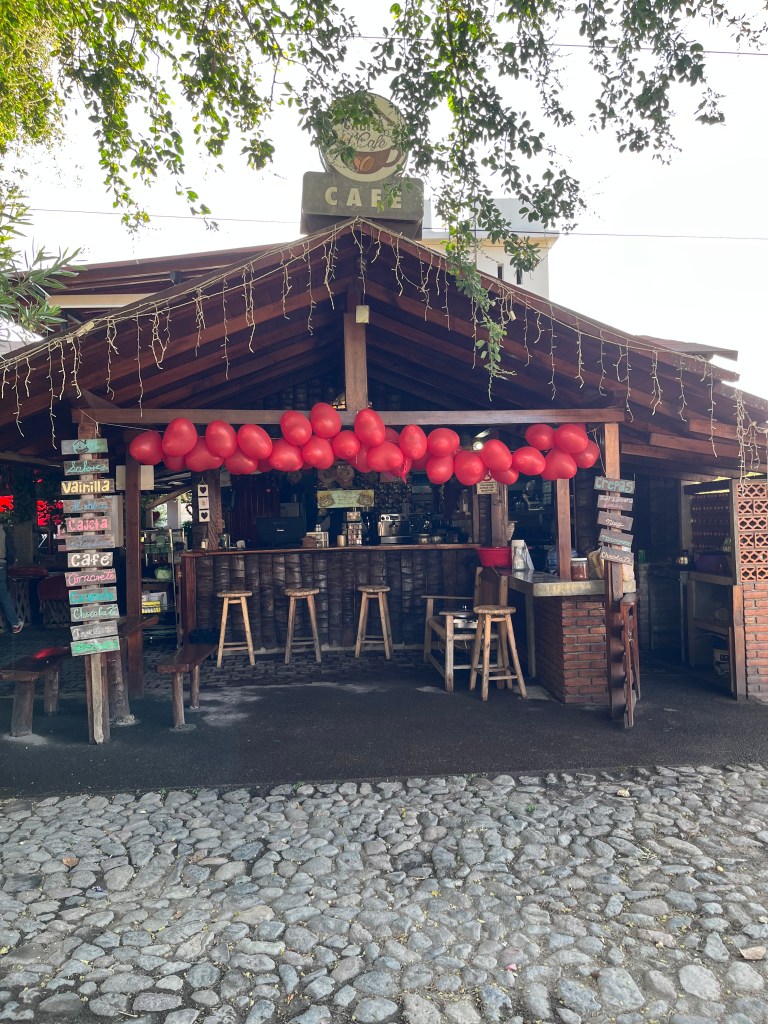
Since my neighbor Lourdes had opened her restaurant, La Casita del Café, she shared the pie with her customers and they loved it, so she asked me to begin providing them for her menu. Since the customers felt that individual-size pies were more appealing than slices from a large one, I bought molds and now make them as personal-size pies. However, if someone is having an event, I do occasionally make one large pie by special request.
Apple pie ready to be served to a customer
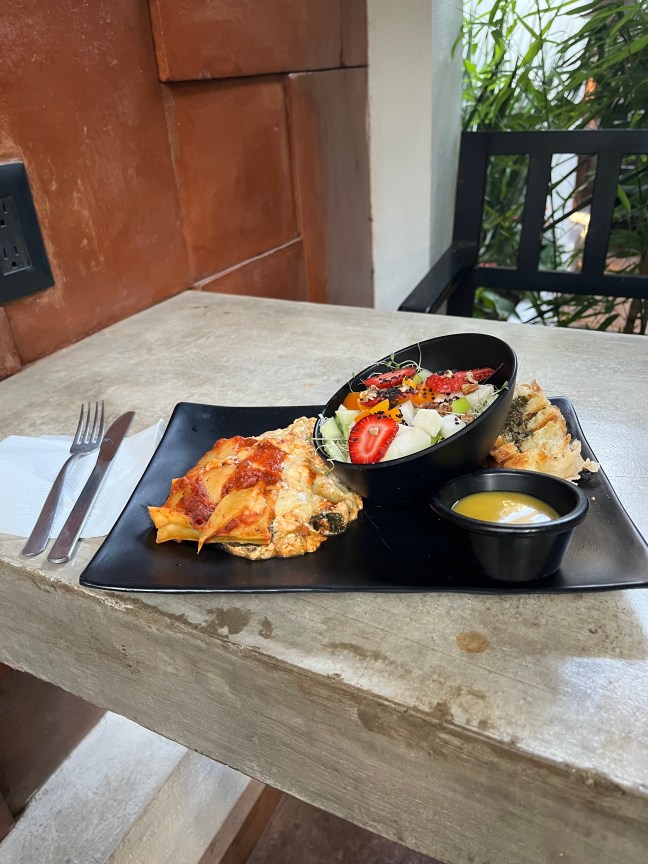
The next dish I made was vegetarian lasagna. I was very surprised at how the Mexicans loved my non-Mexican food. However, the preparation of the pies, starting with a crate of apples, and the preparation of the lasagna was very time-consuming, so, while I still make the pies, I taught Lourdes how to make the lasagna. I’m very specific about the ingredients, and I’ve learned not to make any changes myself. I once switched out the local spinach that I use for a “new variety.” Turns out, the new variety was very bitter. I hadn’t told anyone about the change, but the customers hated it. Lesson learned.
Lasagna served with bread, salad and salad dressing
Enjoying my lasagna dinner at La Casita del Café
For a while, I also supplied ice pops (popsicles) – water-based made with fruit. With those, I was told something that I had not anticipated. I was told to add green food coloring to the lemonade pops. When I asked why, I learned that the color yellow is associated with pineapple, and what we call limes are called “limones” and are green. It is extremely rare to find anything with yellow lemons here, so “limonada” is made from limes. Therefore, even though I had bought imported yellow lemons to make the popsicles, they wouldn’t sell unless I added green food coloring. However, they still didn’t sell enough to make it worth while, so I no longer make them.
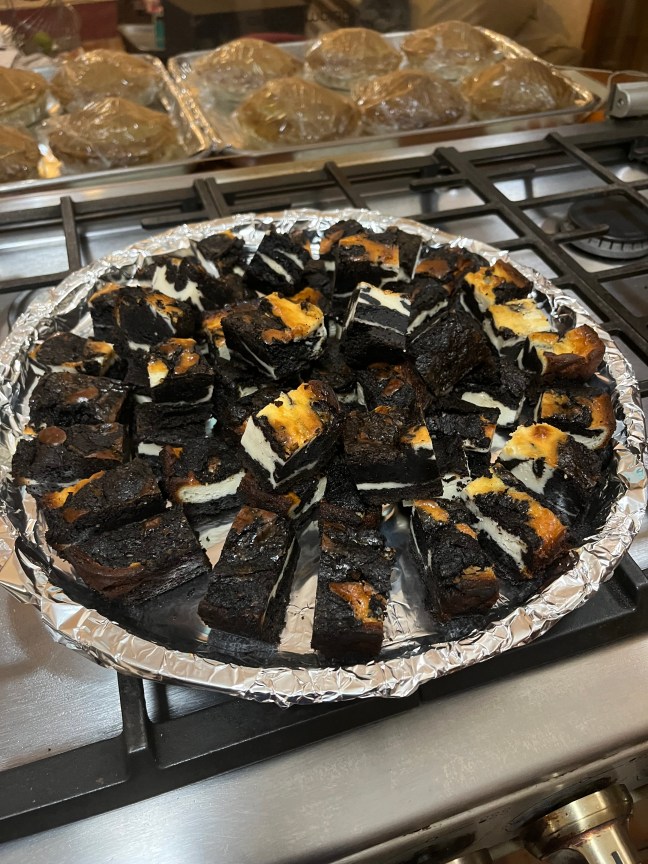
In my family, my mother had a recipe for chocolate cream cheese brownies. Once grandchildren were in the picture, they were referred to as Grandma Ryan’s Chocolate Cream Cheese Brownies. They are difficult to make, and therefore a bit time-consuming, so I rarely made them in the past and now I only make them by special request for special occasions. They are also a big hit here.
Grandma Ryan’s famous chocolate cream cheese brownies
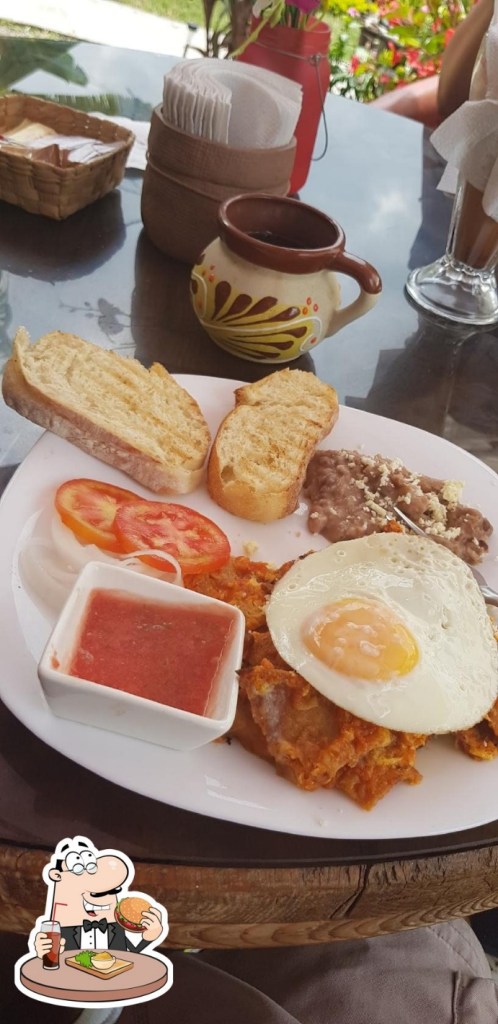
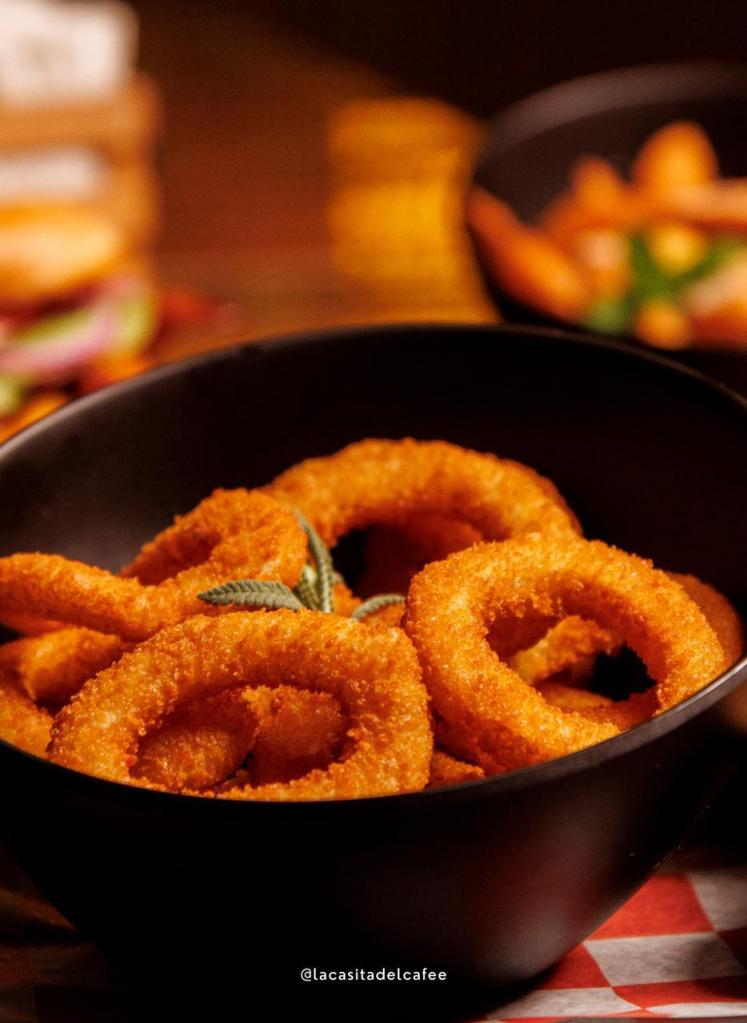
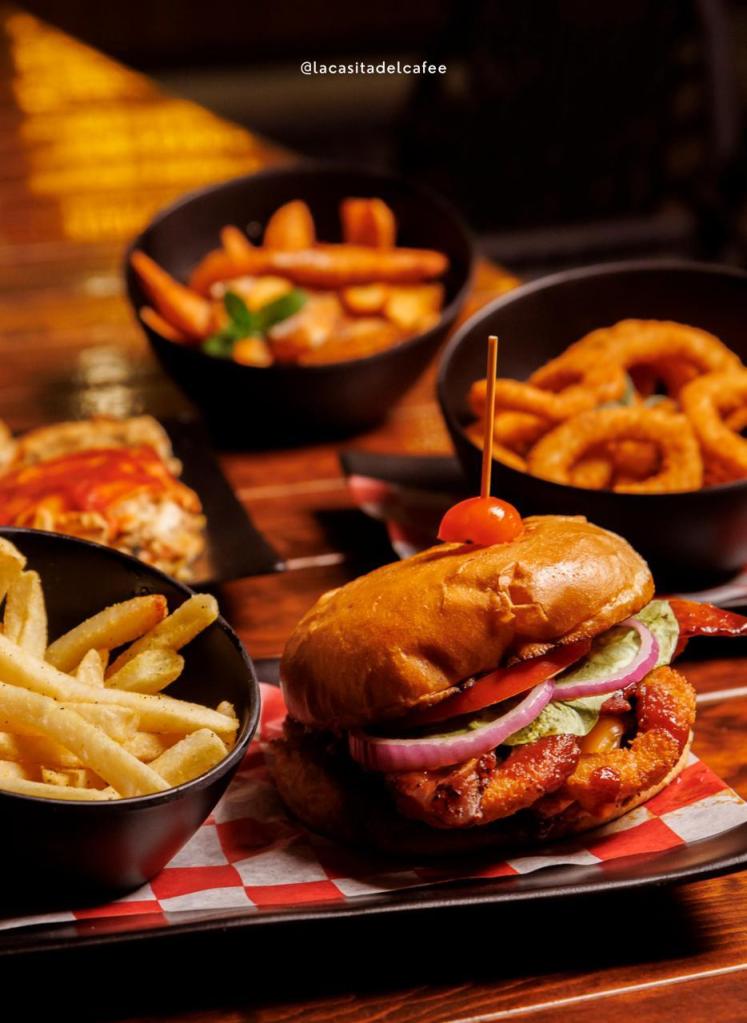
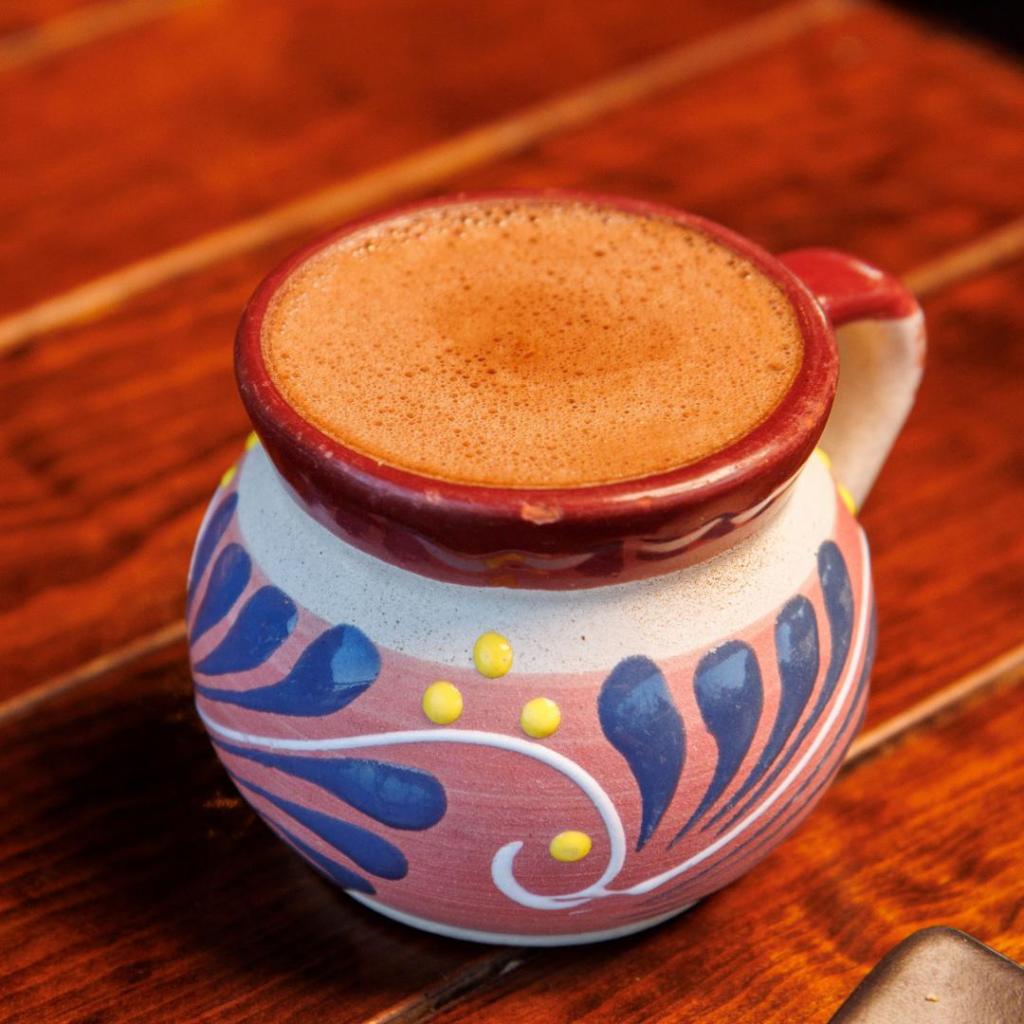
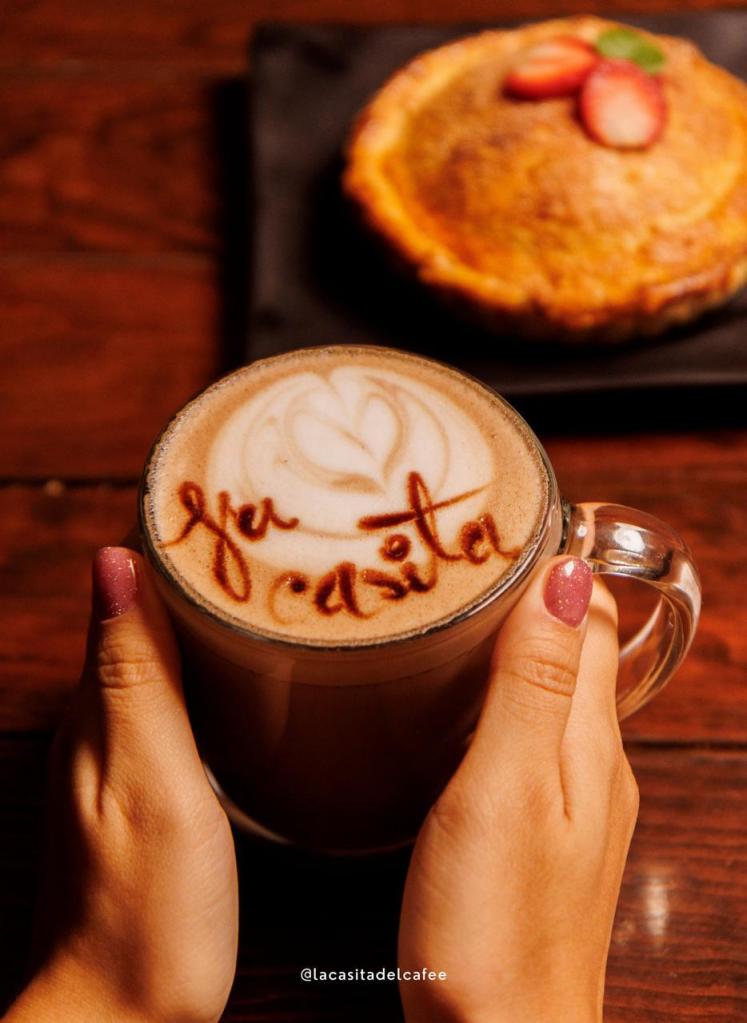
So, even though it is a bit of a joke among my family and my friends in both countries that I am a caricature of a gringa who cannot tolerate hot, spicy food, I have built a bridge through baking. Below are photos of the various items on the menu.
I hope you have enjoyed reading about the culinary adventure that I have had here in my little corner of Mexico, and I wish you safe travels and as wonderful an experience trying different foods, even if it is in a different state or a nearby neighborhood.
chilaquiles with egg and beanssandwichmore chilaquilesHamburgerOnion ringsHamburger platter
American-style food
Cold drinkHot chocolateCappuccinoA slice of pie with a hot drinkLa Casita del Café decorated for Valentine’s Day
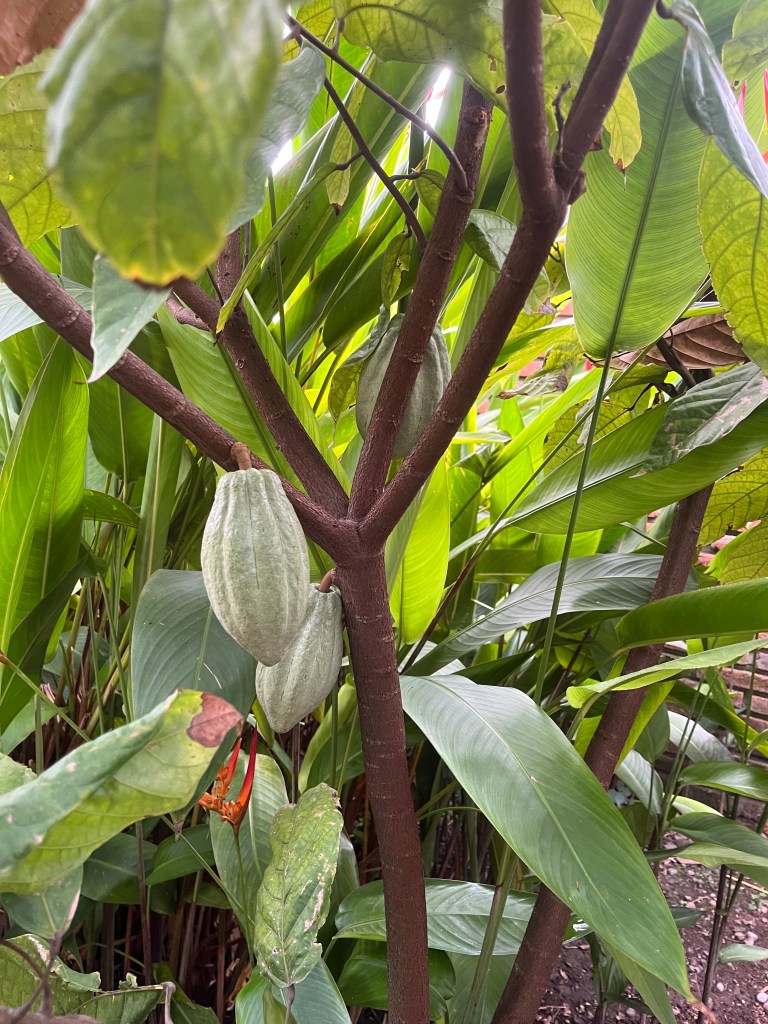
Five years ago, I decided to try my hand at making chocolate. I had read that it takes a cacao tree five years to produce cacao, so five years ago I planted two trees. One tree is still not able to produce and I believe it is because it has been fighting against my banana trees to access sunlight, but the other tree is strong and now producing many pods of cacao, so I am now documenting my first efforts to make chocolate from tree to table.
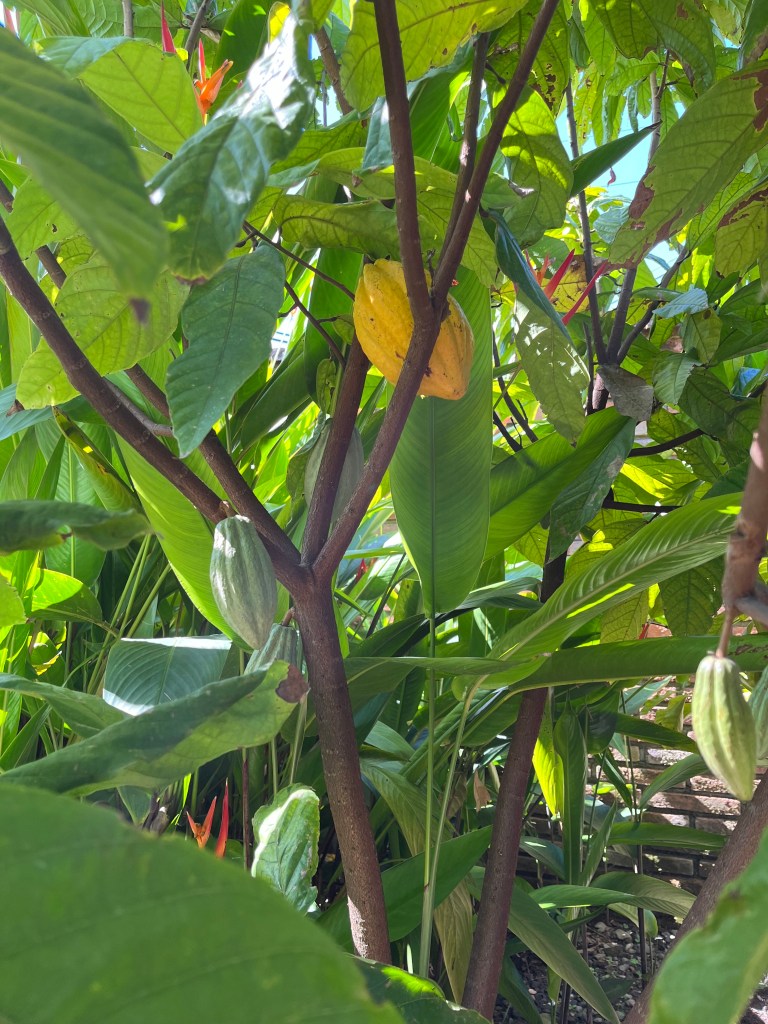
Unripe cacao pods
To prepare myself, I studied many articles and watched many videos about the process. There are so many methods depending on the quantity of cacao seeds, the equipment you use, what type of chocolate you plan to produce. As a result, I put together a pick-and-choose plan, combining what I thought could produce a good chocolate using the whole pod, from seeds to pulp to husk because I wanted it to be as pure as possible while eliminating wasting the pulp and husk.
When the cacao first forms, it is a small, green pod which eventually grows to its full size and then changes to an orange color. Literature says when you shake the pod it isn’t ripe until you can hear the seeds rattle when you shake it. This was difficult, since the stem connecting it to the tree branch was short and the pod was growing in between two branches and basically stuck there. I did my best at deciding when to harvest it and am still not sure it was ripe enough. But there was no bad smell, so I don’t think it was overripe.
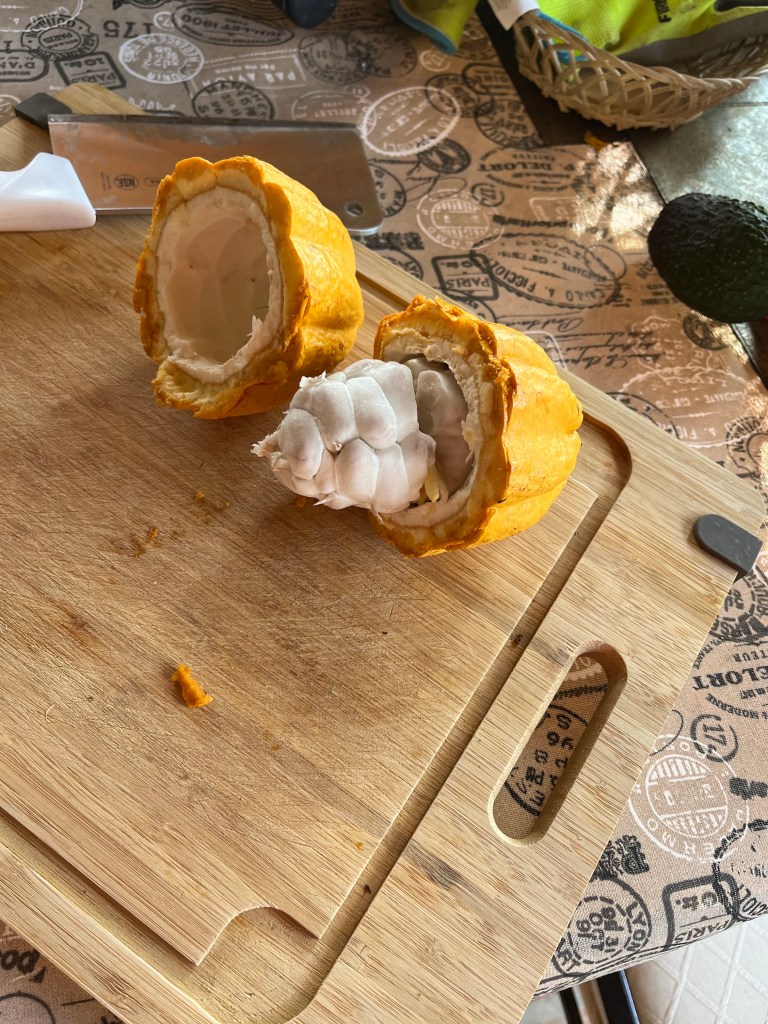
The next step was to open it without cutting the seeds, which I did.
One article said that the seeds taste a bit like pineapple. I ate one of the seeds and the article was correct – it did taste a bit like pineapple. The article also said that the juice is 14% sugar, and by distilling it down to form a highly concentrated syrup, “combined with the pulp and then taking sustainability to new levels, mixed with the dried husk, or endocarp” forms a very sweet cocoa gel which, when combined with the cacao beans, eliminates the need for refined sugar.
This is what I was hoping to accomplish.
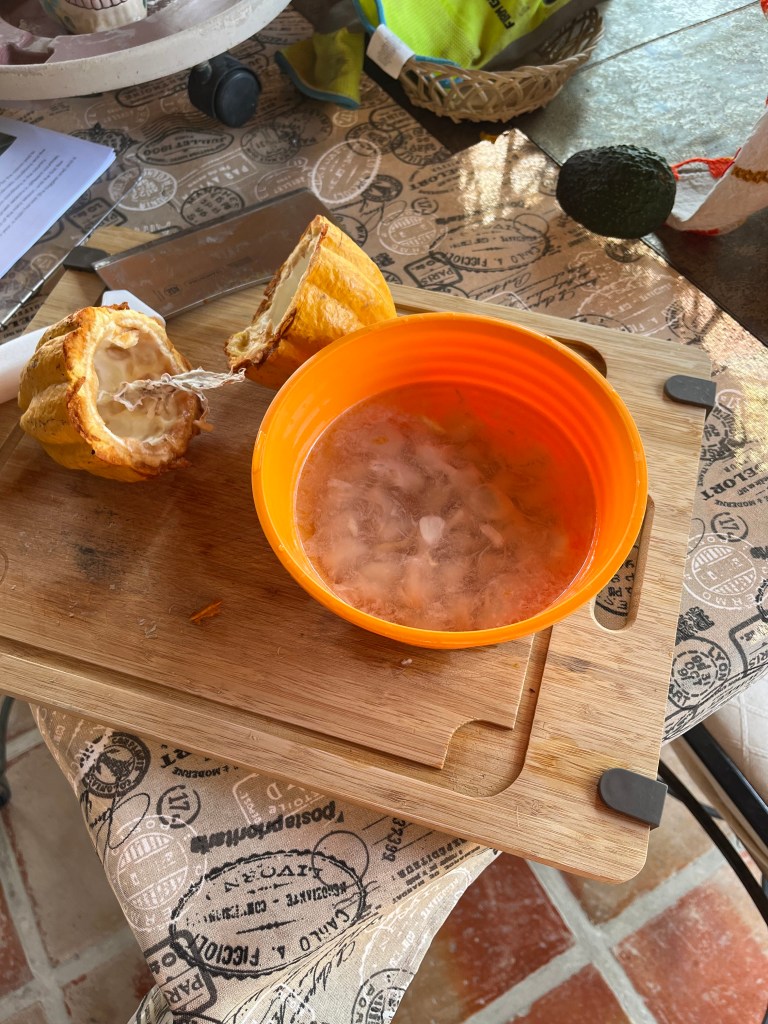
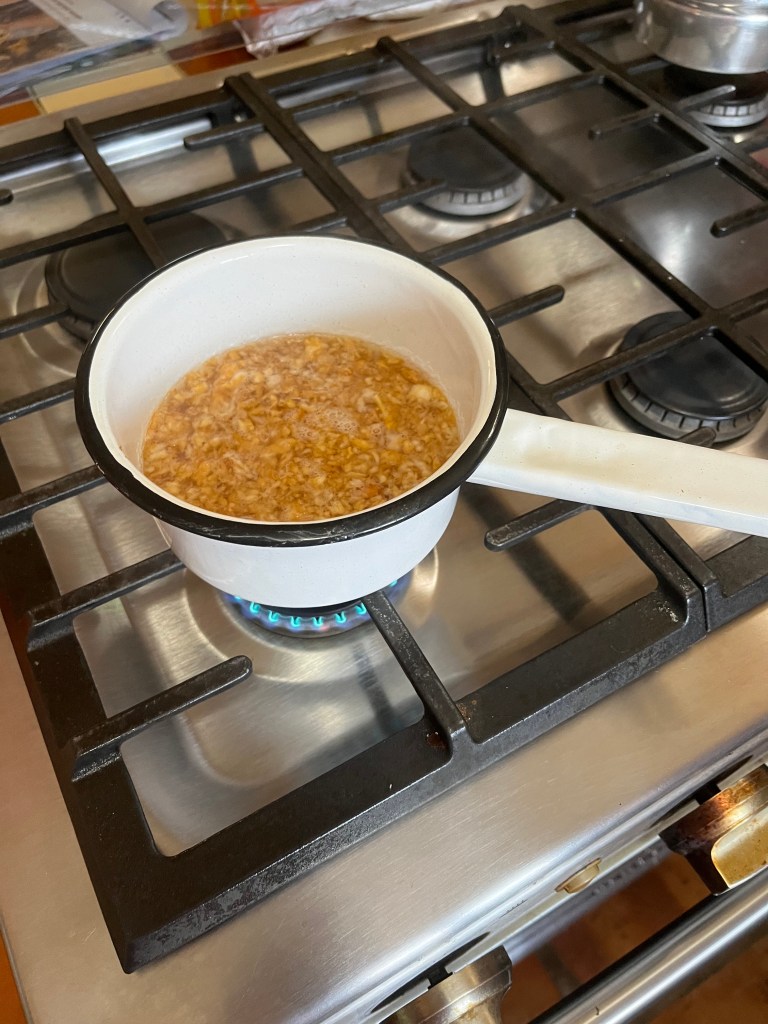
What I did was put the seeds in a small dish of water to wash off the thick white coating from the seeds. Then I cut the pulp from the husk and used a garlic press to try to extract the liquid from it. That didn’t work very well. In the end, I put the water with seed coating into a saucepan along with the pressed pulp and heated it on my stove. I didn’t end up with a gel, but I figured that the sugar content was still there, and I would add it to the finished product.
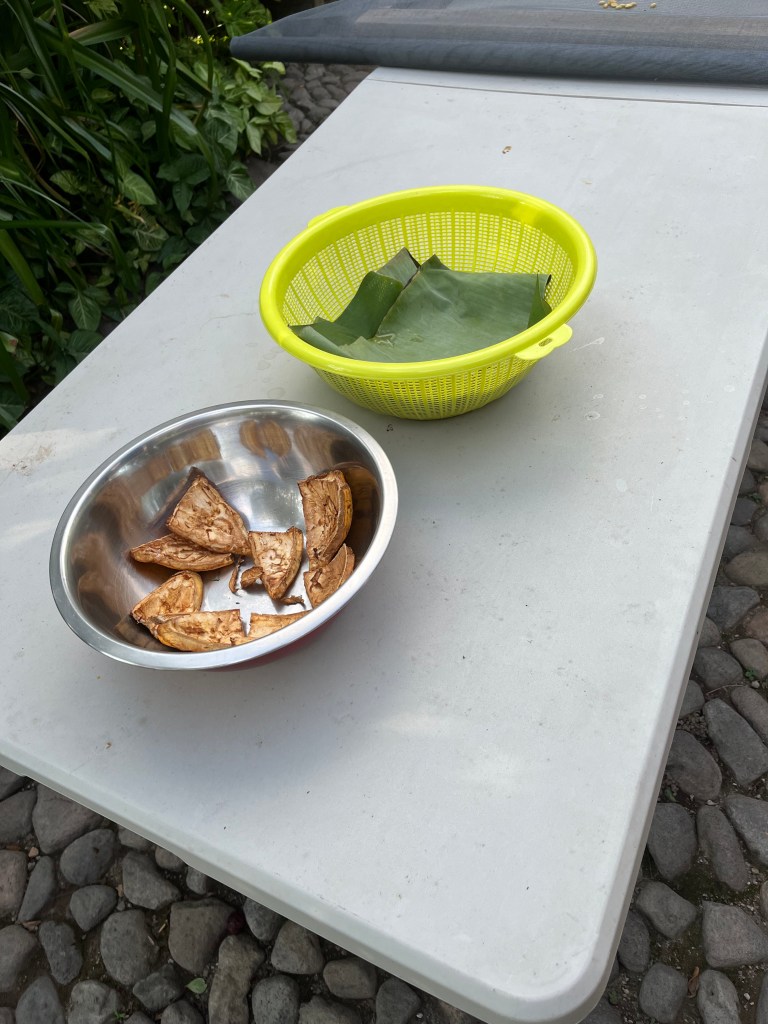
In the meantime, the literature said to dry the husk in an oven at 80ºC (176ºF) for 18 hours. I was not going to run my oven for 18 hours, and since it’s still very hot here, I put the pieces of husk on my outdoor drying table in the sun, covering them with plastic during the night to avoid the humidity. The literature also says to mill it to a fine powder once it is dry. Not having the equipment to do that, the husk ended up in my compost pile.
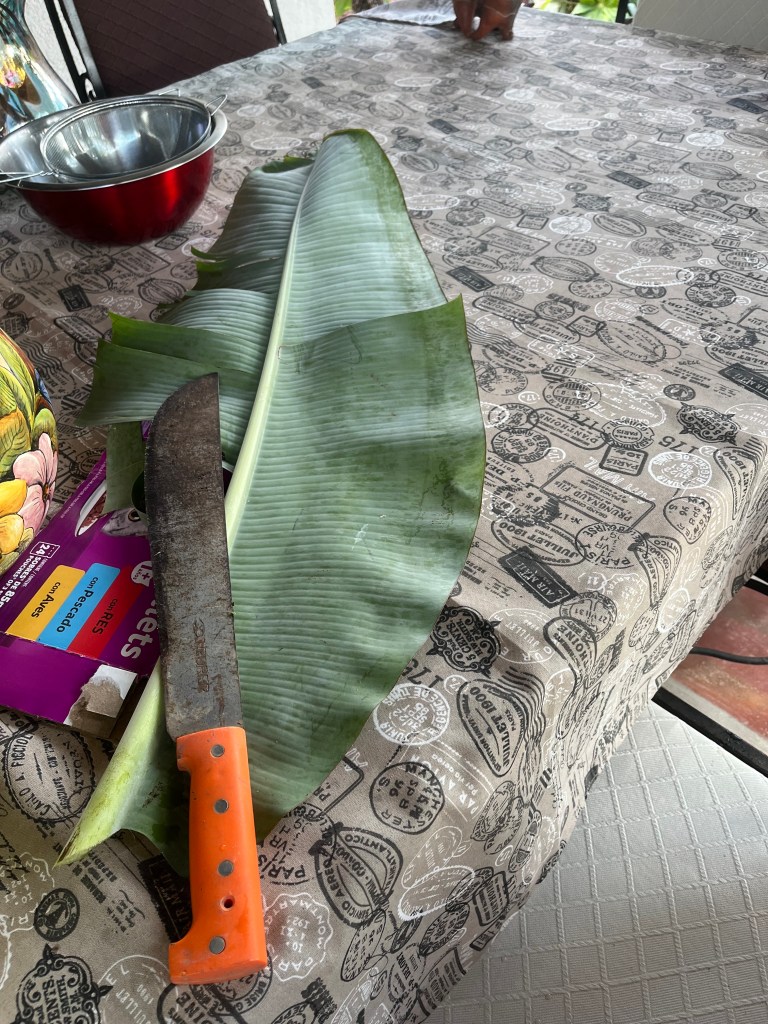
The seeds needed to be fermented as the next step. I read that some producers wrap them in banana leaves and leave them to ferment for 7 days, turning them daily. Since I grow banana trees I decided to use this method, and the seeds did turn brown, but I had no idea if and how much they had fermented. Because the seeds needed so much time to ferment, I froze the heated pulp mixture so it would not spoil.
Husk drying and seeds fermenting in banana leaves
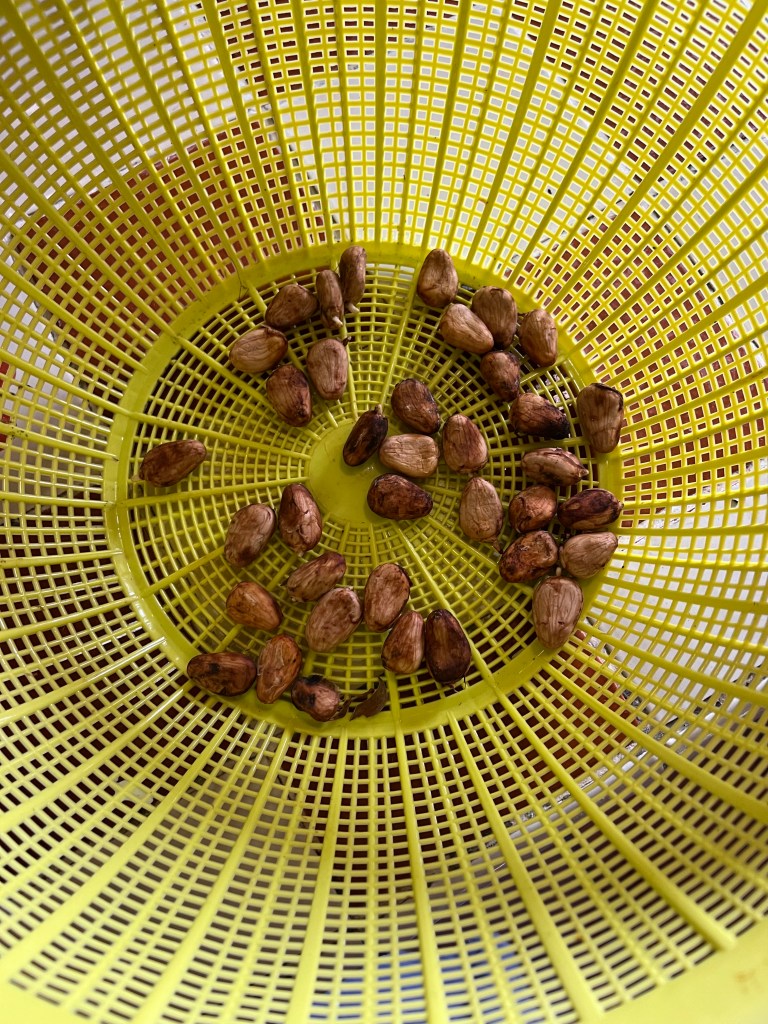
Then it was time to roast the seeds. I put them on a cookie sheet and roasted them in the oven at 205ºC. (401ºF) for 6 minutes, then for 20 minutes at 132ºC (270ºF). They were then removed from the oven and left to cool for 15 minutes.
Cacao seeds ready to roast
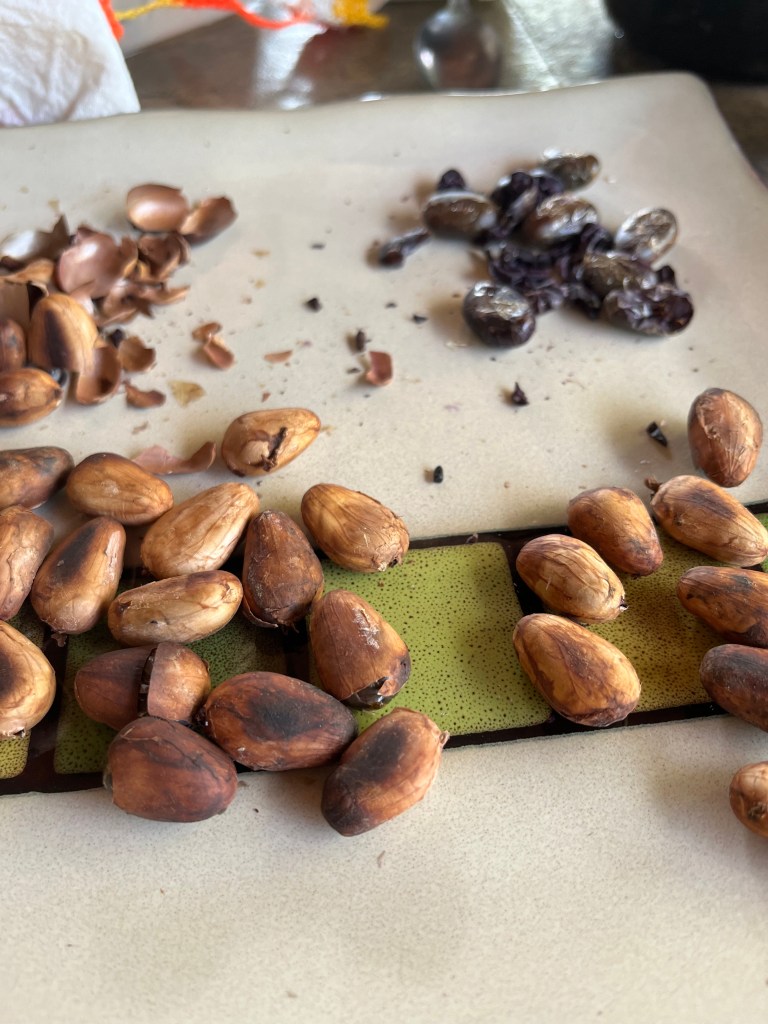
Roasted cacao seeds with and without the shells
NOW they were starting to smell like chocolate.
I had already defrosted the frozen pulp mixture and was now ready to peel the roasted beans. Once peeled, I put them in my NutriBullet and they did end up as a thick paste. I added the pulp mixture and blenderized it some more.
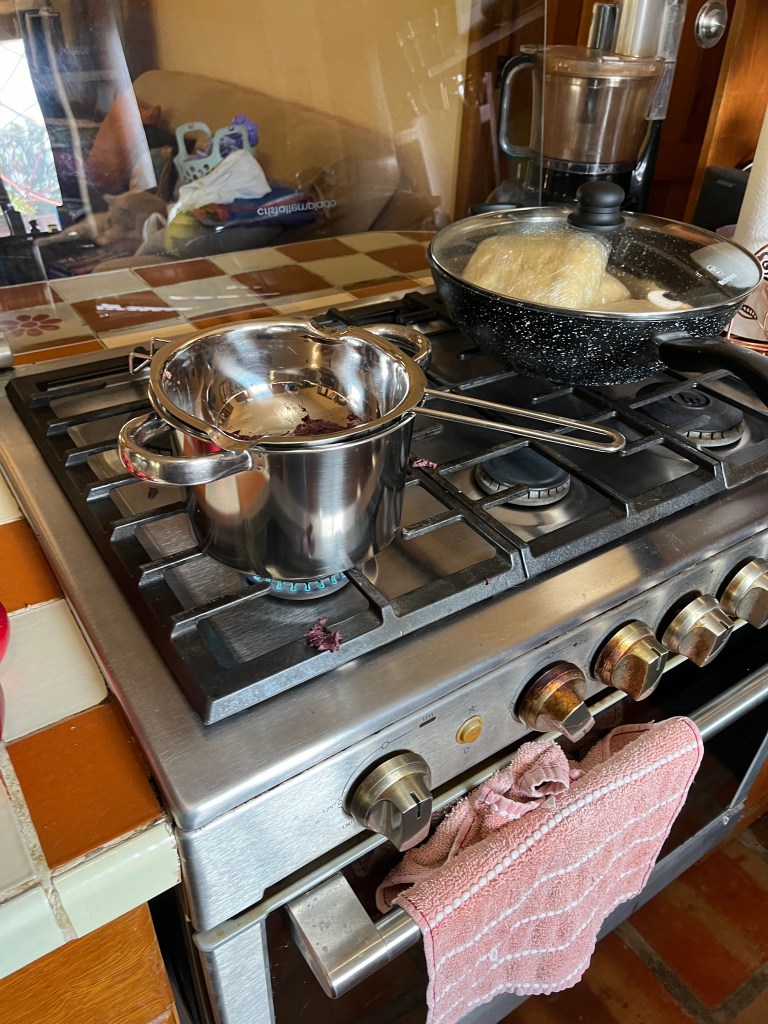
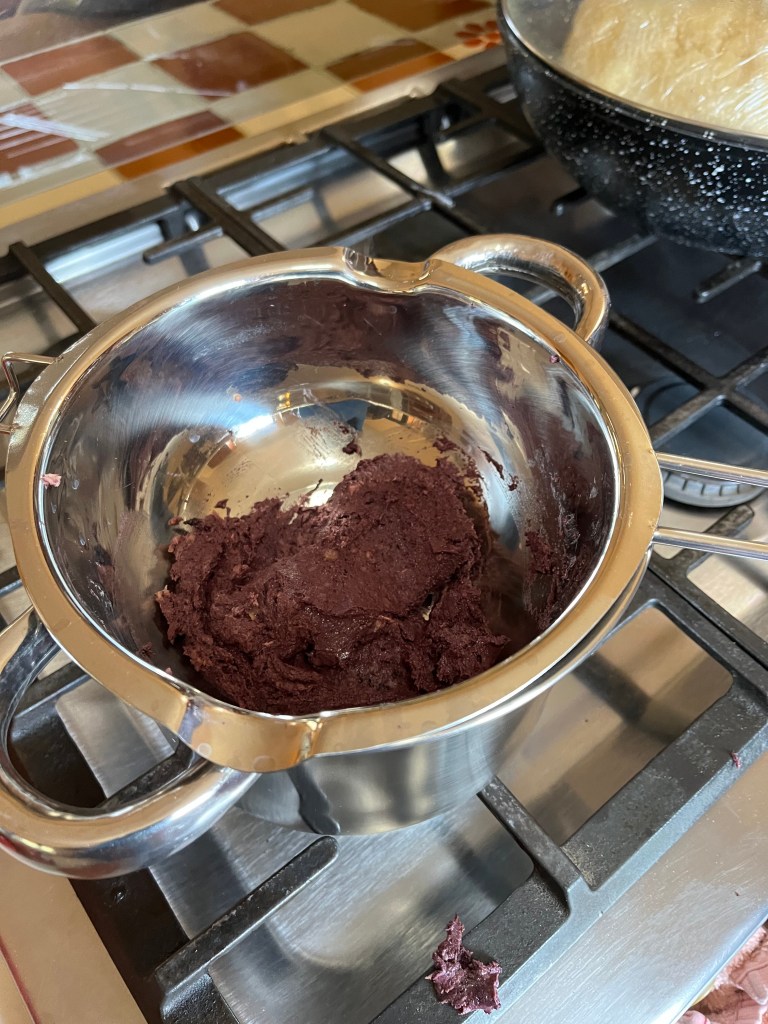
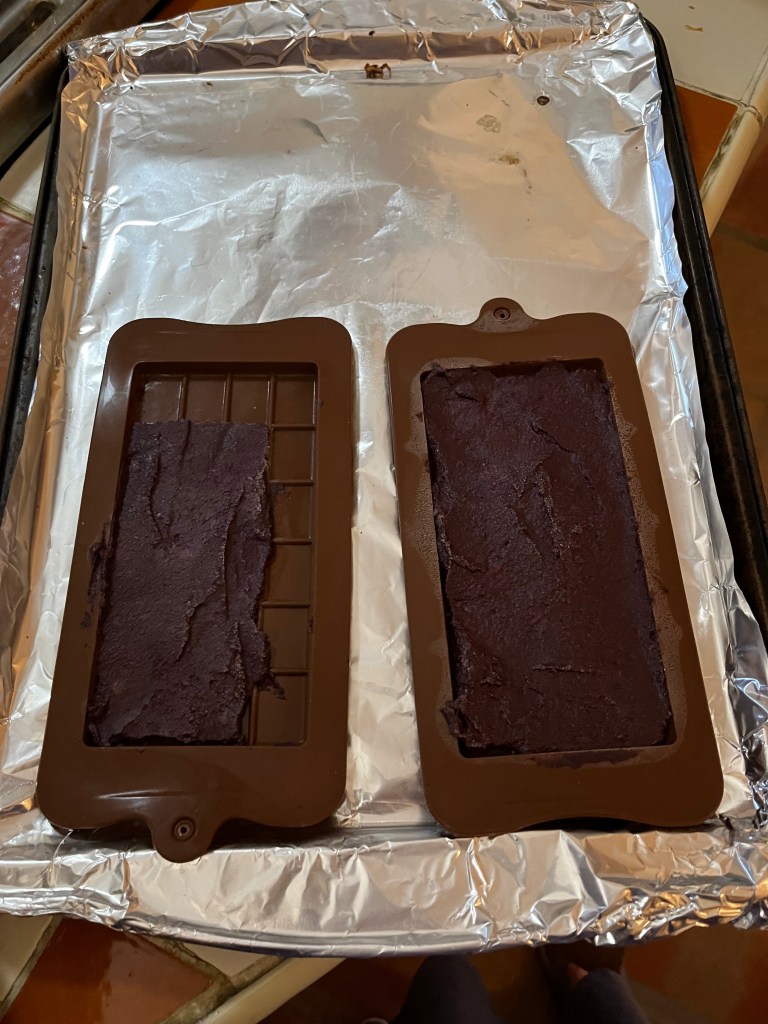
The taste of the resulting mixture was very bitter, so I ended up adding a few drops of almond extract and some refined sugar. It became slightly more tolerable. After that, I heated it in a double boiler to smooth out the mixture and spread it into the chocolate molds.
Heating the paste in the double boilernext to some defrosting pie dough
In the molds, ready to freeze
After freezing the chocolate came the moment of truth – how good or bad was my chocolate. Here is the video with the honest results:
I have to say it was a good learning experience. This was only from one cacao pod, and my tree is producing many more, so there will be many more trials until I get it right, if ever. It certainly won’t replace Hershey bars, Ghirardelli or my now favorite Carlos V Mexican chocolate, but it is a fun hobby. After years of living in a basement apartment, working nights and not seeing much sunlight, my garden is my little bit of Paradise and I enjoy every minute of being able to plant new species and work with many products which was impossible to do in New York.
And – most of the time I am not discouraged by failure. I remember decades ago when my son was in Cub Scouts. I volunteered to make brownies for an event. Knowing that many people were diabetic among the adults, I used saccharin instead of sugar. They were AWFUL – I’m guessing the correct word might be astringent. I apologized to everyone and admitted that they were, in fact, awful.
And finally, a thought that has crossed my mind many times as I learn to prepare meals from scratch. How long did it take various species of humans to convert certain natural plants, etc. into various forms of food – such as wheat into bread. Or poisonous plant life into edible forms. How many people died from eating raw casava, which contains cyanide, before someone decided – “Well, this root has killed so many of my kin, I wonder what would happen if I soaked it in water and then heated it and THEN WE ATE IT ANYWAY?” I believe that would take more daring thinking than to find meat that was cooked in a naturally occurring fire and discovering that it tasted pretty good and was easier to digest.
In case anyone else is interested in this sort of thing, I recommend the book “Catching Fire: How Cooking Made Us Human” by Richard Wrangham. Be careful when ordering it. Make sure that you are ordering it by the entire title, or you might accidentally end up with the book “Catching Fire” from The HungerGames Trilogy, which happened to me (but I still enjoyed both of them).
Reference:
Source: Mishra, K., Green, A., Burkard, J. et al. Valorization of cocoa pod side streams improves nutritional and sustainability aspects of chocolate. Nat Food 5, 423-432 (2024).
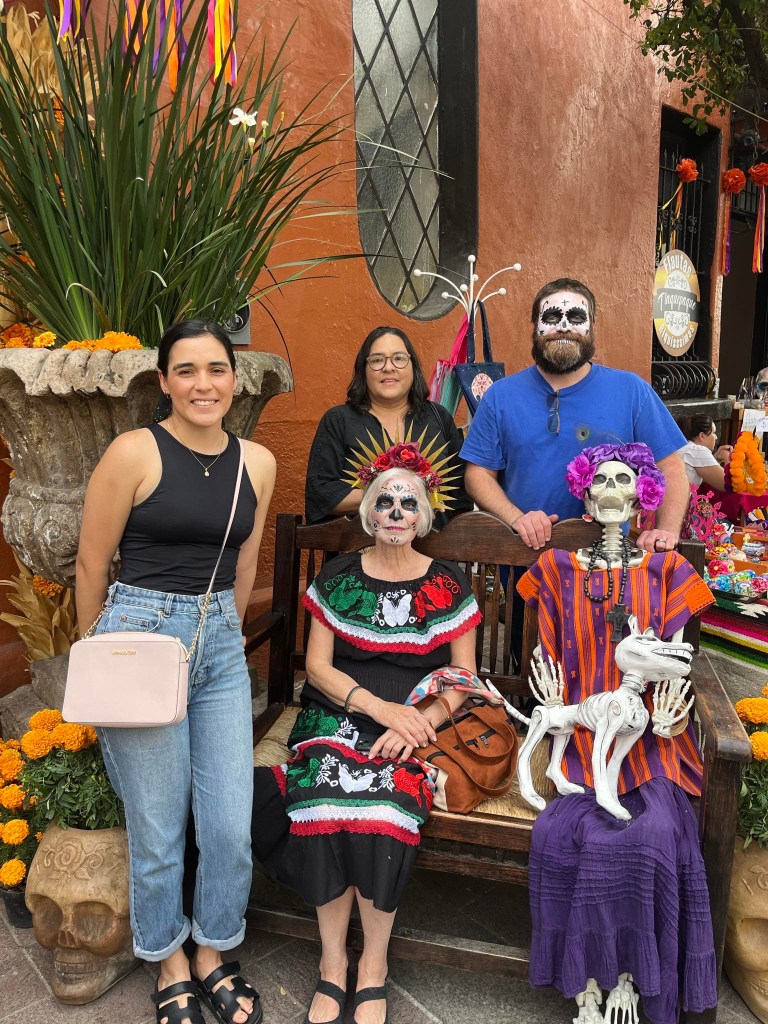
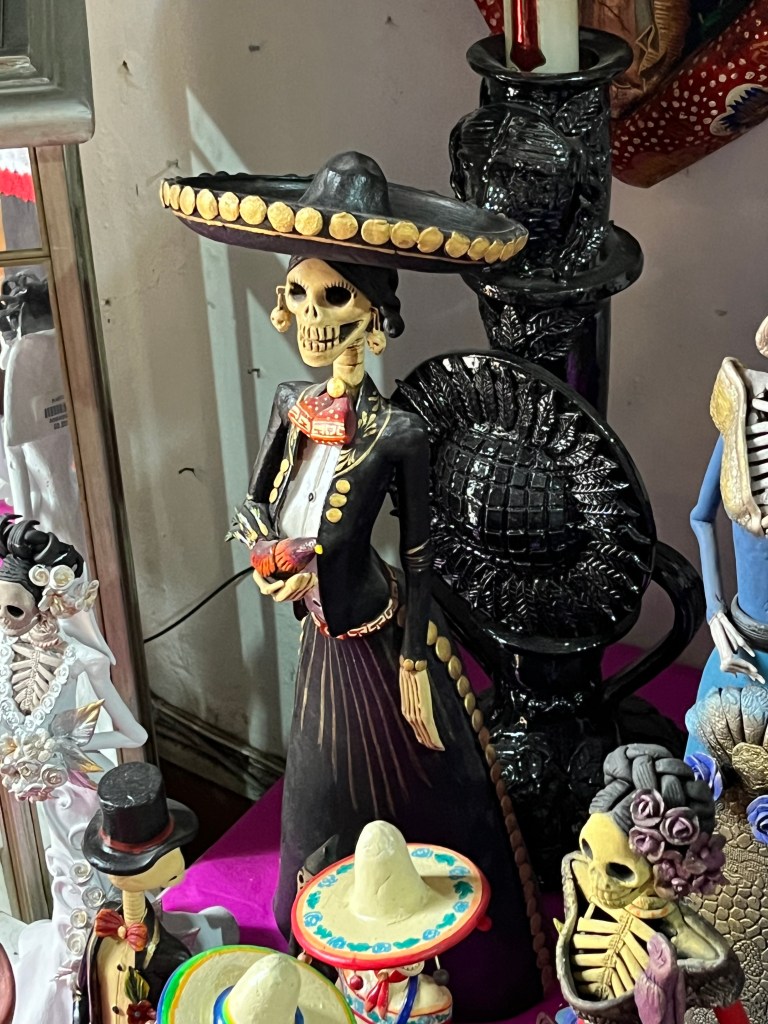
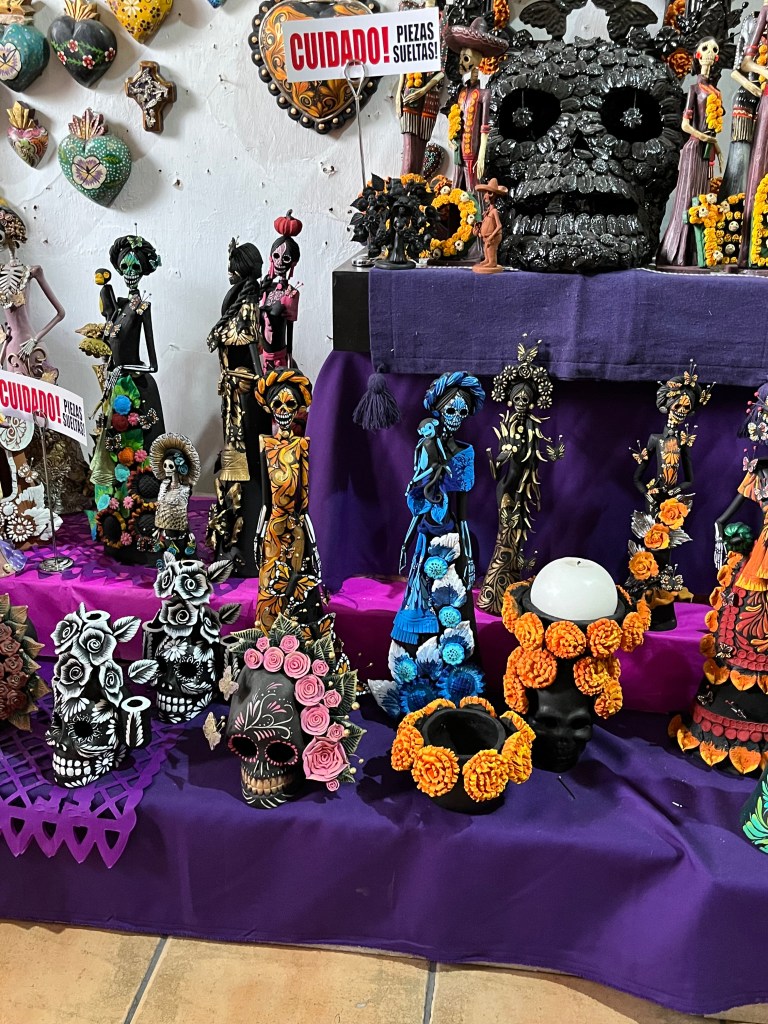
As I said in my previous post, whenever someone wants to visit me, I ask several questions, such as what type of climate do you prefer, what activities do you enjoy, what type of wild creatures are you willing to tolerate or look forward to seeing. For my son, he preferred cooler weather and wanted to come down for my birthday. Since not much is happening here around my birthday, I suggested his present to me would be to celebrate Day of the Dead with me. He asked me several times to be sure, but I assured him that nothing would make me happier than to celebrate this holiday with him.
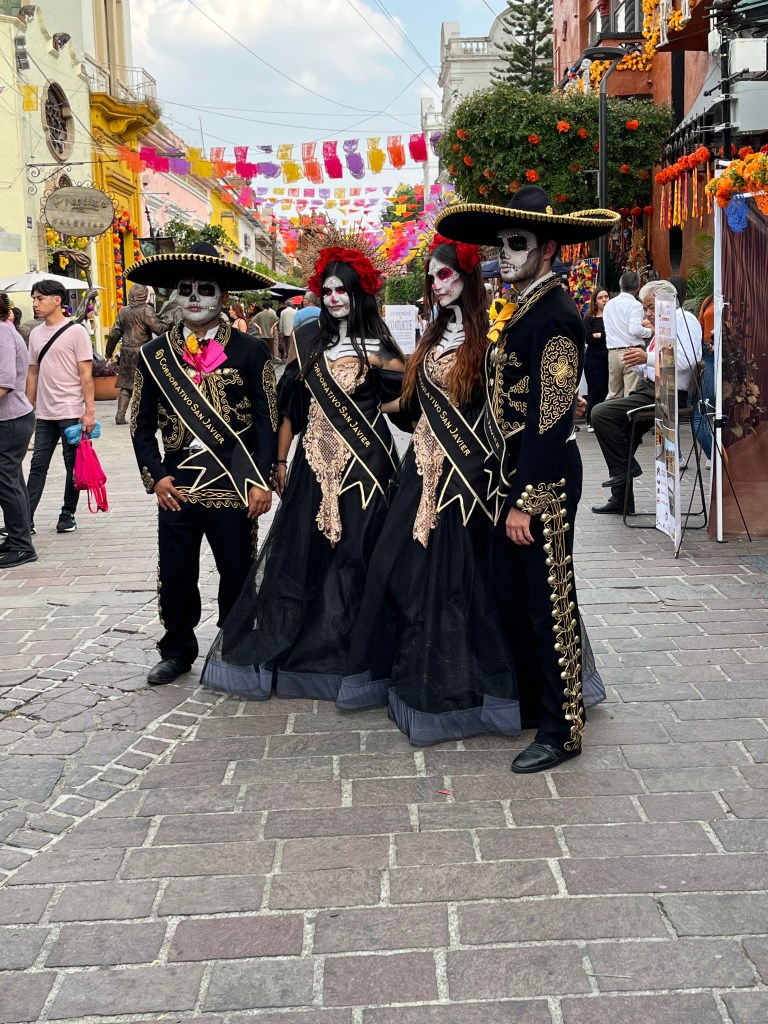
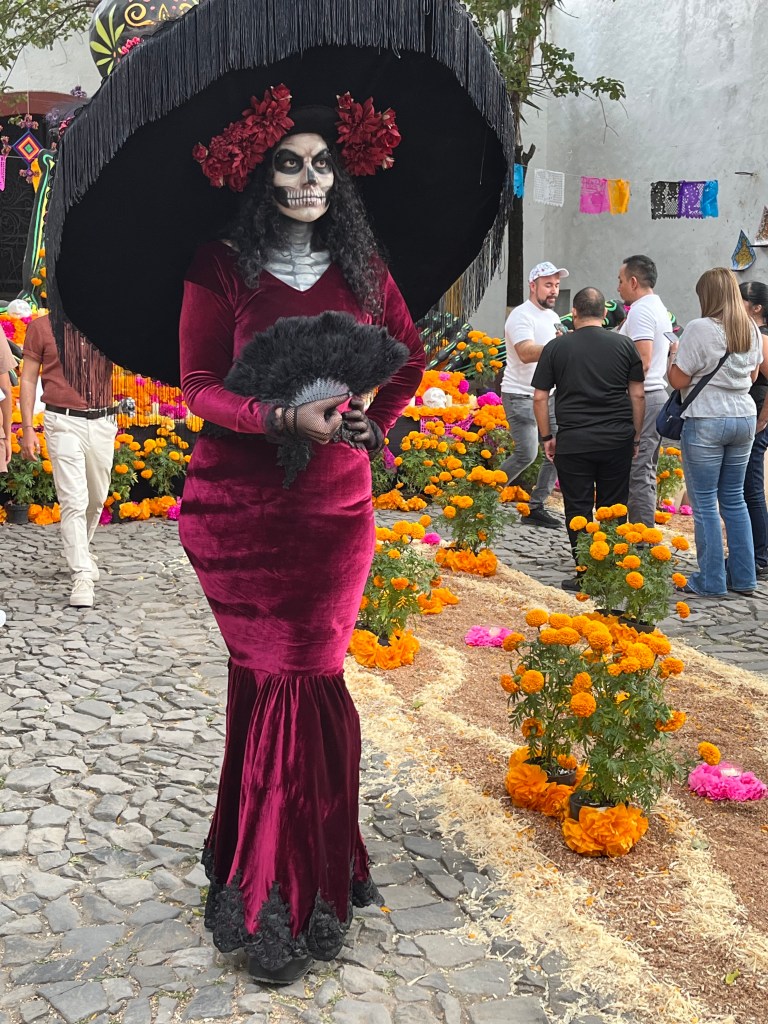
As I did when my sister visited me for Mexican Independence Day, we did not spend the time in my village, and in the case of my son we spent the weekend in Tlaquepaque – a town in the state of Jalisco that celebrates Big Time. Day of the Dead is a MAJOR holiday, and as I feared, by the time the dates of the visit were confirmed, most of the hotels in Tlaquepaque were booked solid. However, I was able to find rooms at hotels which were close to the plaza where all the action would take place. Once the reservations were confirmed and bus tickets bought for the trip between Cofradía and Jalisco, I notified my friend Claudia and her daughter Sofia so that we could get together during my visit.
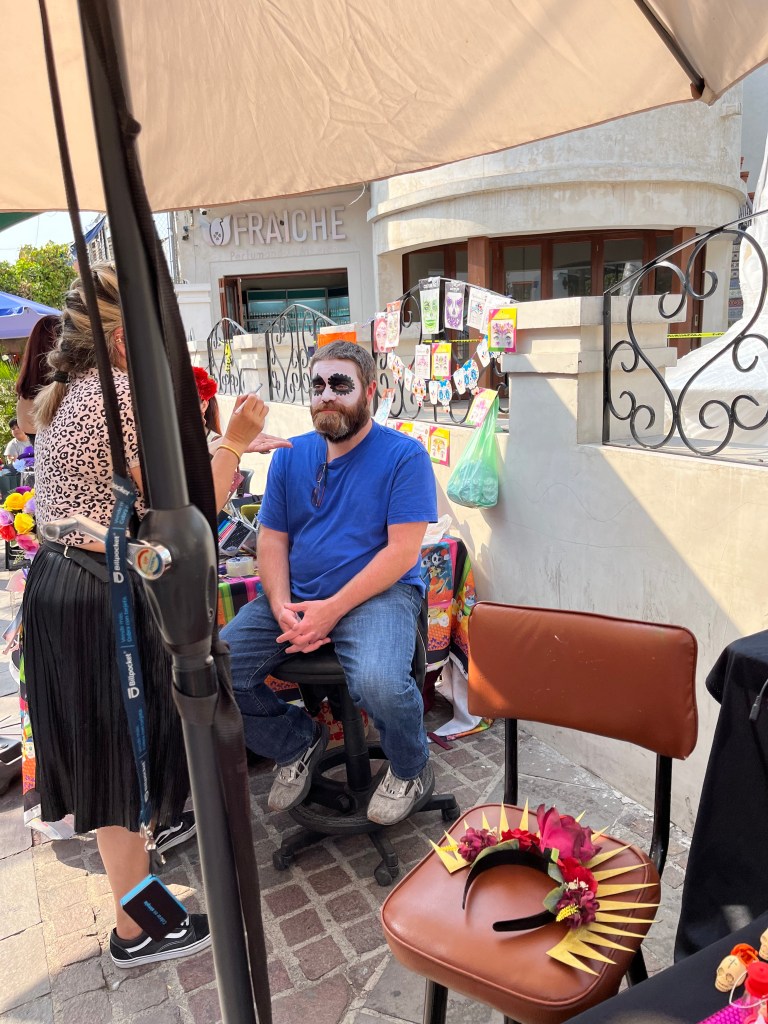
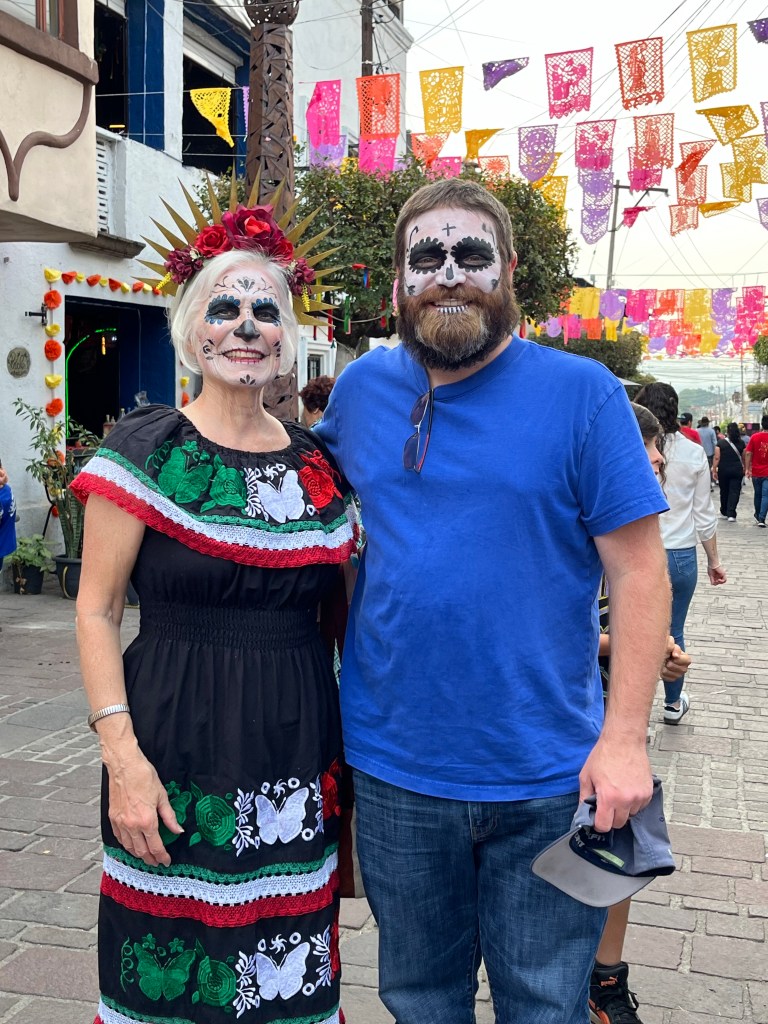
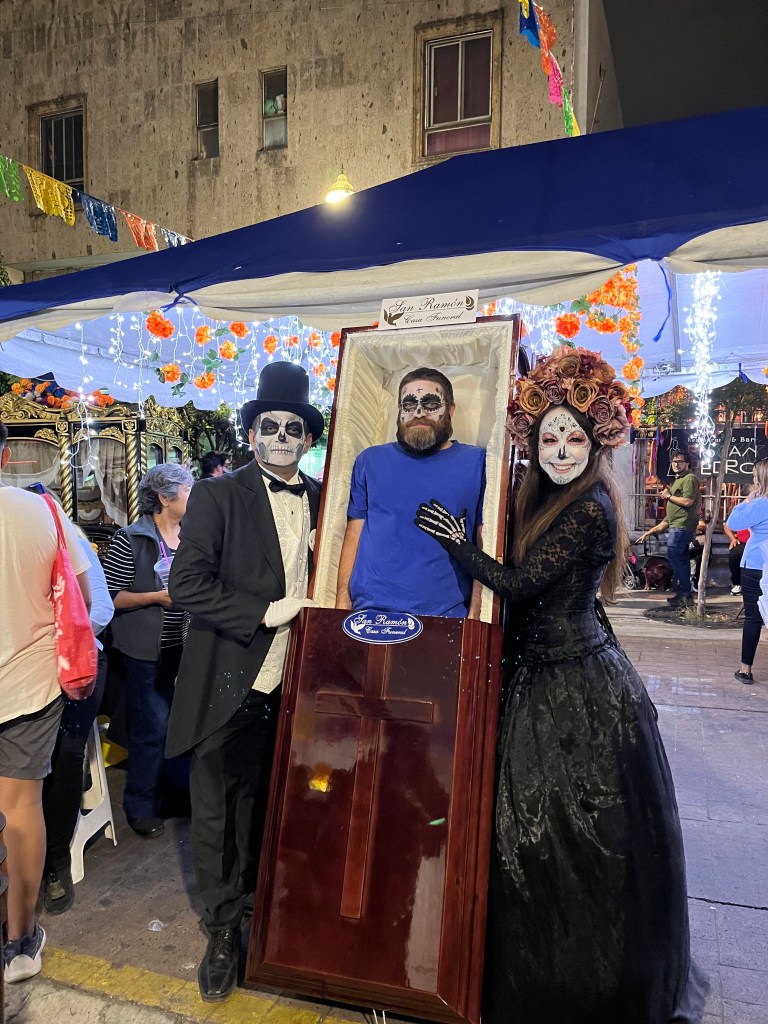
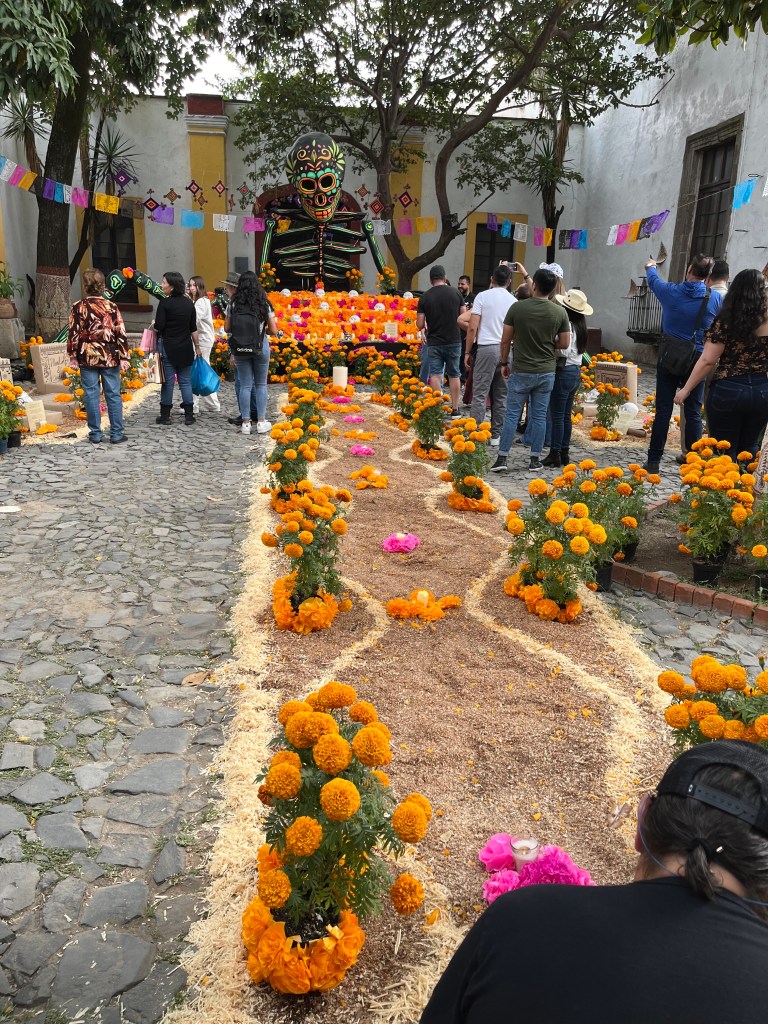
Of course, the first thing we wanted to do was to have our faces painted. I was afraid my son’s beard would interfere with that, but the artist managed. As for me, it was a different story. The artist was using a different type of paint than I had experienced in previous years – not as heavy, so it did not give the appearance of an actual mask, but it was still beautiful. My eyes are sensitive to eye makeup, so I expected my eyes to tear and eventually smear the makeup. Good thing we took pictures right away, since the tearing was heavier than usual, and by the next morning I had an infection/inflammation. We went to a hospital clinic that was in the plaza where I received prescriptions and after a while needed to go rest in our hotel room while my son Michael, Claudia and Sofia continued with their day.
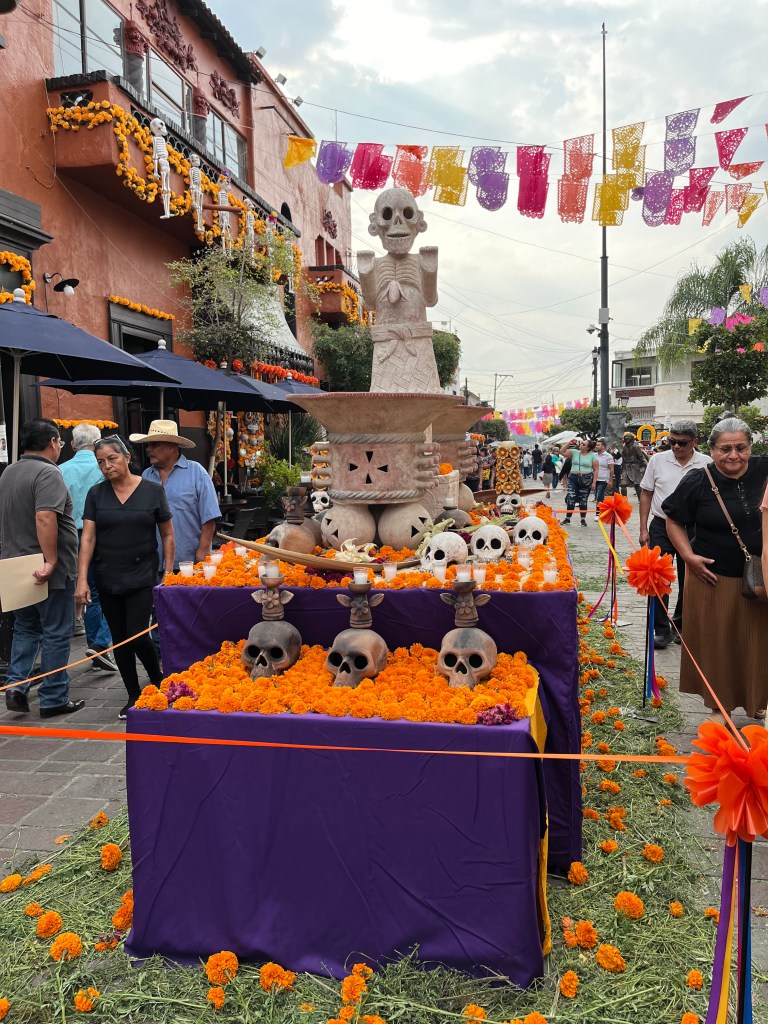
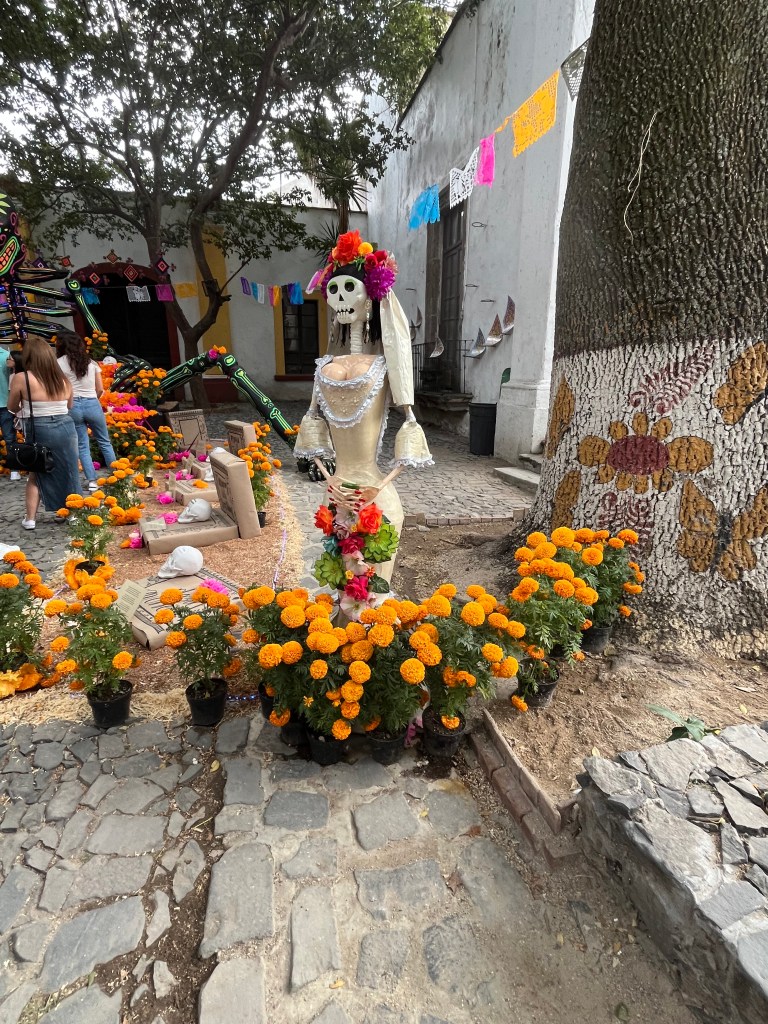
That first day, more and more people arrived to celebrate. By lunch time, it was so crowded that we could barely move. It reminded me of New York City at Christmastime with people shoulder-to-shoulder. The second day, it was much less crowded during the early part of the day, so we could see many of the displays that were just unapproachable the night before.
When it was time for lunch, there was a waiting list for every restaurant, so we picked the one with the shortest wait time, and we were not disappointed after we were seated. Two dancers performed for the customers, and it was very impressive.
That first night, there was a procession which we followed. People in costume would stop at various places in the street and tell stories. At the end, we were in the cemetery, and they introduced the speakers, who were actually members of the Toastmasters Club, and for one of the ladies, it was her first time telling a story in public.
While there is something magical about Día de los Muertos at night, it was also very nice to see all the altars and other decorations and displays during the day. All in all, I am glad that my son got to have the experience of Mexico during this special holiday.
Please enjoy the videos and photos, and if you are planning one day to see Mexico, consider spending a day or two in Tlaquepaque. It has so many things to do and experience – great restaurants, shops, museums, outdoor sculptures by our famous artists. You will definitely not be disappointed.
When friends and family say they want to visit, there are several questions that I ask. If they are working, when would they have vacation time, and how much time. Whether or not they are working, I ask – What type of weather do you prefer, hot or cold? Dry season or rainy season? What type of insects and other creatures will you be comfortable with? Would you like to be here to experience any of our holidays? What type of activities would you like – hiking, the beach, educational tours, cultural events, etc., or just plain hanging out and relaxing. The answers help me plan an enjoyable visit.
When hosting visitors during Mexican holidays, especially national holidays, there are added things to consider. You will probably need a great deal of advance notice if you need tickets or a hotel room, since these events attract hordes of international visitors, and this turned out to be the case for my son’s upcoming visit for Day of the Dead. But for now, I will write about my sister’s visit for this year’s Mexican Independence Day.
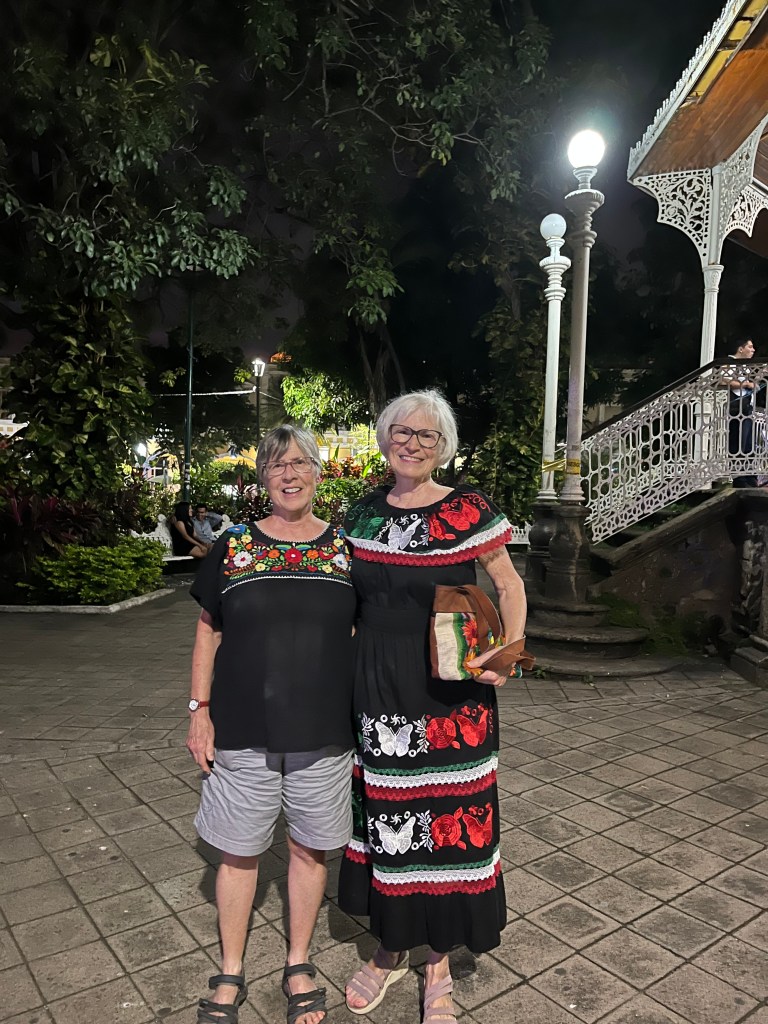
As I’ve mentioned before, Colima is an agricultural state, and I live in a small village of less than 2000 people. Normally, I am content to attend whatever ceremonies we hold in the village for Independence Day and then watch the president give “The Grito” from Mexico City via the internet. However, for my sister’s visit, my neighbor suggested I reserve a hotel room in our state capital, also called Colima.
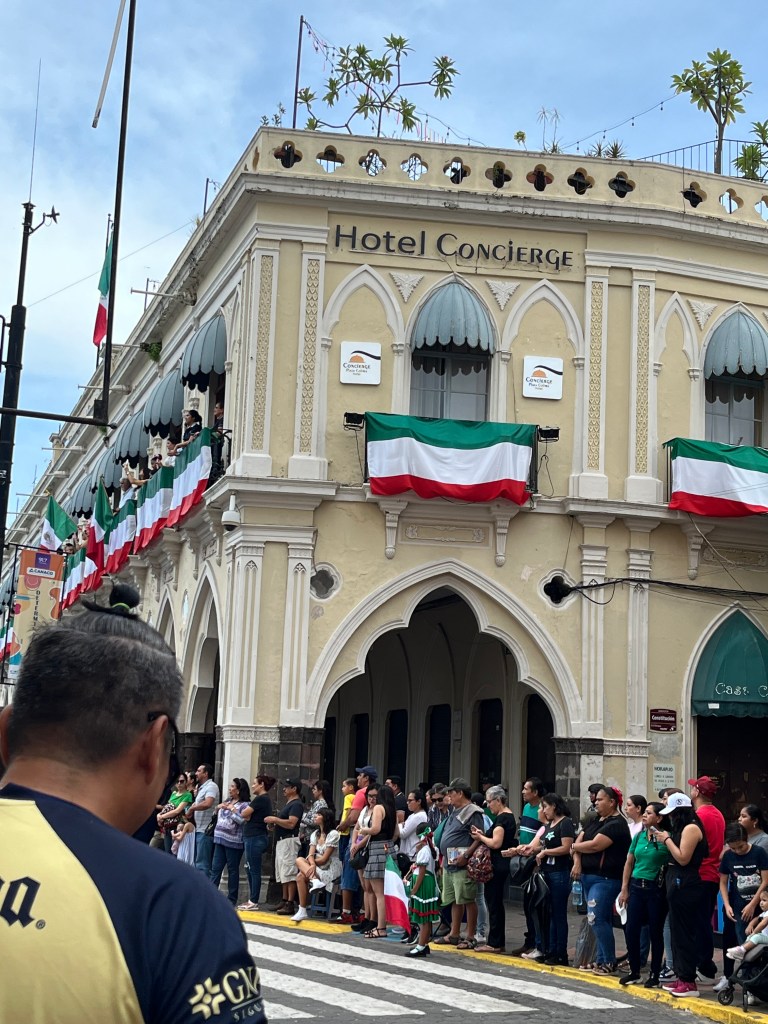
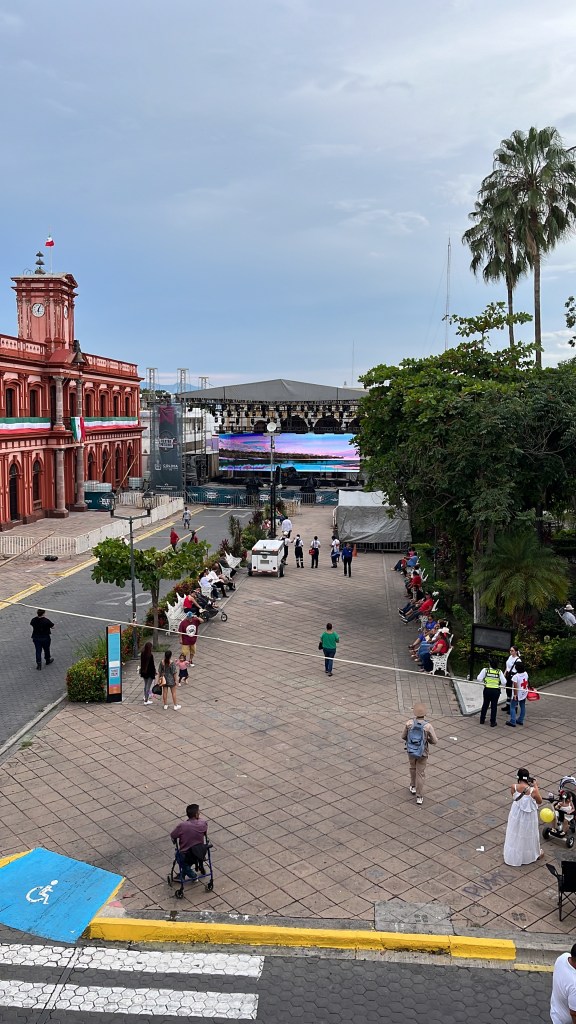
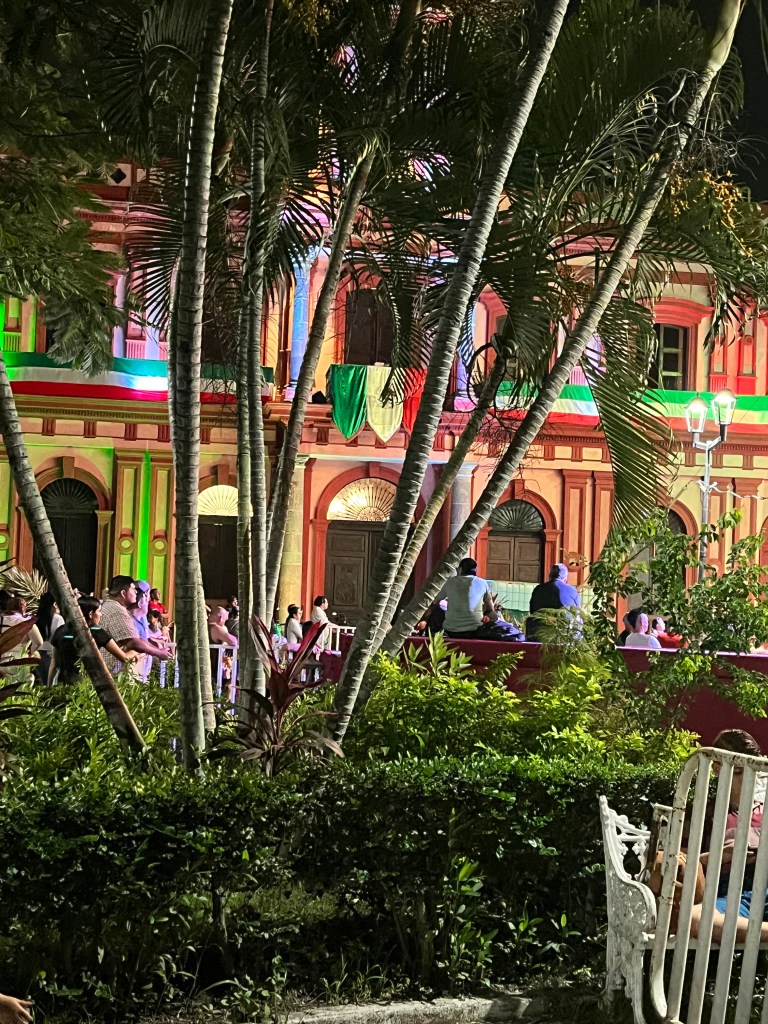
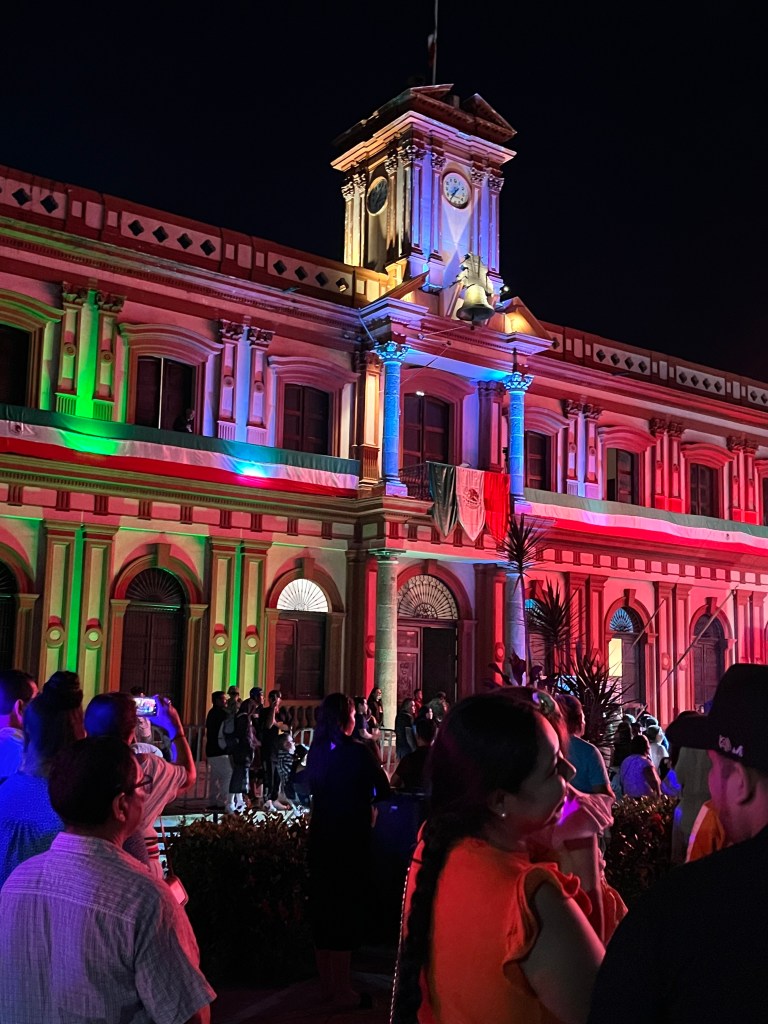
Fortunately, I WAS able to reserve a room at the hotel that used to be called Hotel Ceballos, and is now the Concierge Plaza Colima. It sits along the border of the plaza, along with the Old Cathedral and government buildings, so we had a good view of the events from a hallway balcony.
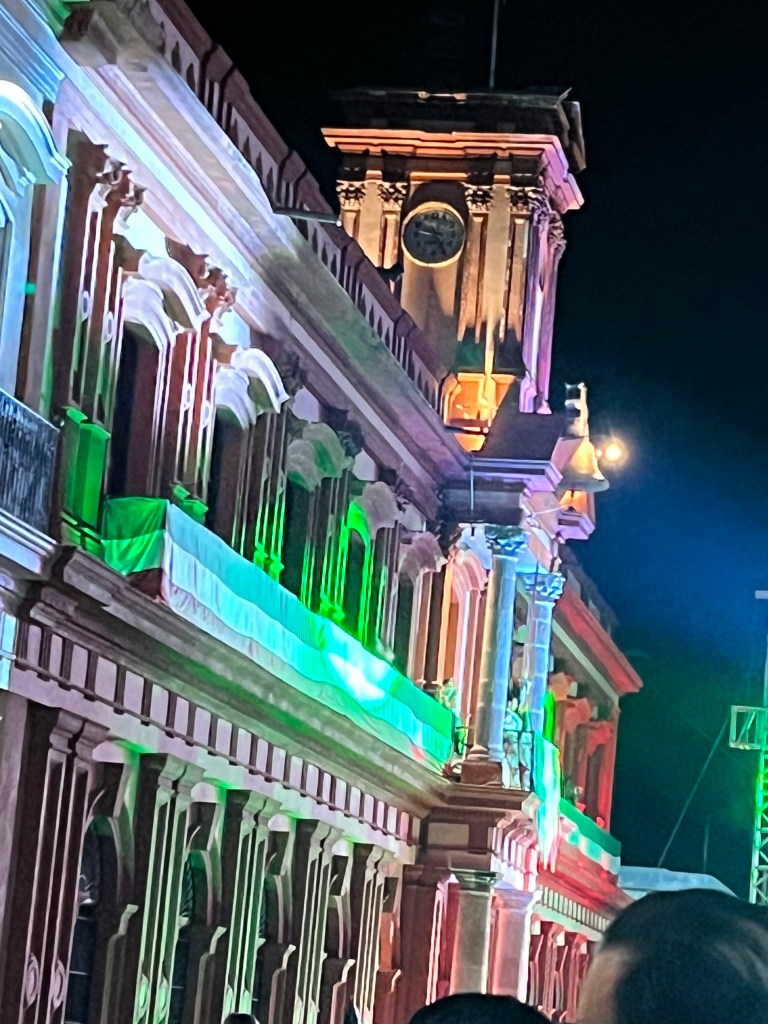
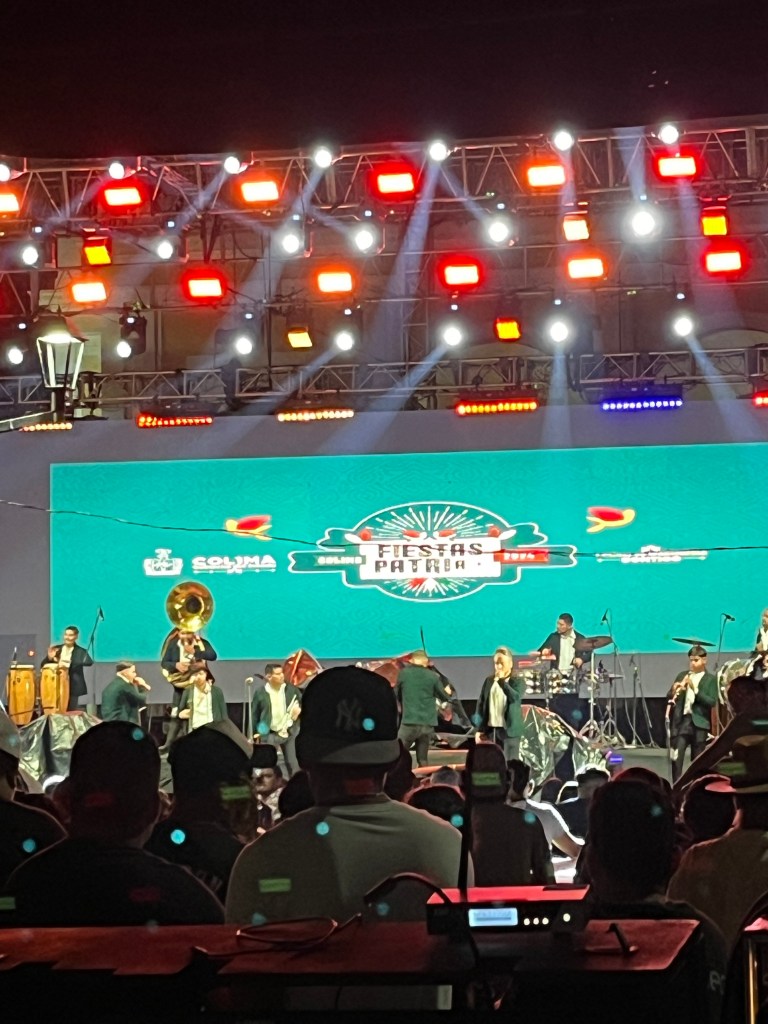
I was worried about the weather since this is still the rainy season, but fortunately it did not rain for the two days we were there. The night of the 15th was great, with bands, dancing in the plaza, The Grito shouted from the balcony of the government building, and then fireworks into the sky, followed by the grand finale – the lighting of the Castillo, a tower of fireworks set off one level at a time until the top was lit and flew into the sky.
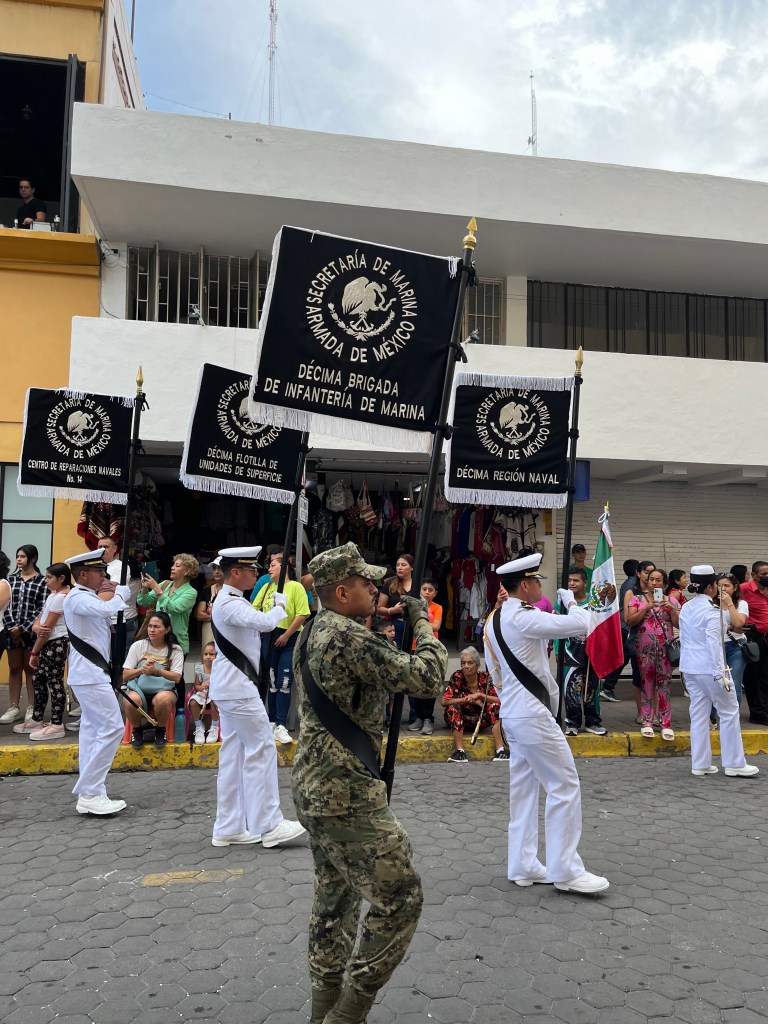
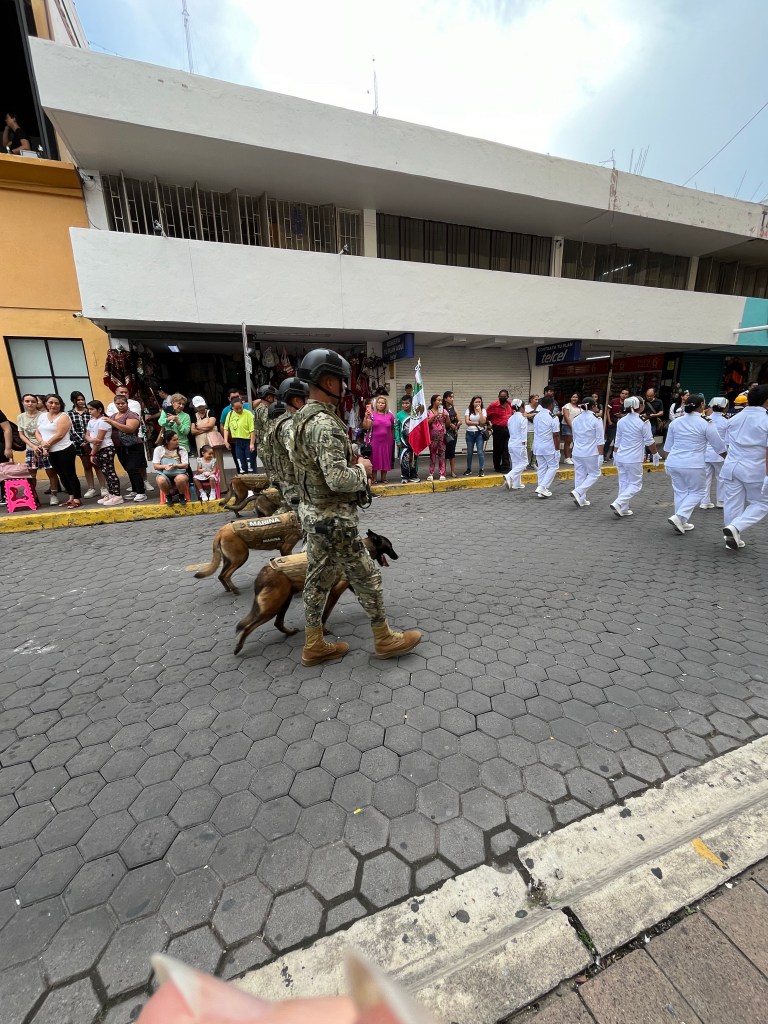
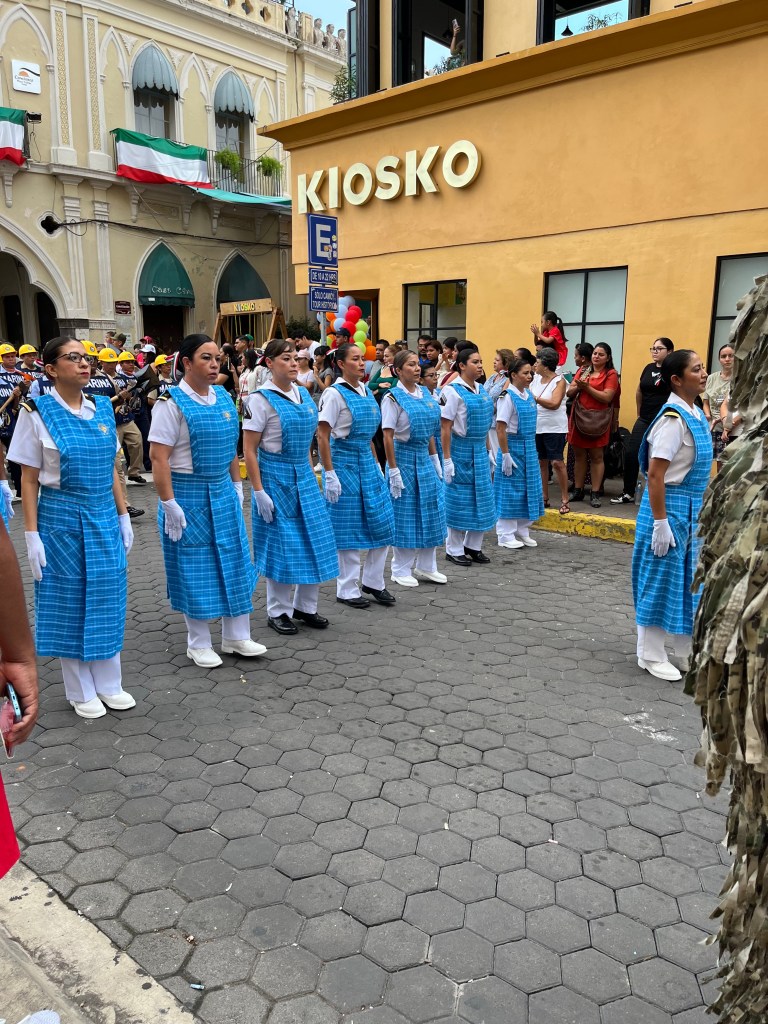
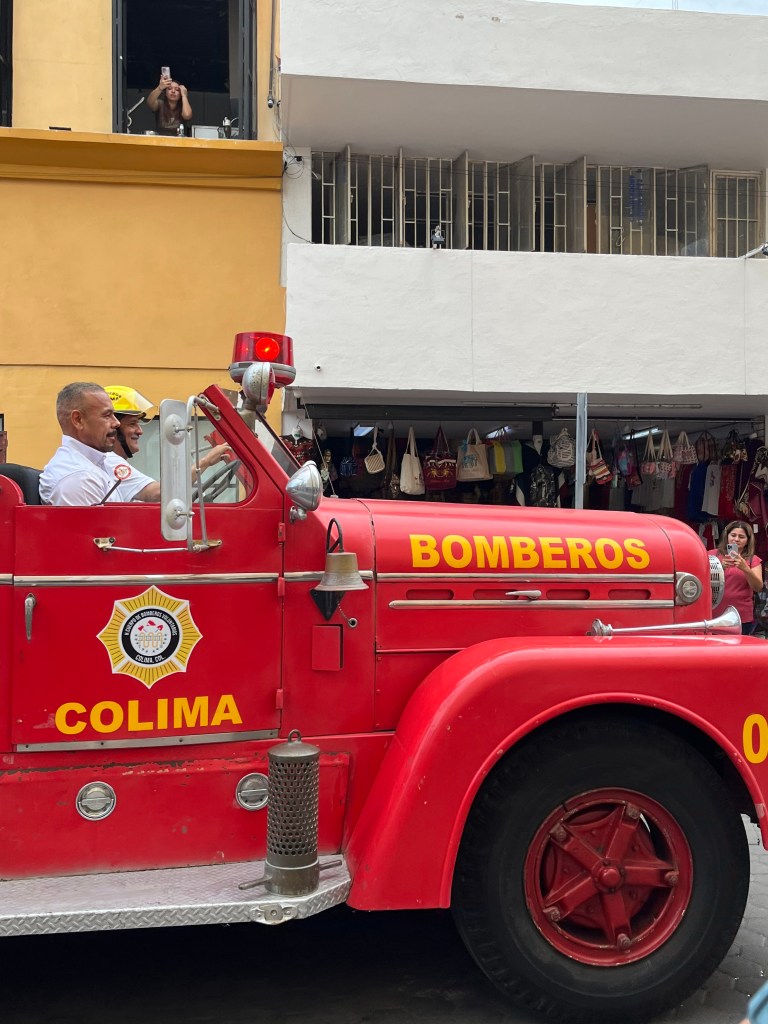
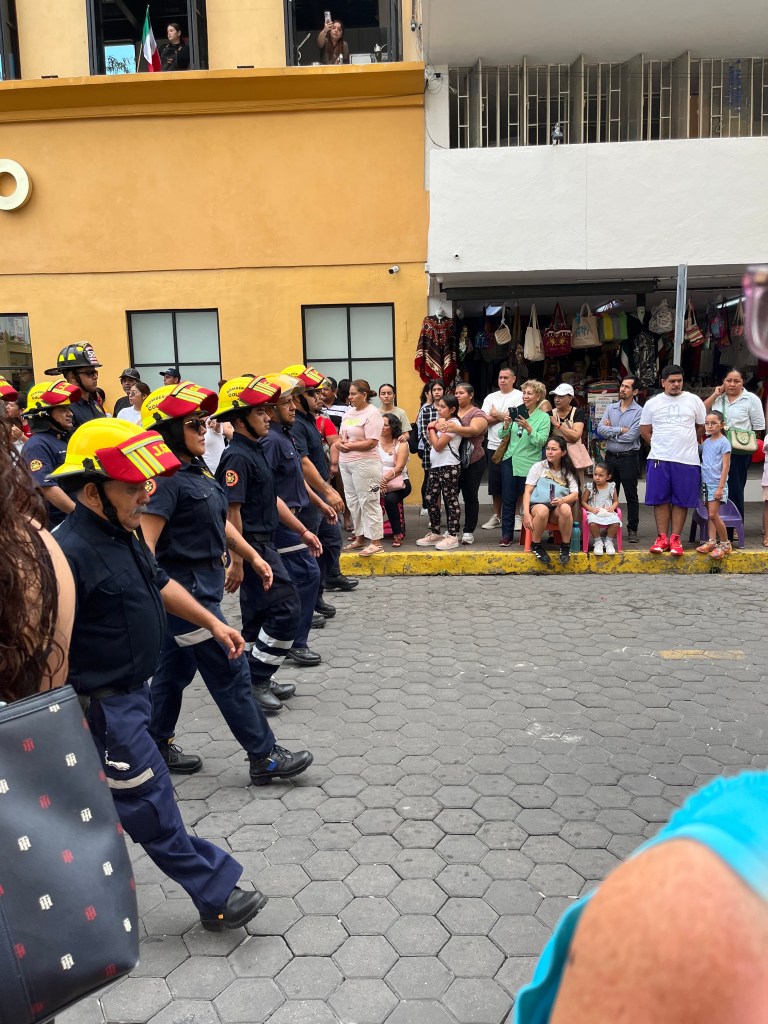
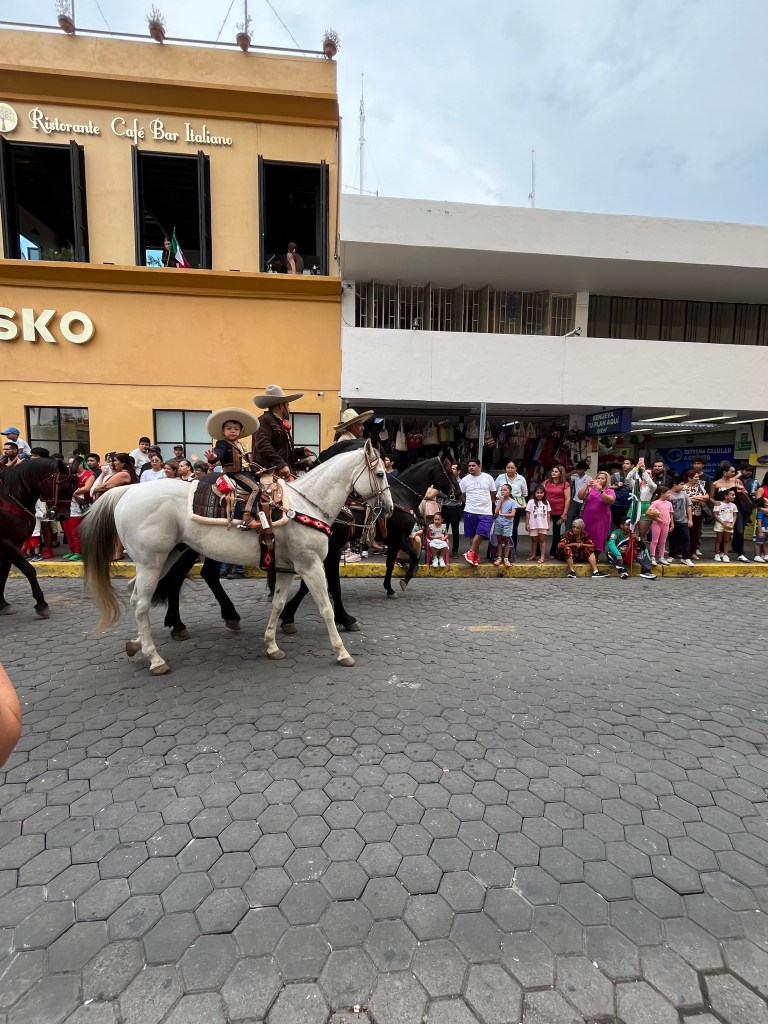
The next morning, after breakfast, was a parade featuring bands, school children, the military, firefighters (bomberos in Spanish), and many more people representing various sectors of the community.
In conclusion, spending the holiday in a hotel abutting the plaza where all the activities would be taking place resulted in a wonderful experience. Besides being right where the activities would be held, it was nice to be able to just walk downstairs, spend as much or as little time as one would want in the midst of all the activities, and then go back upstairs to rest, or simply go to the balcony to observe. For us, it was much better than returning to the village during the night and returning in the morning.
So there you have it, some suggestions for hosting visitors which I have found useful. For the timetable, for major holidays, the sooner you begin making and implementing plans the better. And even if you think you know the preferences of whoever will be visiting you, it is better to discuss various options such as those I listed above.
So enjoy the photos and videos.
The hotel
View from the Balcony
Government building and balcony where El Grito will be shouted
Ready for the festivities to begin
One of the bands on stage
Fireworks in El Castillo (The Castle). The video is 9 minutes long for the entire fireworks display.
Reading or having a conversation in a foreign language can be a tricky thing. Mistakes and misunderstandings can happen, and they can take many forms. It may be a simple grammatical error, a funny misunderstanding or create an incident if you mistakenly insult someone.
In its simplest form, you simply use incorrect grammar. In my experience here in Mexico, when I make a grammatical error, the person I am speaking with simply repeats what I said, but they say it correctly, and for that I am grateful. No lectures or condescension, simply a correction of my grammar.
The next problem was what to do if I didn’t know the Spanish word for what I wanted to say. Decades ago, I also spoke German, so initially, when I wanted to say something and didn’t know the word in Spanish, I would automatically say it in German. It was like my brain was telling me, “You need to say this word in a foreign language – not English – so use this German word instead.”
I asked one of my sisters, who was a certified legal translator for the Spanish language, how she dealt with it. She told me to just describe what I want to say. One example was, if I couldn’t remember the word for “dog,” just say “that animal that chases cats.” It still helps me, even though I don’t automatically substitute German words for Spanish anymore. Though – that habit might begin again, as I have decided to start studying German again. I have forgotten a lot of it, but the vocabulary is returning quickly, so I guess the German language is still buried in my brain somewhere.
These are a few examples of holding-your-head-in-your-hands mistakes.
Now, onto gasping, turning red and “i can’t believe I said that – I am so sorry” mistakes.
For many years people have at times assumed that I am angry when my facial muscles are simply relaxed and I’m not thinking of anything in particular. In the U.S. there’s a term for that – “Resting B……. (rhymes with witch) Face. We use it among friends, and everyone understands what it means. No one is insulted.
Well, I wanted to explain to my neighbors why my face apparently shows an emotion that I do not have and looked online for a translation. I sent the explanation them by WhatsApp and used words in Spanish that I found on the Spanishdict.com site. My friends were horrified and wondered why I would say such a thing. Fortunately, I was talking about myself. Apparently, the word I used is an extremely derogatory term for a certain type of woman.
A relative of my friend was in her house when I went to explain. This relative spoke excellent English, had lived in the United States for years, and also explained to her that the term was innocuous there. But – I understood that it was something that I should never use again.
Lesson learned.
So it is important, when translating concepts or common terms from your native language, it might be wise to consult with a native speaker, or use the thousand words to describe what you want to say before depending on automatic translation services, such as Google Translate or Spanishdict.
Sometimes a sight, a smell or a taste of food might remind you of the country of your birth. I had that feeling tonight and it took me by surprise. I loved living in New York, but after 66 years, I had enough of the cold and snow and vowed that upon retirement, I would buy a house somewhere, anywhere, where I would never have to see snow again. It just so happened that after years of volunteering here I decided that Colima would be my new forever home. When it gets really, REALLY cold (for Mexico), we will see snow on top of the volcanoes, but never in our village.
Right now it is the beginning of the rainy season here in Colima, Mexico. It barely rained a few nights ago, but every evening and into the night we have rolling mist. Heavy mist that reminds me of ocean waves. The air is cool and you can feel the moisture on your skin.
Tonight I was looking up at the sky, and suddenly had the same feeling I had in the past when it was snowing in New York. The air is cool, the sky is white, and there is absolute silence in the air. Not a single sound can be heard.
Of course, I am in a completely different climate, with foliage that can never be mistaken for New York State, but for the time I was standing outside, my mind was back in New York looking at the sky and experiencing the silence that accompanies a soft snowfall.
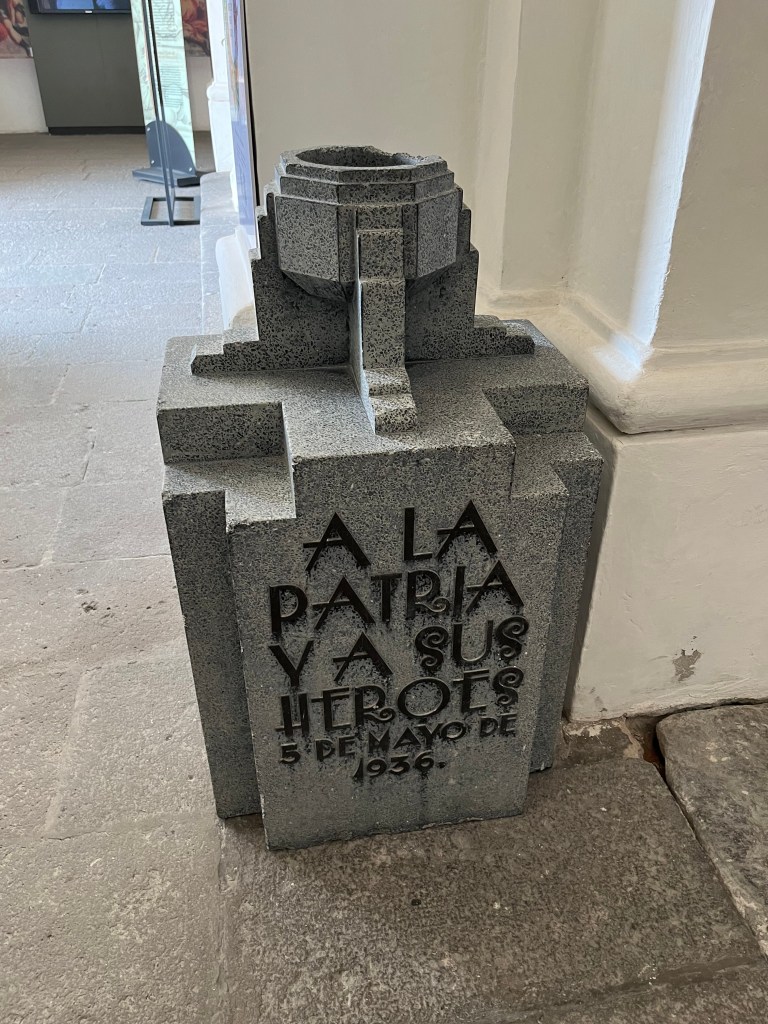
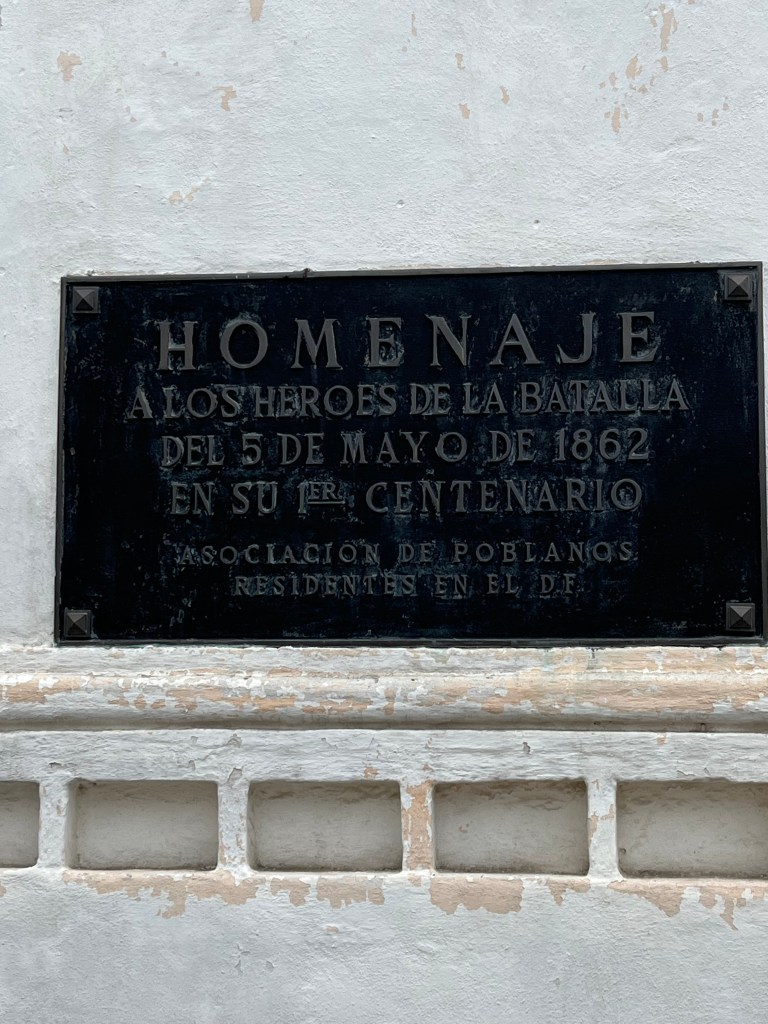
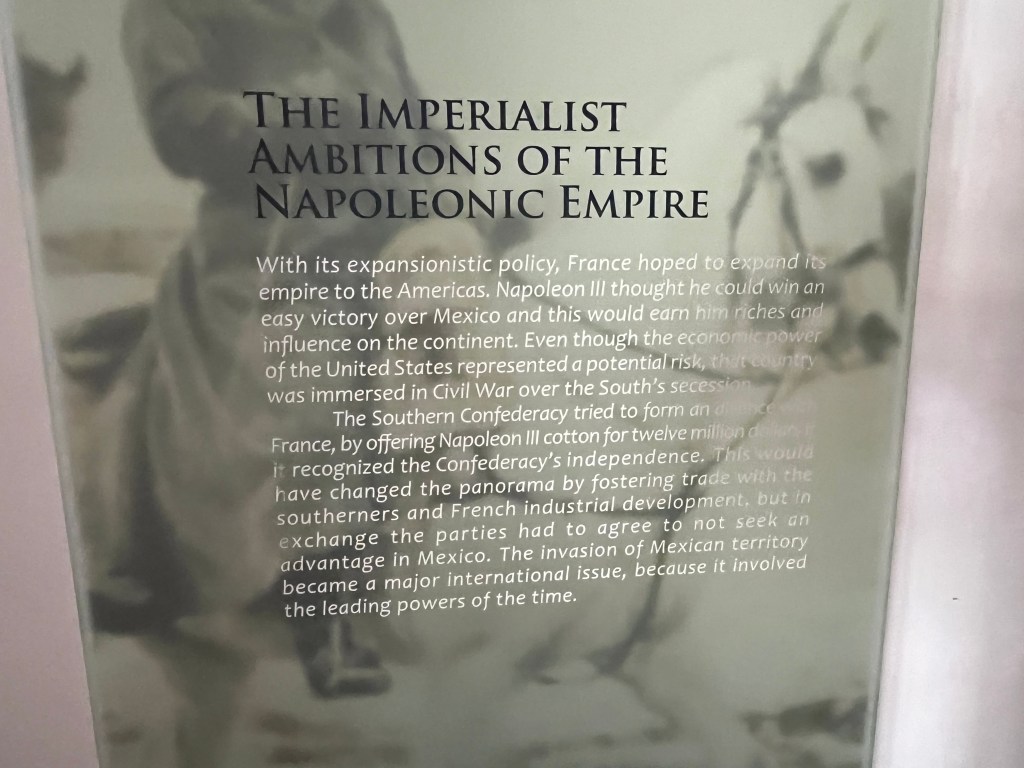
While many people believe that Cinco de Mayo is Mexican Independence Day, it is not. However, it was a battle not only important to Mexico, but also to the outcome of the American Civil War. Because it is also called the Battle of Puebla, it is celebrated in that state, but not nationally throughout Mexico.
At that time, Mexico was indebted to many European creditors, due to many decades of internal conflict. Among those creditors was Spain, the United Kingdom and France. In 1860, the Mexican government announced that it would suspend its payments for two years. Naturally, their creditors were not happy about this, but eventually agreements were made with Spain and the United Kingdom.
However, Napoleon III of France saw this as an opportunity to create a new French colony in the Americas. He felt that since the United States was occupied with their civil war, they would not interfere with his plans.
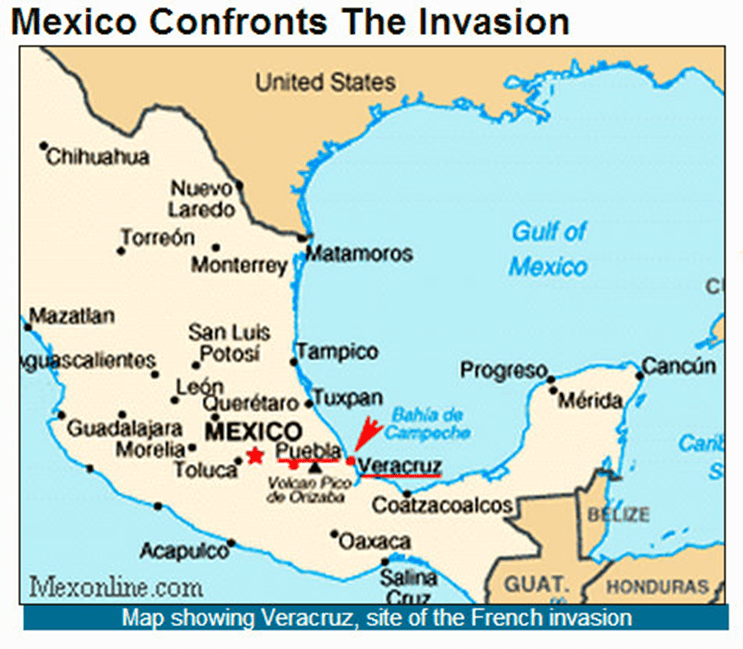
In the United States of America, part of the war strategy of the Union was a blockade of goods from the southern states, including Southern cotton, which was a valuable commodity in Europe. The plan was to capture Mexico City, set up a puppet government and then provide weapons to the Confederacy in exchange for cotton. And so, with their eyes on this prize, in 1862 General Charles de Lorencez led his troops from Veracruz towards Mexico City.
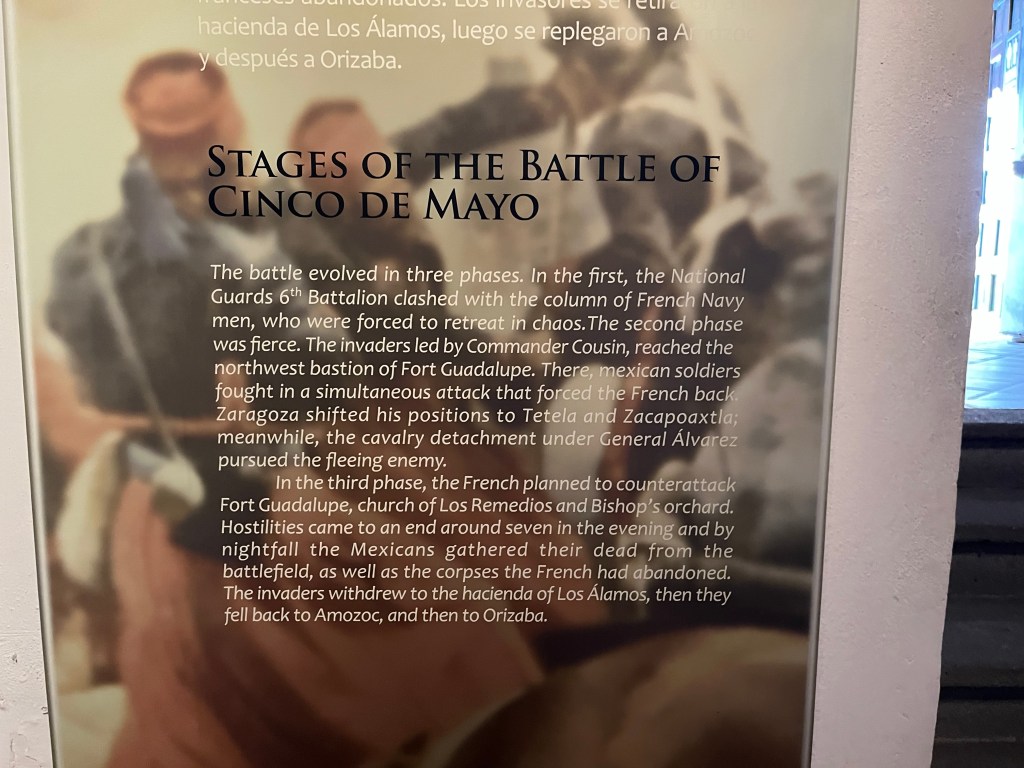
On May 5th (Cinco de Mayo), they engaged in battle at Puebla with the outnumbered forces of Mexican General Ignacio Zaragoza and suffered a surprising defeat. The French army retreated to Veracruz and did not return until May of 1863, after which they occupied Mexico City in June of 1863. The delay prevented the French from providing much-needed arms to the Confederacy, during which time the Union Army secured many decisive victories.
So this answers the burning question – WHAT does Cinco de Mayo have to do with the American Civil War????? And now I can focus on Mexico.
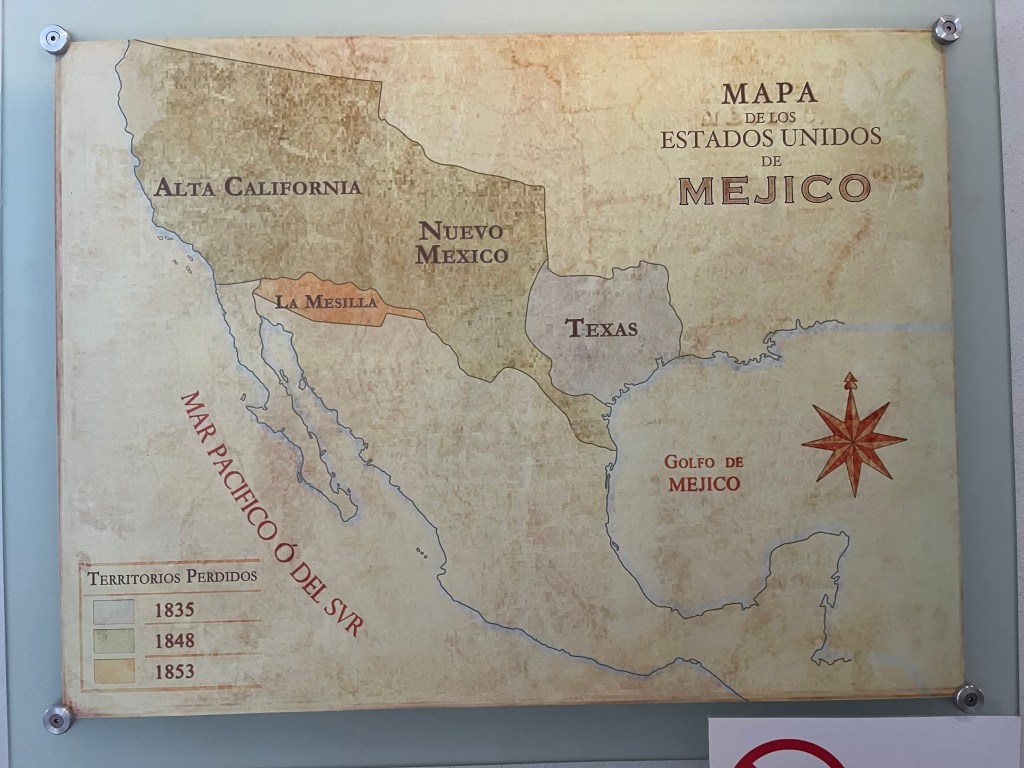
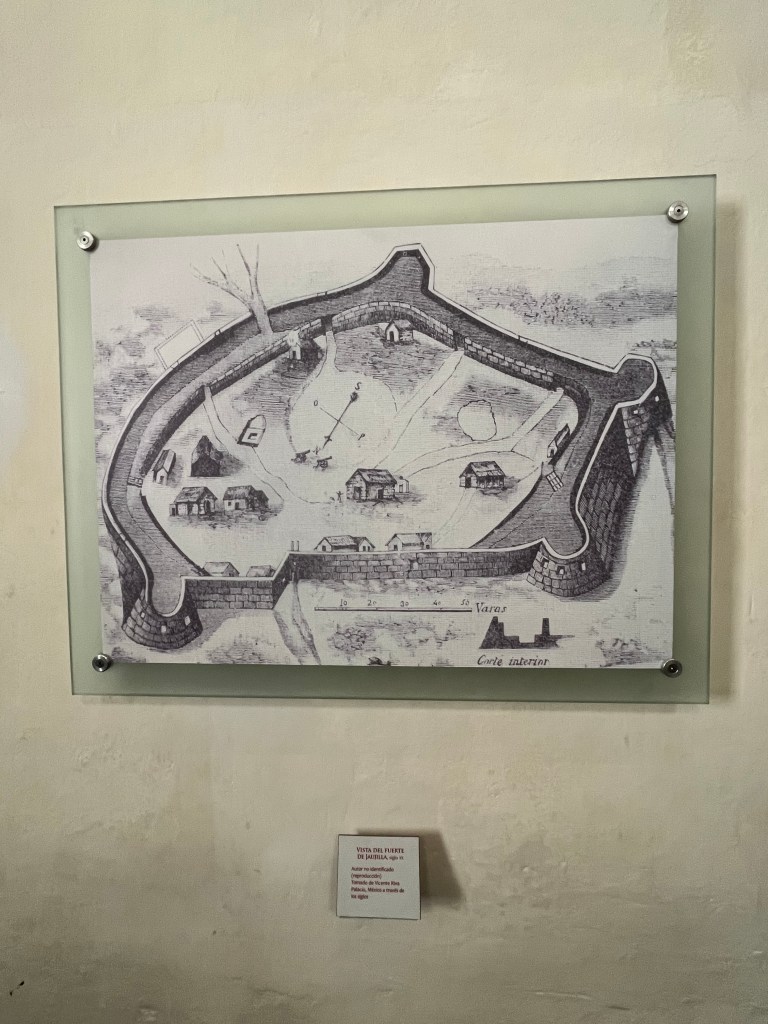
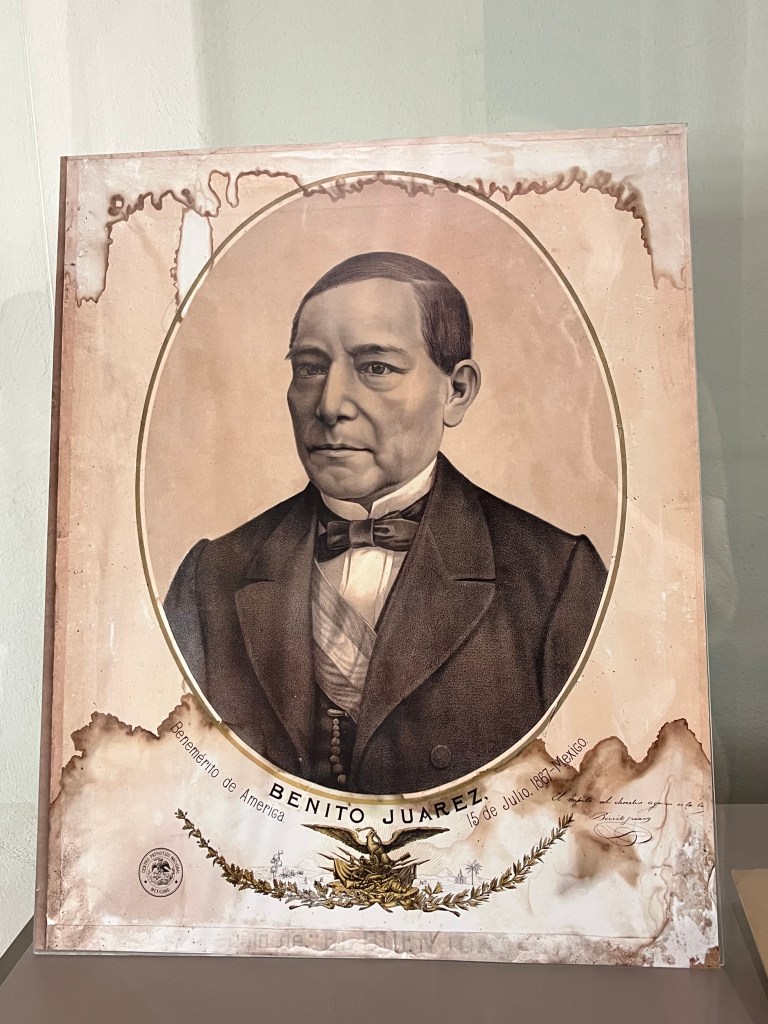
In late 1861, the French fleet landed off the shore of Mexico and stormed Veracruz, which drove President Benito Juárez and his government into retreat. The French forces of about 6000 troops engaged with the forces of Texas-born General Ignacio Zaragoza on May 5, 1862, in Puebla. The Battle of Puebla involved two forts – Fort Loreto and Fort Guadalupe.
Map showing Mexico at the time General Zaragoza was born in 1829 in Texas, which waspart of Mexico
Although vastly outnumbered and poorly supplied, the Mexican army was able to triumph over the French. The French forces lost 482 men, with 25 captured, while the Mexican loss was 83 men. While eventually the French did triumph a year later, this Battle of Puebla represented a great symbolic victory for the Mexican government and bolstered the resistance movement.
As has happened in the past, as well as in wars and battles in recent times, it seems that General Lorencez was given false and misleading information about how they would be welcomed and was surprised that they were not greeted as conquering heroes. According to a plaque in Fort Loreto, General Lorencez stated, “Such was, monsieur marshal, my situation confronting Puebla, the city most hostile to Juárez, in the opinion of the individuals whom I had to trust and who formally assured me, based on the information they had the opportunity to gather, that I should be received there with transport and my soldiers would be covered with flowers.”
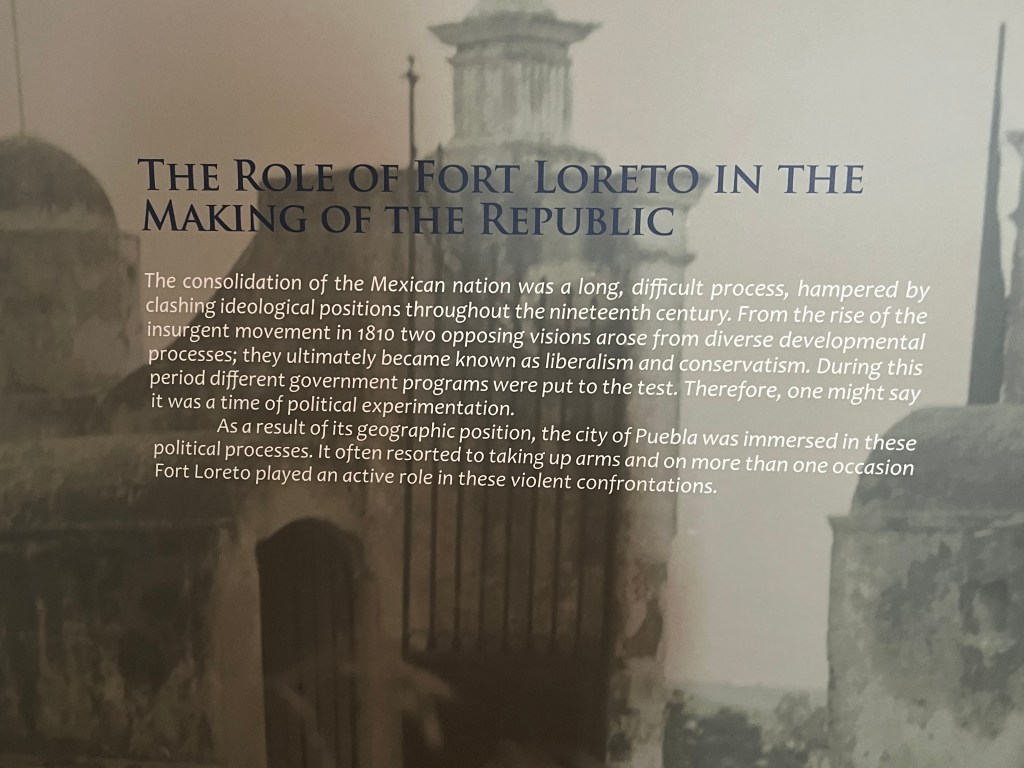
To clarify the “most hostile to Juárez” part, from 1858 to 1861 a civil war, called the War of Reform took place in Mexico which was a conflict between the reform government of Benito Juárez and the conservative government of Miguel Miramón. The reform government instituted the Reform Laws which sought to limit the power of the Catholic Church, secularize education and promote civil liberties. The conservative faction sought to prevent these changes which led to conflict, with the reform government emerging victorious by 1860. Reforms included confiscation of church property except for places of worship without compensation, suppression of monasteries, nationalization of cemeteries and introduction of civil marriage.
I have to say that Mexico is a very religious and Catholic country, but there is a definite separation of church and state.
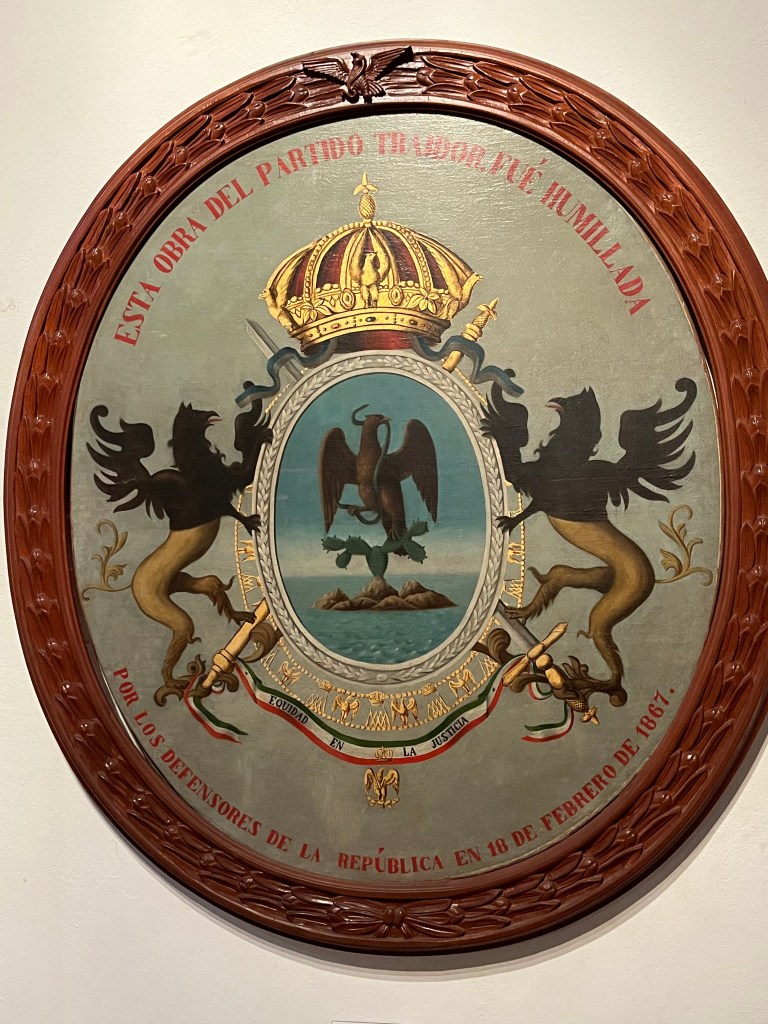
With this in mind, it was easy to see why General Lorencez assumed that his troops would be greeted by overjoyed conservative Mexicans showering them with flowers. In order not to have this post go on forever, you can read the history of how the French came to leave Mexico in 1867 here:
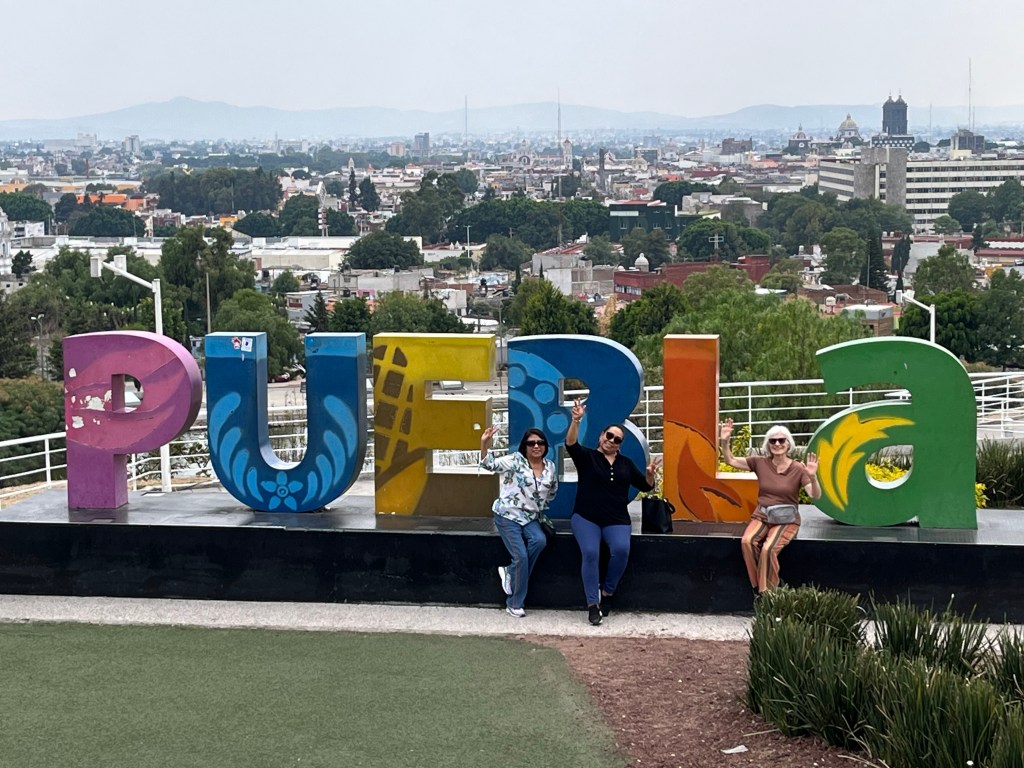
Last year I was fortunate enough to visit my friend Martha in Atlixco, Puebla during the Cinco de Mayo celebrations.
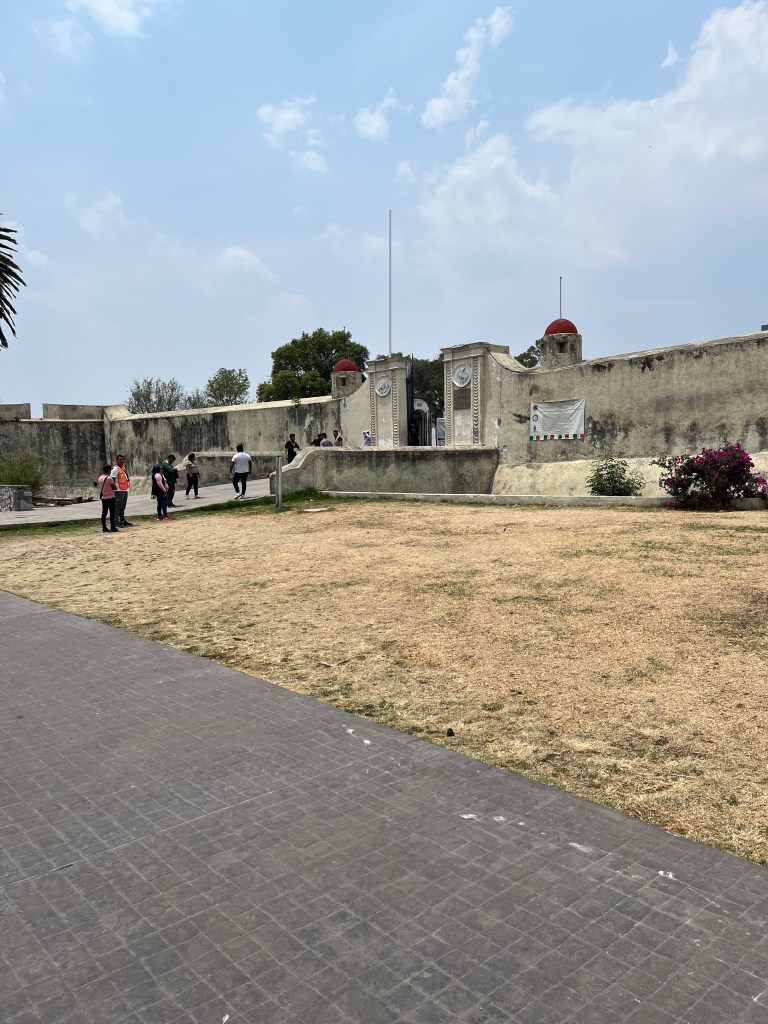
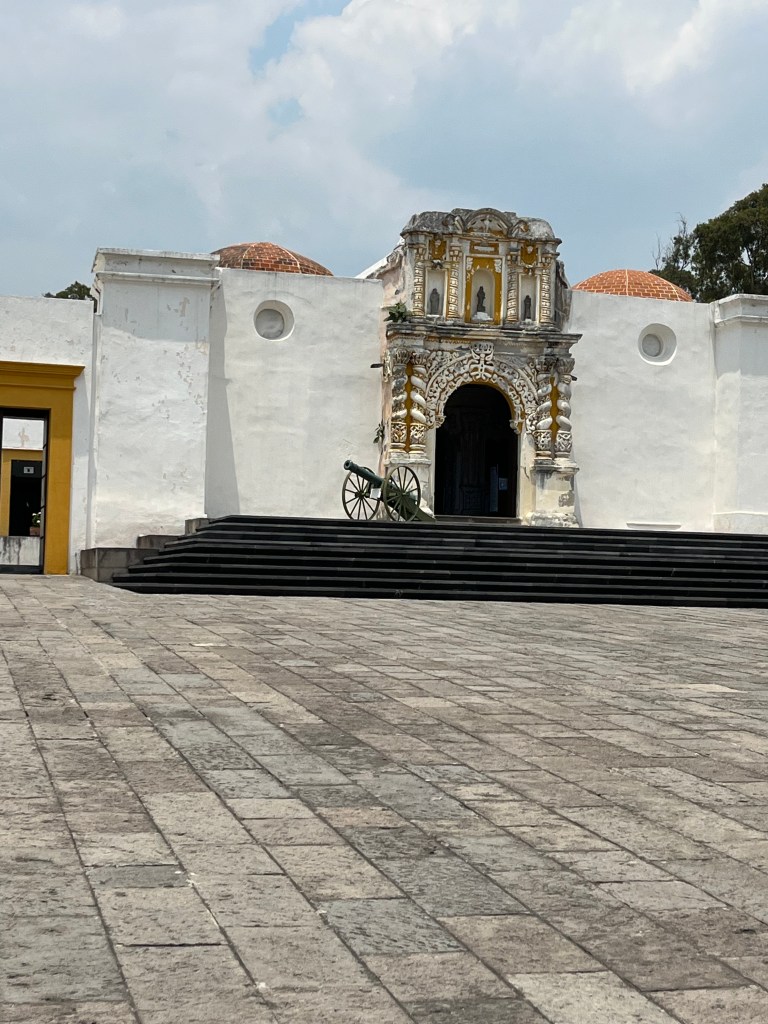
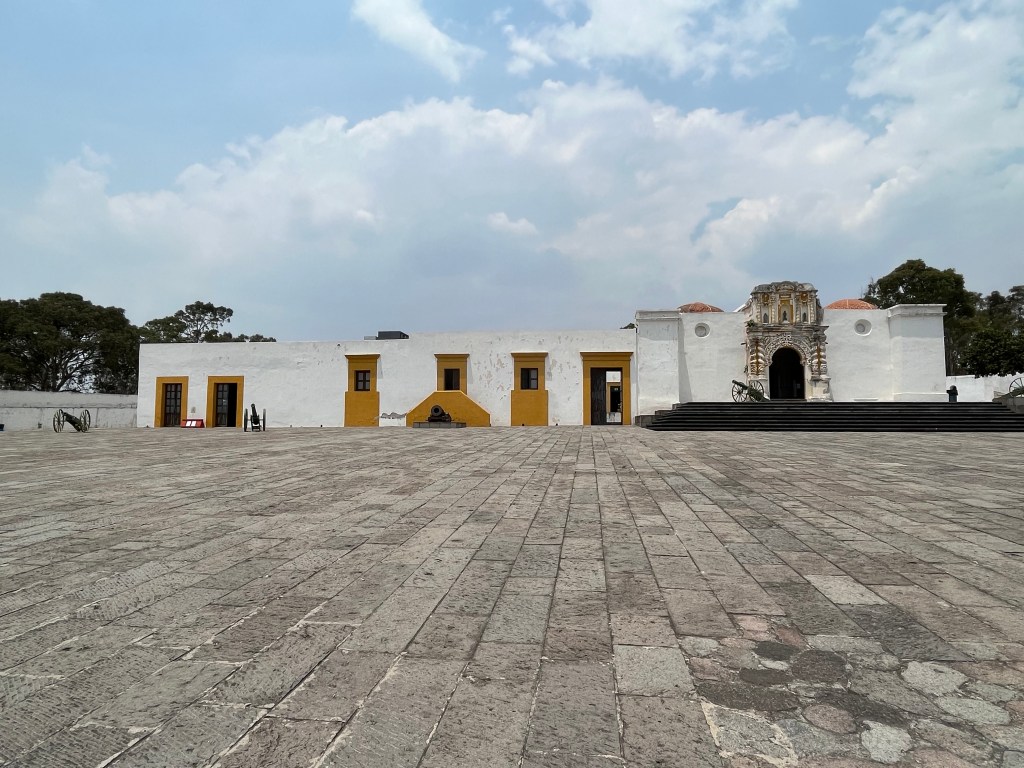
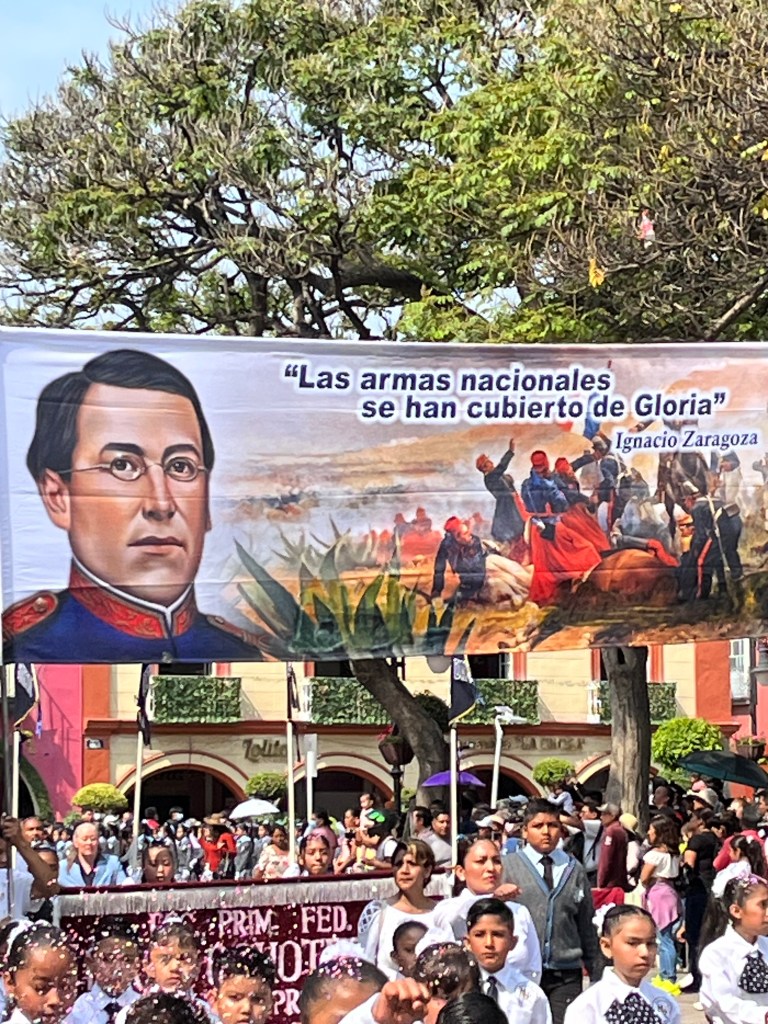
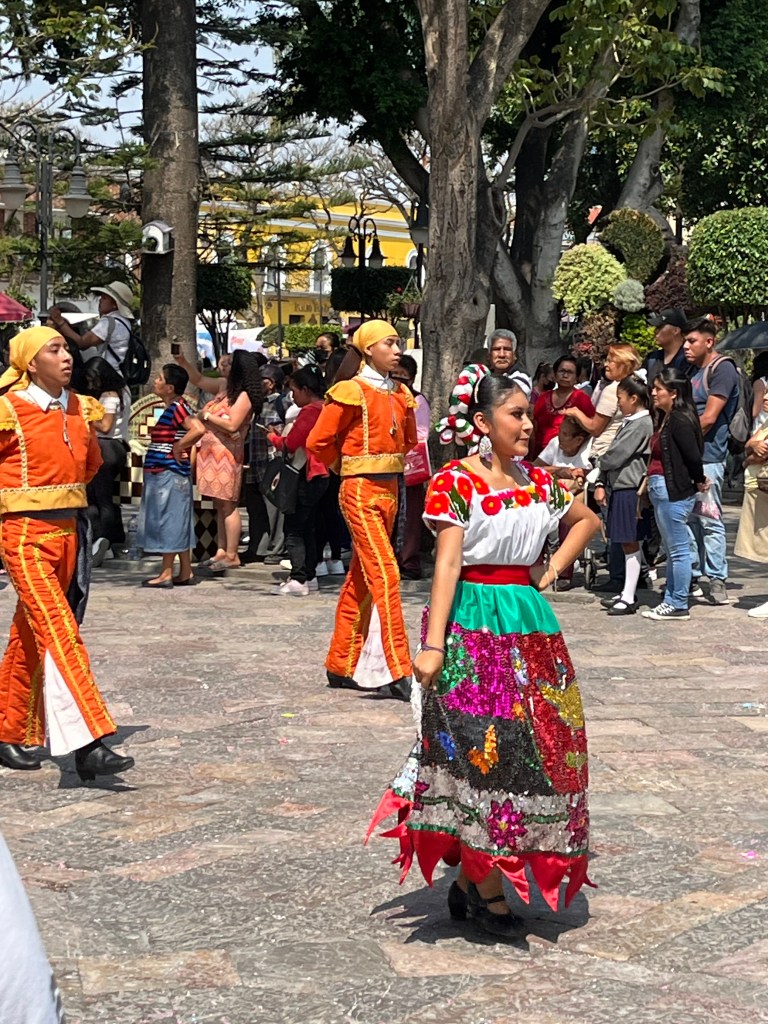
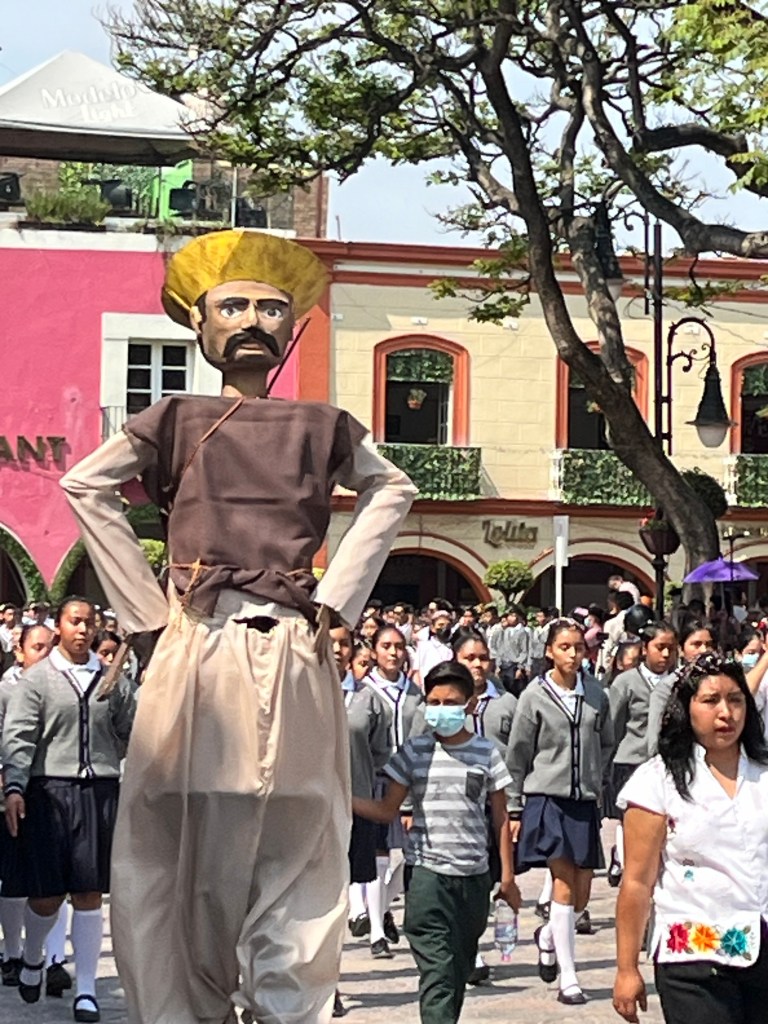
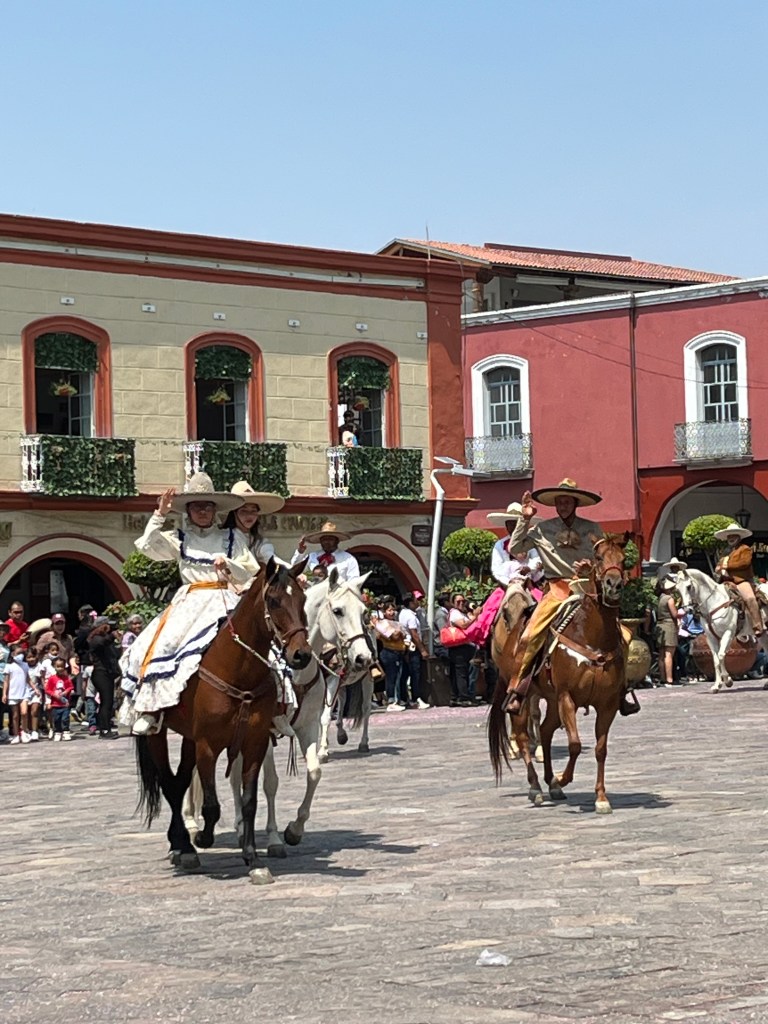
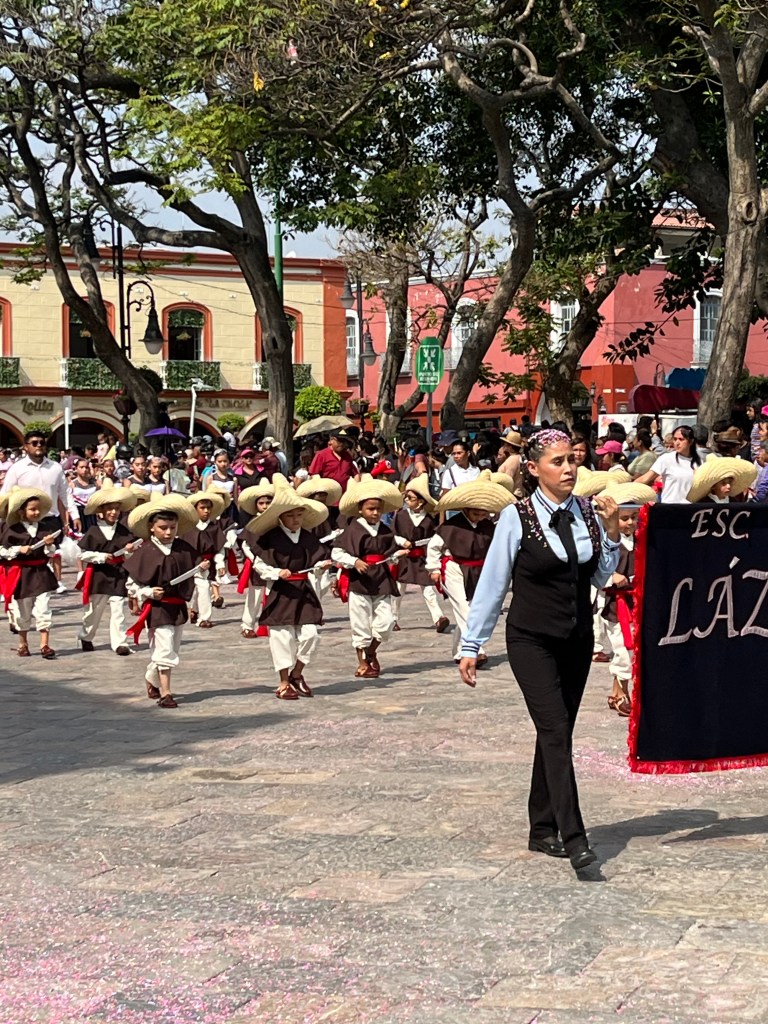
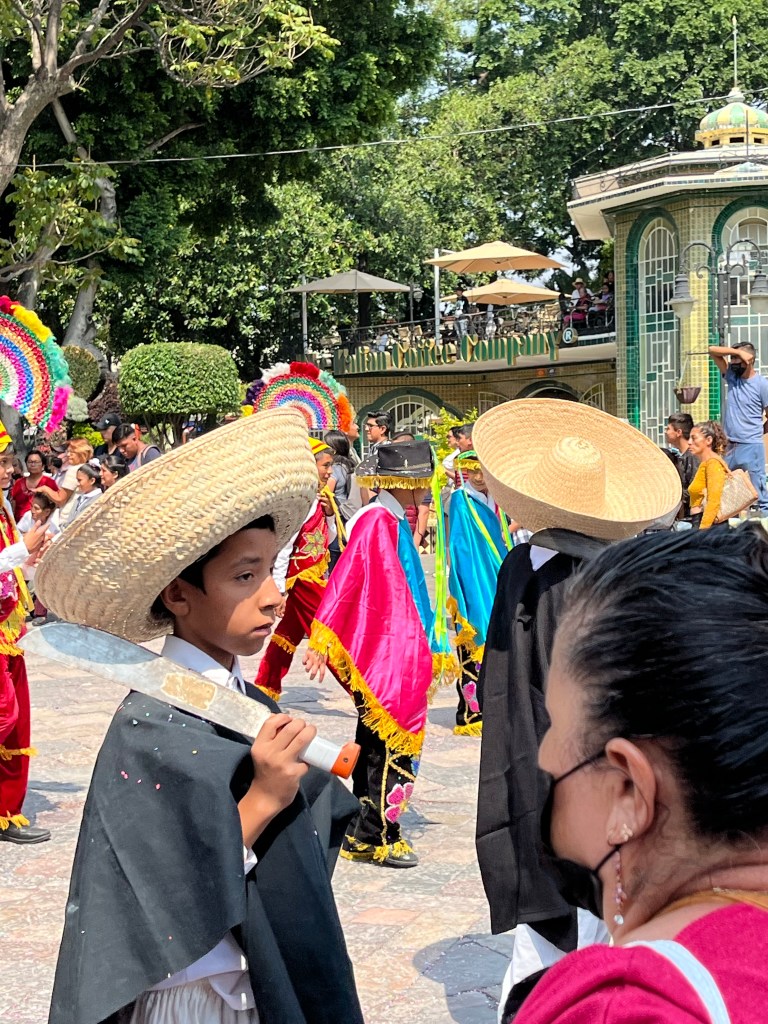
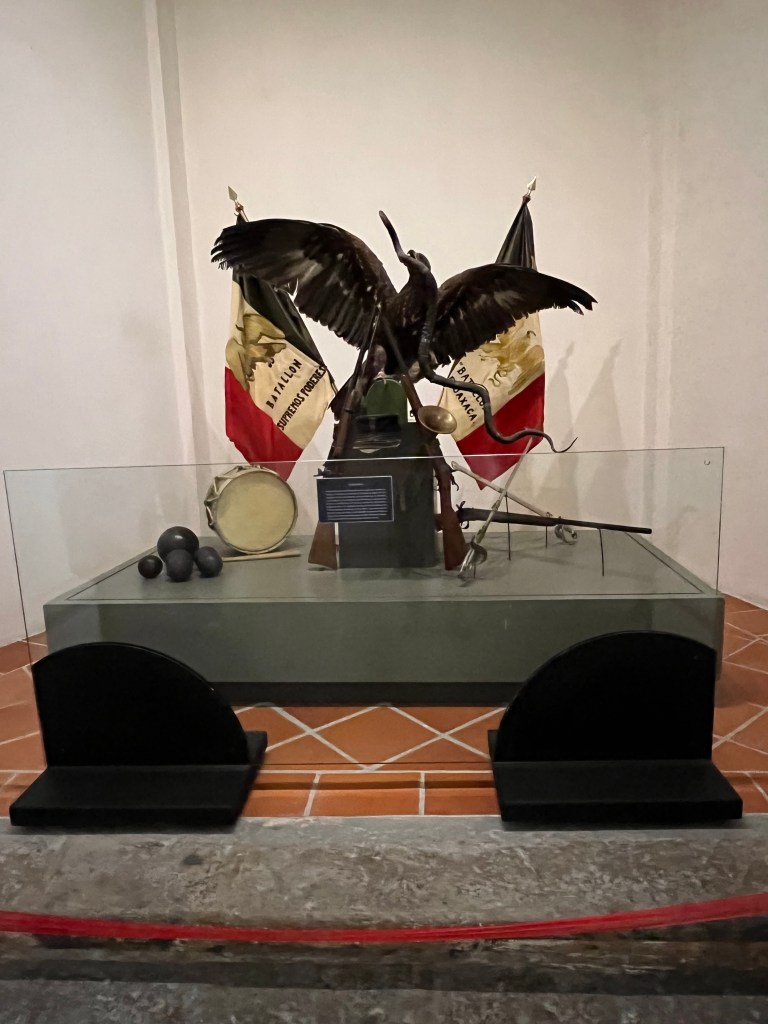
We visited Fort Loreto, which is now a museum and on May 4th attended a lengthy parade of school children and staff and various organizations.
Fort Loreto
On May 5th, I watched the celebrations online. President Lopez Obrador (aka AMLO) attended, and it was a very long day, which would have necessitated leaving early in the morning to where the event would take place and waiting hours for the festivities to begin.
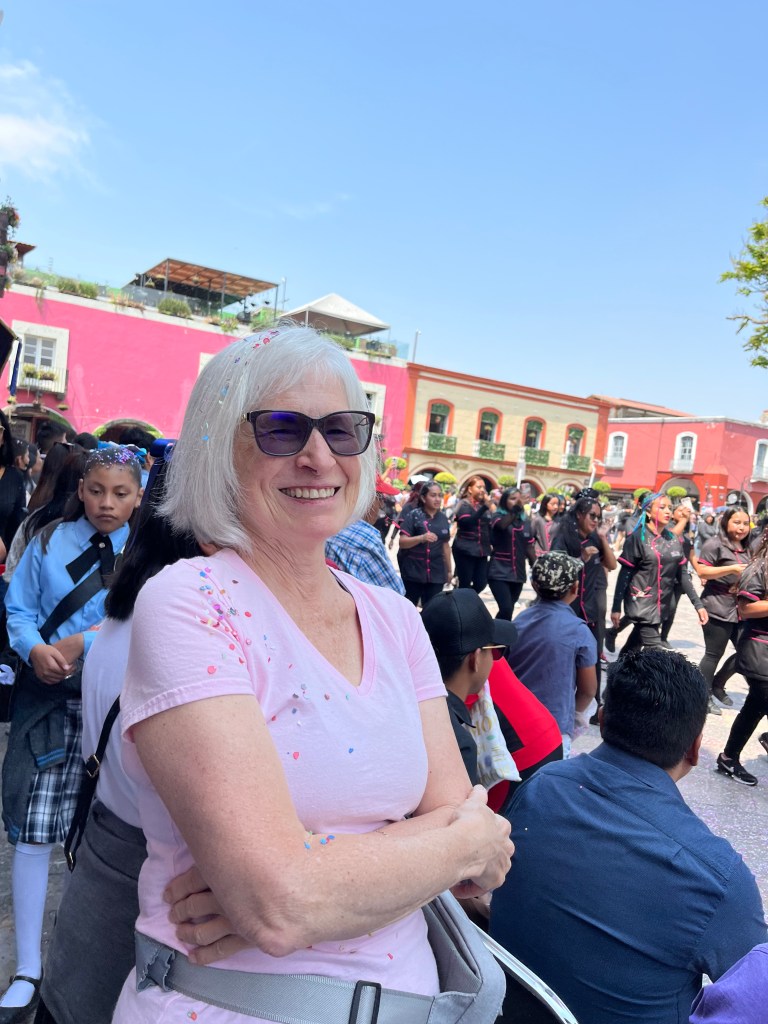
Scenes from the parade on May 4th
During the parade, people were throwing confetti at the spectators as well as the participants. I am not comfortable in crowds, but it was a wonderful event, a wonderful experience and I am glad that I was able to actually be in Puebla for this important event.
So to all my readers, if you wish to visit a country and find that there are events to celebrate national holidays or important historical events, please consider traveling at those times. In researching for this post, I was amazed to discover the connection with the American Civil War, something about which I had no previous knowledge. You, too, may be pleasantly surprised at what you might learn by exploring the human histories or natural histories of the places you visit and experience the wonder of standing in the same place where persons or events have occurred.
Throughout the years, I have studied several different languages – Japanese, Ukrainian, Latin, German, French and of course, many years of Spanish. Each language has its own structure, and each country has its own idioms, unique collections of sayings and phrases. One example of an idiom is “por mis huevos.” Word for word that translates to “for my eggs” which makes no sense, right? However, it means “because I said so” – something a mother might say to her child.
A local expression might be something like calling someone “Catrina,” which someone did to me. La Catrina is the elegantly dressed skeleton of Mexico, and so I was wondering if I actually looked like a skeleton, until it was explained to me that calling someone Catrina means they look elegant.
I have been taking private Spanish lessons twice weekly, and through conversation my teacher sees where I need help. I also am sometimes called upon to translate letters from our local students to their non-Spanish-speaking sponsors, and through these two activities I have come to realize that I need to see my world a bit differently to become accustomed to a new way of speaking.
One example is, “Me encuentro en el segundo semestre” - I find myself in the second semester. I had no idea how to translate that into proper English and consulted with the administrators of the literacy project. Turns out, a proper translation is “I’m in the second semester.” I explained that “to find yourself” in my experience in the U.S. means that you are unexpectantly in a place or situation, as in “I was wandering around town and suddenly found myself in an unfamiliar neighborhood.”
Another way of thinking that needs to be turned on its head is “gustar” or to like something. In English I can say “I like chocolate.” In Spanish I need to say “Me gusta chocolate” – or Chocolate pleases me. When it gets complicated, as in one or more persons liking one or more things, I still need to think of it in English first in order to translate it properly, even after living here for eight years.
And now for the explanation of the title – It’s never my fault. ”I forgot my keys” becomes “Se me olvidaron las llaves” – I didn’t forget the keys; they forgot me. Not my fault. ”La taza se cayó” – the cup fell itself. Still not my fault.
I’m sure you understand now that sometimes when translating you need to do some mental gymnastics, but it is good exercise for the brain and I have heard that it keeps you young. I have been helping three people with their English every week and I find that giving classes in English also helps with my Spanish, so we are actually helping each other.
Learning a new language is best done when you are young, when your brain is like a sponge. The younger you are, the better your accent and ability to automatically understand the language. However, you are never too old to start learning. Although I had studied various languages at different ages, I didn’t begin studying Spanish until I was in my 50’s. Learning a language also exposes you to different ways of thinking – the mental gymnastics I mentioned – and gives you insight into different cultures, which explains why some expressions, jokes and ideas are difficult or impossible to translate accurately into your native language.
Anyway, for those who love languages, I hope this was enjoyable and for others, I hope it was at least a little bit interesting.
Years ago, when I lived north of New York City, I was taking Spanish classes in the language school of New York University in Manhattan. The campus was near many ethnic neighborhoods, and since I love trying different cuisines, I would leave my home early, take the bus into the city and have dinner at a different ethnic restaurant before each class. The restaurants included cuisines of India, Ukraine and Afghanistan, among others.
Lately, I have occasionally been watching videos from Nigeria to pass the time and I noticed a few characters in the stories eating Jollof rice. Curious, I looked up some of the recipes and decided to try it myself.
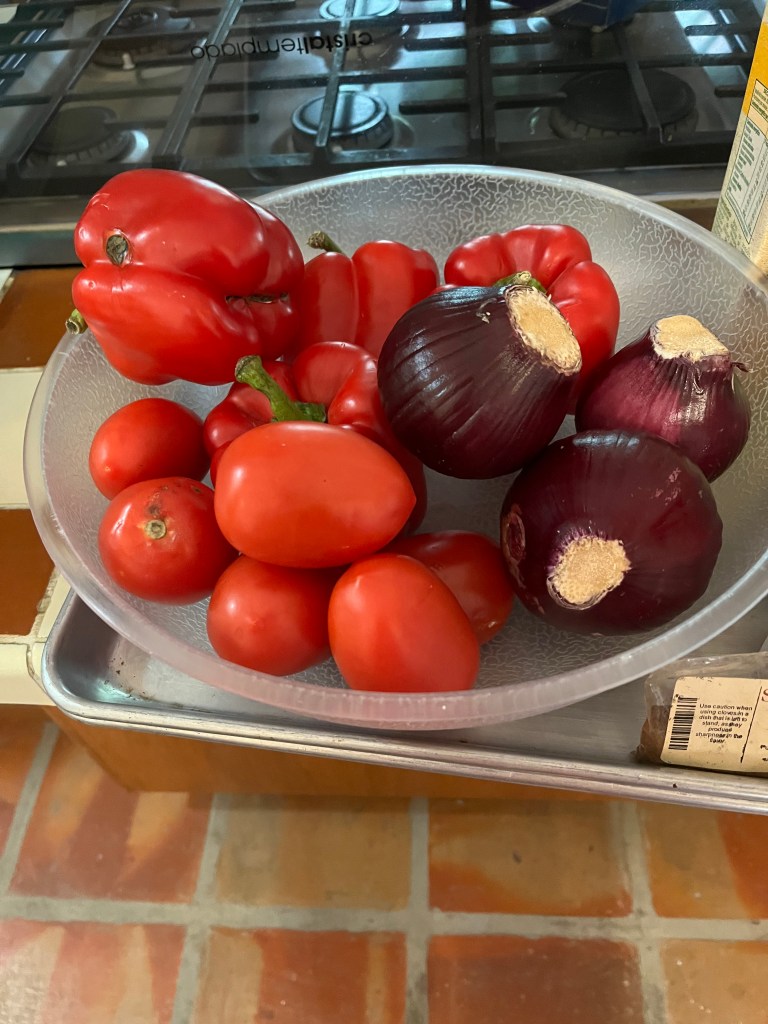
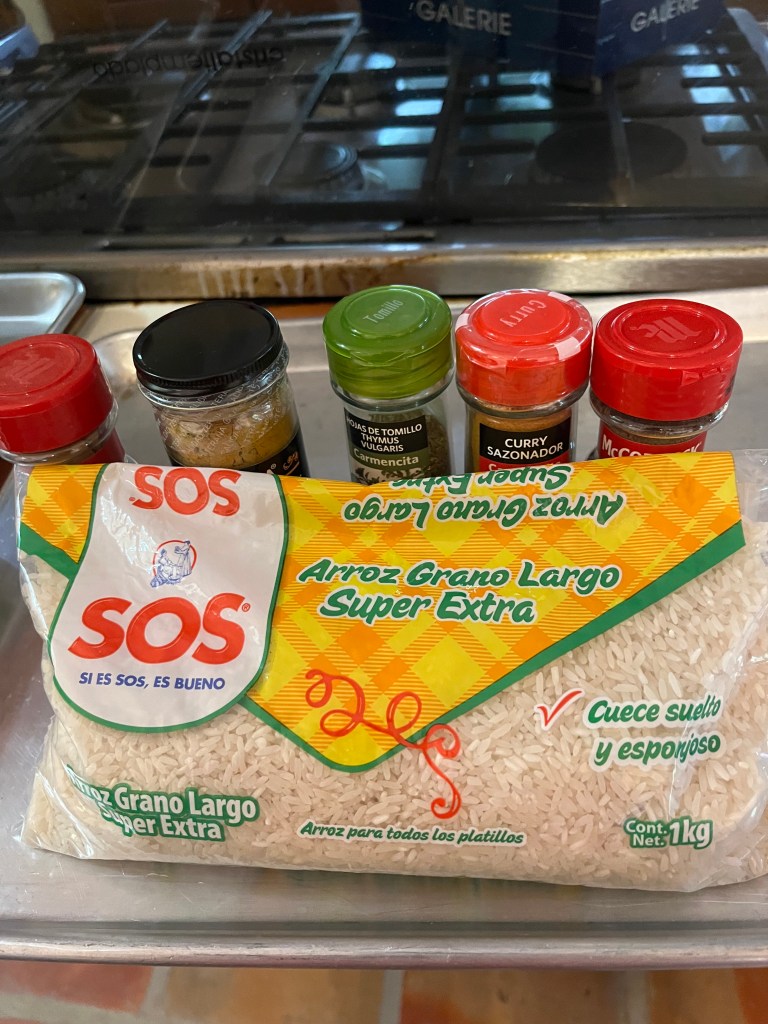
The first consideration was whether or not I could obtain the ingredients here in Mexico. Fortunately, the rice and vegetables were readily available.
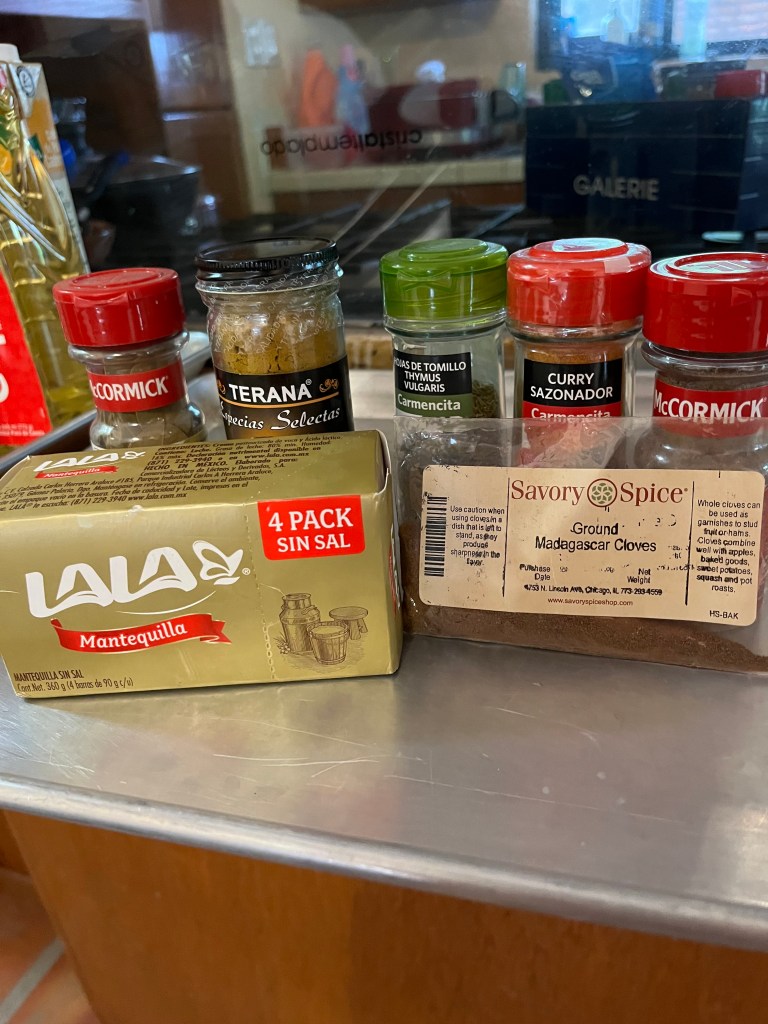
One thing I had to modify was the curry powder. The recipe calls for Caribbean/ Jamaican-style curry powder. Try as I might, I could not find it so I bought a bottle of Indian Style Curry Powder and one of Carmencita brand curry powder which seems to be similar to the Indian style but with a few different ingredients. Also keep in mind that the spices might have a different name in the language of the country in which you are.
There are many types of rice, so I picked what I felt was the closest to the converted, long-grain that is listed in the recipe.
The next consideration is that I am highly intolerant to chili peppers. The recipe not only calls for curry powder, but also hot peppers and poblano peppers. What I normally do in this case is leave out the hot stuff altogether or make a substitution. In this recipe, they say I can substitute red bell peppers, which I did.
OK, slight pause here. Several people in the past have said to me, “You live in Mexico, and you don’t eat chilis?!?!?!?” My answer is – I live in my own house, I buy my own produce and cook it the way I prefer it. End of story….
Normally, when I am preparing a dish that I will be sharing with others, I bring a bottle of hot sauce or in this case I brought along both bottles of curry. The neighbors with whom I shared this dish spooned on their own chili that they kept in their house, preferring it to the curry.
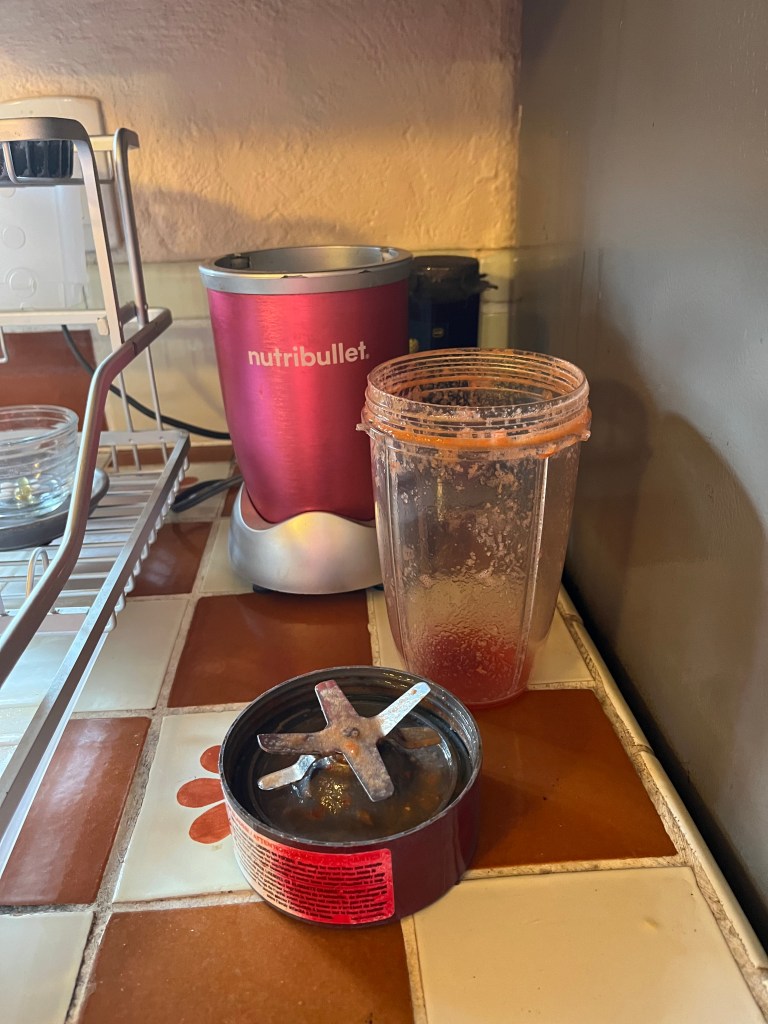
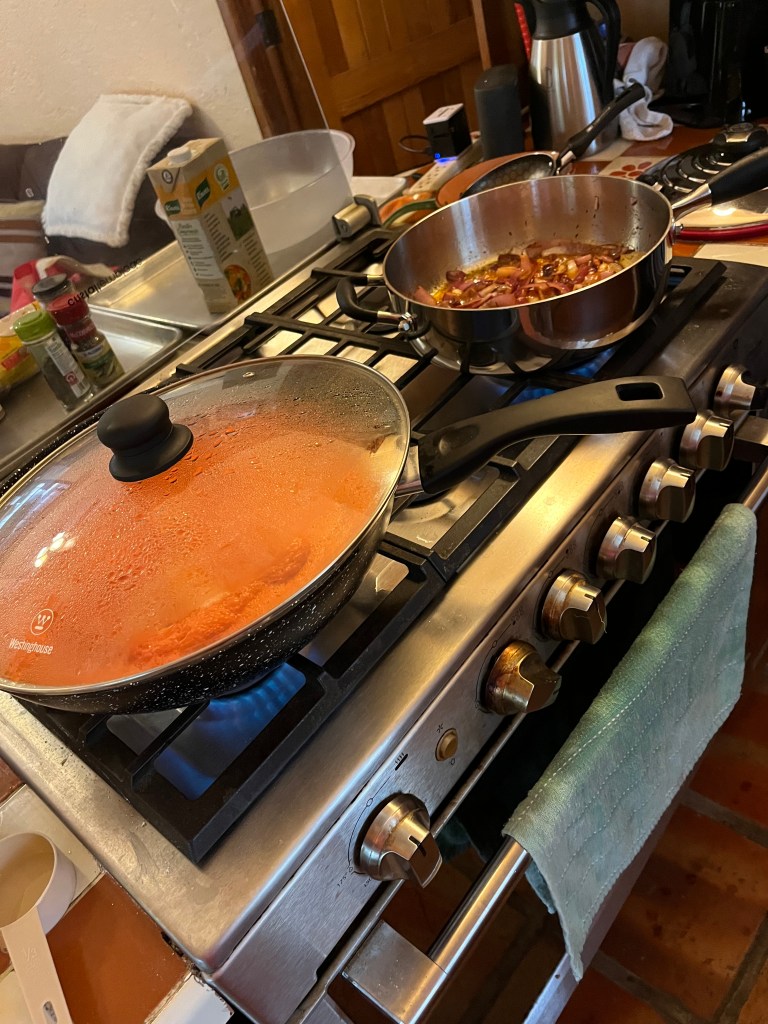
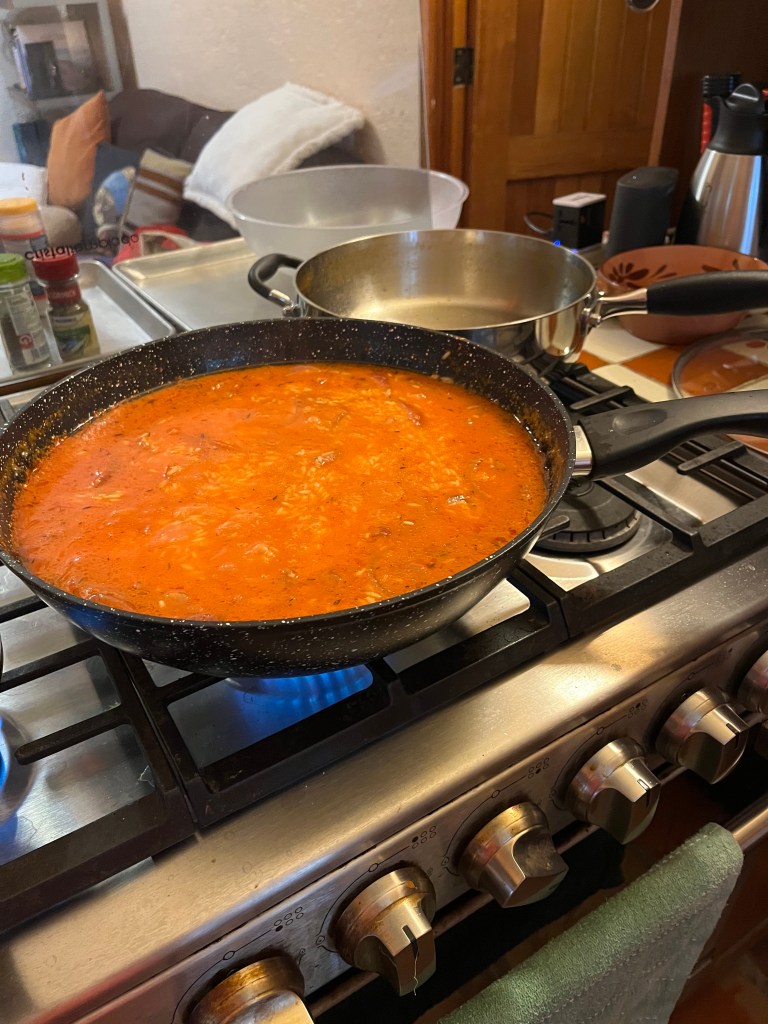
So – back to the recipe. The tomatoes, some of the onions and the peppers mixed with the stock were liquified in my Bullet. The rest of the sliced onions were fried separately and then added to the broth and finally the rice was cooked in the broth.
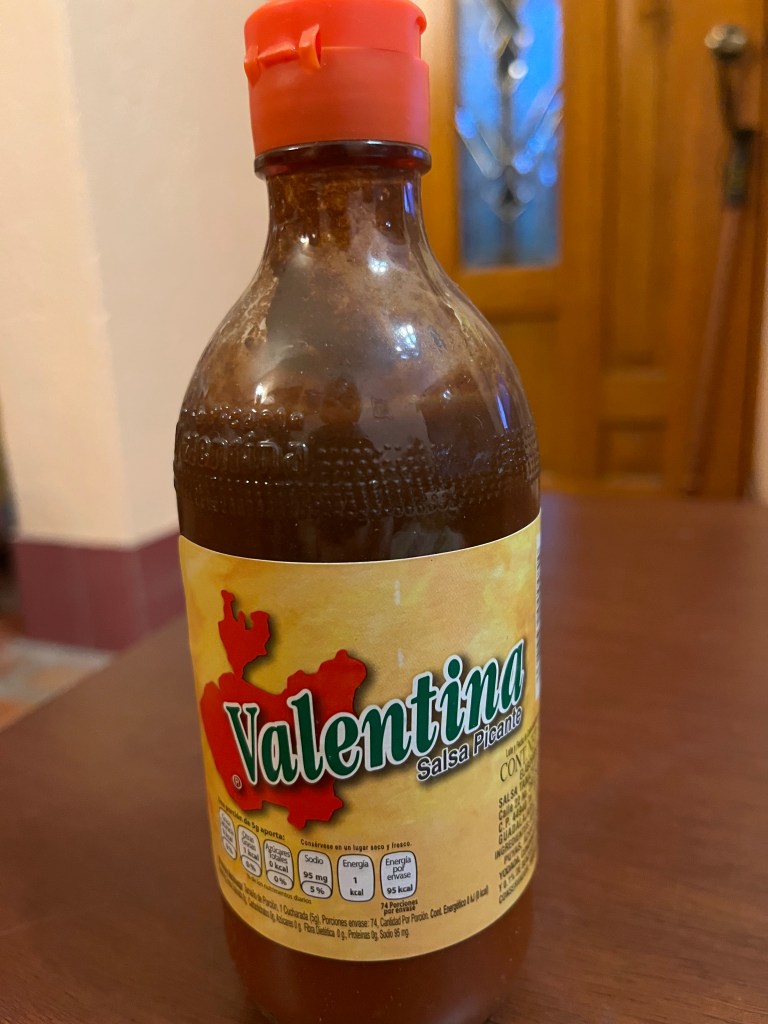
Frankly, it came out bland because of the spices that I left out. For me, whenever I have tried chilis, I didn’t even taste any flavor, just heat and pain. Depending on the chili, it burns my tongue, lips, throat with various degrees of pain. Occasionally, I can put a drop of the yellow label Valentina sauce (one drop, and making sure it’s the yellow label, not the much hotter black label) and I was able to put a miniscule amount of the Indian style curry on it.
So I am sure that if you want to make it yourself, it will taste better with the chilis and curry. If you are someone who stays away from the picante (hot and spicy) condiments, you might try to add spices or herbs that you normally like.
And one more precaution for those of you with allergies or sensitivities. As I stated, I am pretty intolerant and can detect even a tiny amount of the offending substance, and I have had two unfortunate instances in the past few months.
At a restaurant in Puebla, I ordered a dish with a red sauce. I was assured it wasn’t picante. I tasted it and immediately felt the pain. My friends tried it and agreed, although they liked it. We called over the waiter and explained that there was chili in it. My friend and I switched plates, but explained to the waiter that for me, it was just an intolerance, but there might be a customer with a genuine life-threatening allergy and it would be much more serious. We just nicely explained the situation so that he would understand when a future client says they have an allergy or intolerance.
The next situation was several days later in a Wings restaurant in the Mexico City airport. I thought that lasagna was a safe choice. The waiter set the plate in front of me and poured the red sauce on top. One bite told me I wouldn’t be able to eat it. I called the waiter over and explained the situation to him the same way my friends and I explained it to the waiter in Puebla. He was very nice and apologetic. I scraped the sauce off, and he brought me non-picante red sauce. I left him a generous tip.
Sometimes the recipe itself does not contain hot and spicy ingredients, but if the pan in which it is prepared was not washed thoroughly enough, it will end up in your dish. Just something to be aware of and a nice way to inform the staff.
Anyway, that’s about it for now. In case any of my readers want to try it, here is the recipe. Enjoy, and have a great day !!!
Classic Nigerian Jollof Rice
Ingredients
1/3 cup of oil (vegetable, canola or coconut – NOT olive oil)
6 medium sized fresh plum/Roma tomatoes, chopped, or a 400-gram tin of tomatoes
6 fresh, red poblano peppers (or 4 large red bell peppers), seeds discarded
3 medium sized red onions (1 sliced thinly, 2 roughly chopped), divided
½ to 1 hot pepper, or to taste (yellow Scotch bonnets were suggested)
5-6 cups stock (vegetable, chicken or beef) or water, divided
2 teaspoons unsalted butter (optional), divided
4 cups uncooked converted long-grain rice or golden sella basmati, rinsed
Salt, to taste
Black and white pepper, to taste
Extra: sliced onions, tomatoes
Directions
In a blender, combine tomatoes, red poblano (or bell) peppers, chopped onions, and Scotch bonnets with 2 cups of stock, blend till smooth, about a minute or two. You should have roughly 6 cups of blended mix. Pour into a large pot/pan and bring to a boil then turn down and let simmer, partly covered for 10-12 minutes.
In a large pan, heat oil and add the sliced onions. Season with a pinch of salt, stir-fry for 2-3 minutes, then add the bay leaves, curry powder and dried thyme and a pinch of black pepper for 3-4 minutes on medium heat. Then add the tomato paste – stir for another 2 minutes. Add the reduced tomato-pepper-Scotch bonnet mixture, stir and set on medium heat for 10-12 minutes till reduced by half, with the lid partly on. This is the stew that will define the pot.
Add 4 cups of the stock to the cooked tomato sauce and bring it to boil for 1-2 minutes.
Add the rinsed rice and butter, stir, cover with a double piece of foil/baking or parchment paper and put a lid on the pan – this will seal in the steam and lock in the flavor. Turn down the heat and cook on the lowest possible heat for 30 minutes, stirring halfway through.
Stir the rice – taste and adjust as required. If rice isn’t soft enough/needs additional cooking, add ¼ – ½ cup of stock or water, stir through and continue to steam, on low till cooked through.
If you like, add sliced onions, fresh tomatoes and the 2nd teaspoon of butter and stir through. Let rest, covered for 5-6 minutes.
To make Party Rice, you’ll need one more step. Now Party Rice is essentially Smoky Jollof Rice, traditionally cooked over an open fire. However, you can achieve the same results on the stove top. Here’s how: Once the rice is cooked, turn up the heat with the lid on and leave to “burn” for 3 – 5 minutes. You’ll hear the rice crackle and snap and it will smell toasted. Turn off the heat and leave with the lid on to “rest” till ready to serve. The longer the lid stays on, the smokier. Let the party begin !!!


































 mex-pat.org