What exactly are the meanings of the words “Talavera” and “Poblana”? If you are familiar with chili peppers, you know the name chile poblano, which means a chili that grows in the state of Puebla, Mexico. The word “poblano” can refer to the people who live there, the type of cuisine there or even things such as pottery that is created there – all are “poblano” (or “poblana” if the word it is describing is feminine).
Talavera refers to earthenware covered with a lead enamel opacified with tin. Put the two words together and you have Talavera Poblana – ceramics of Puebla. Talavera Poblana is of such high quality that on December 11, 2019 it was given the title of Intangible Cultural Heritage of Humanity by UNESCO – the United Nations Educational, Scientific and Cultural Organization.
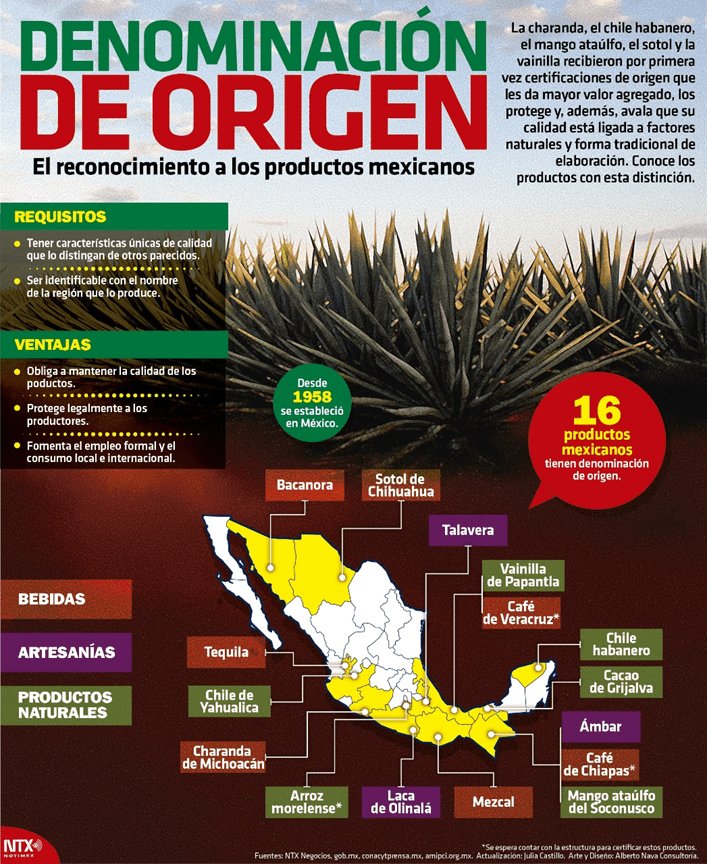
In addition to UNESCO, the Mexican Institute of Industrial Property has given Talavera Poblana the designation of Denominación De Origen, which is a recognition of Mexican products in three categories: drinks, artisanal products and natural products. Mexico has 16 products that have been given this classification.
“Recognition of Mexican products. Requirements: To have unique characteristics of quality to distinguish them from similar products. To be identifiable with the name of the region that produces it.
Advantages: Obligation to maintain the quality of the products. Legal protection of the producers. Encourages formal employment and local and international consumption.”
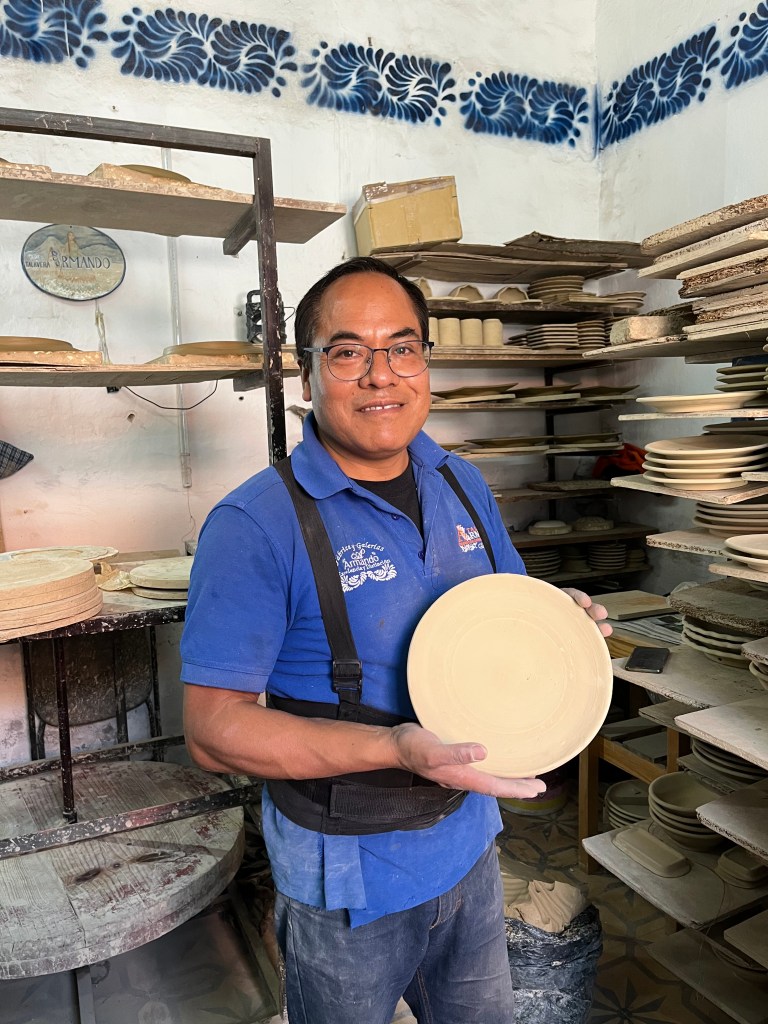
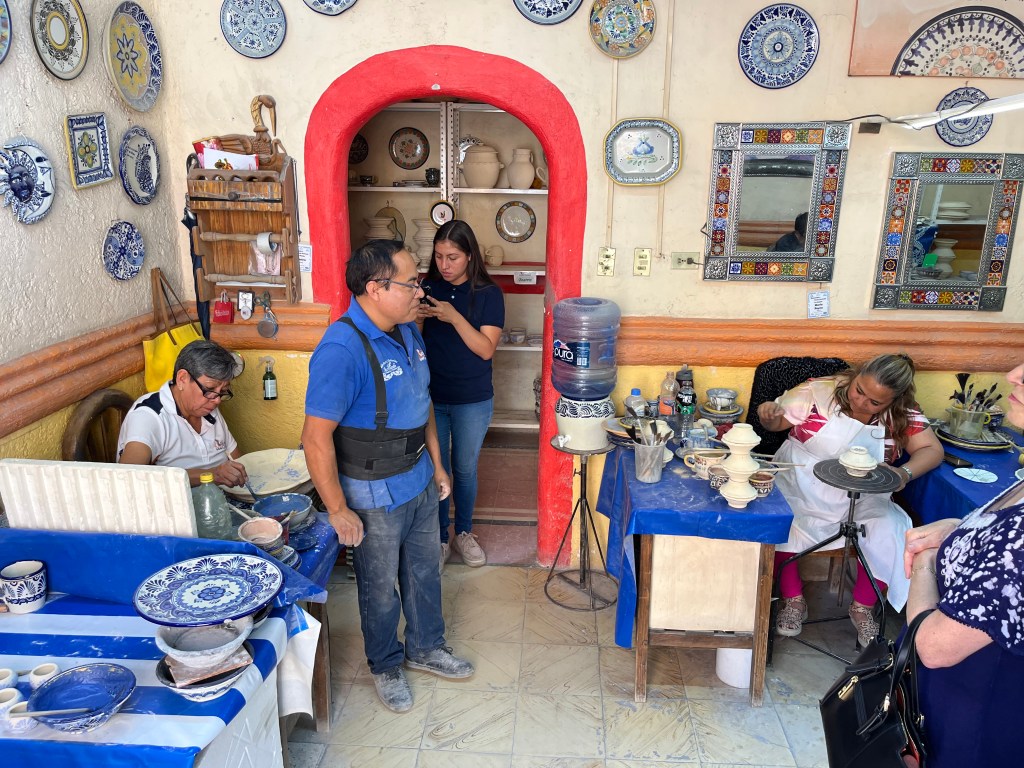
When I visited Puebla last May, it was a pleasant surprise that I could visit a factory where this pottery was made, including seeing the process from the first shovelfuls of clay dug up from the earth to the finished product.
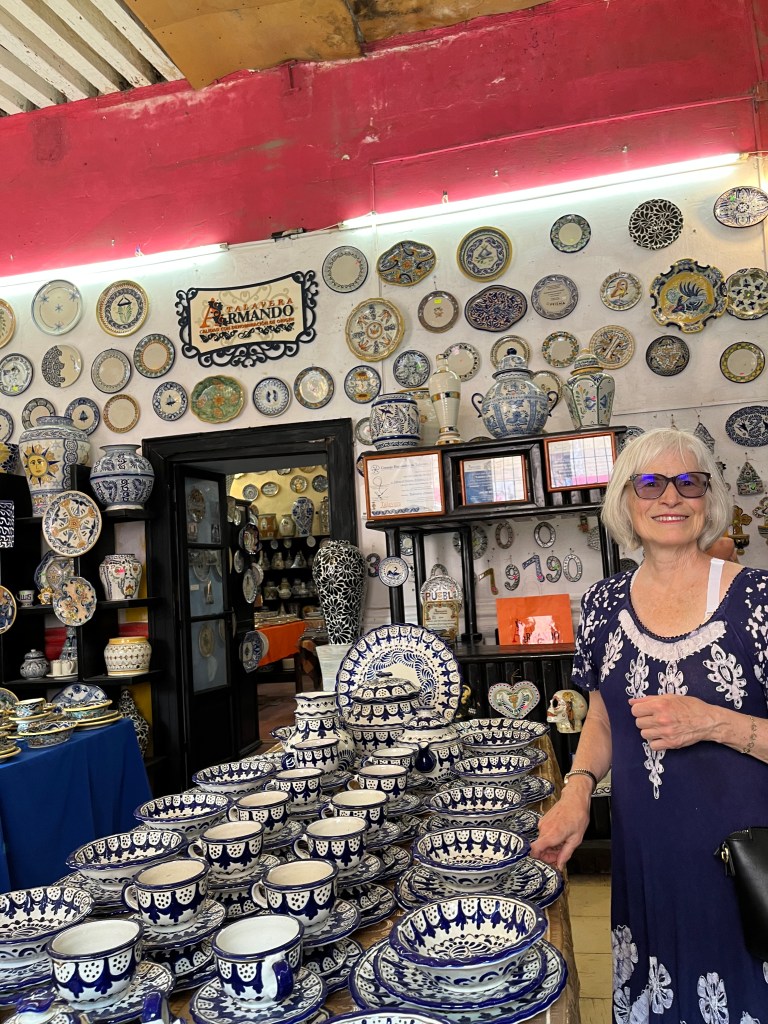
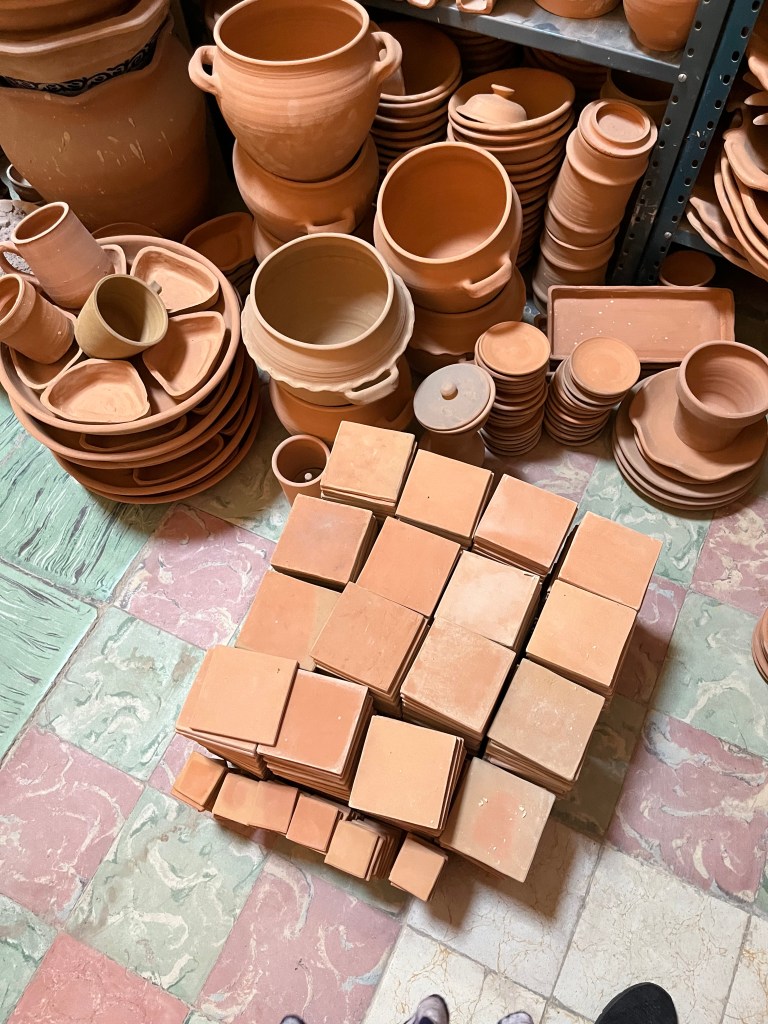
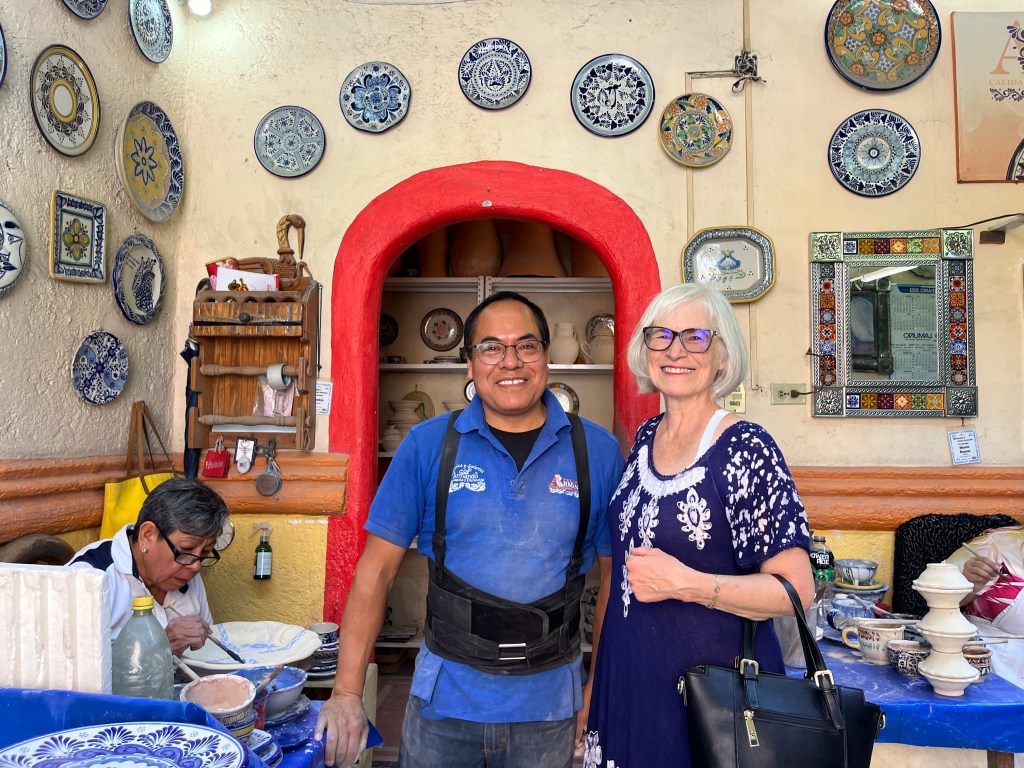
We will start with a photo of the outside of the store, where the finished products are sold. Behind the shop is the area where the clay is prepared.
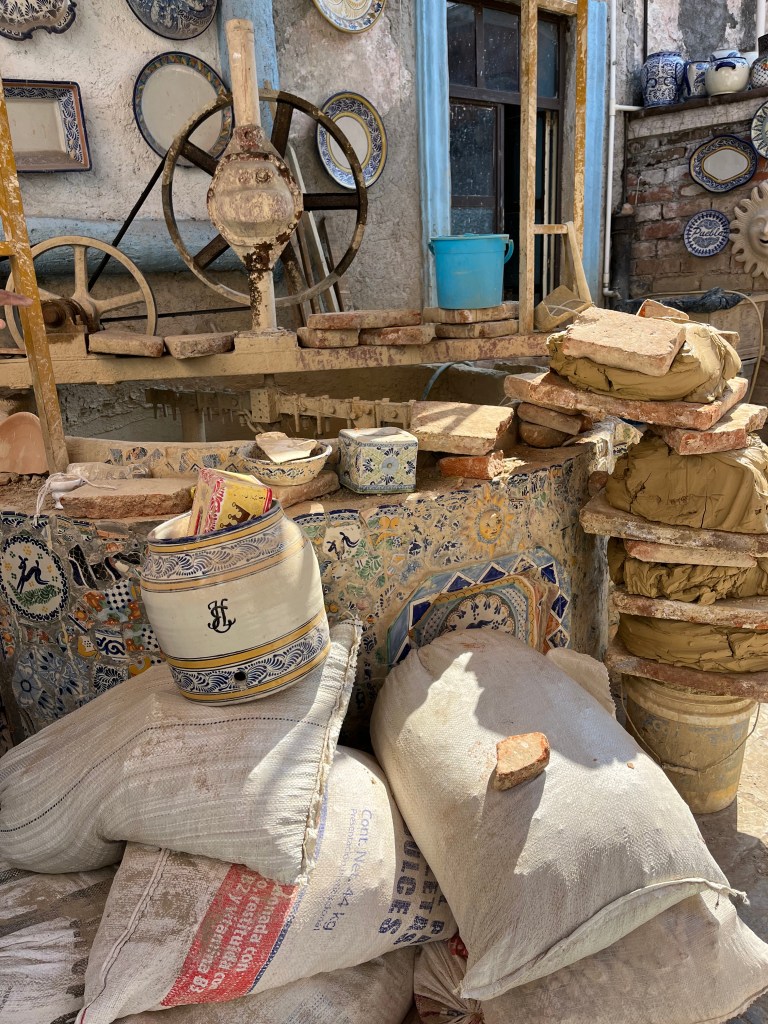
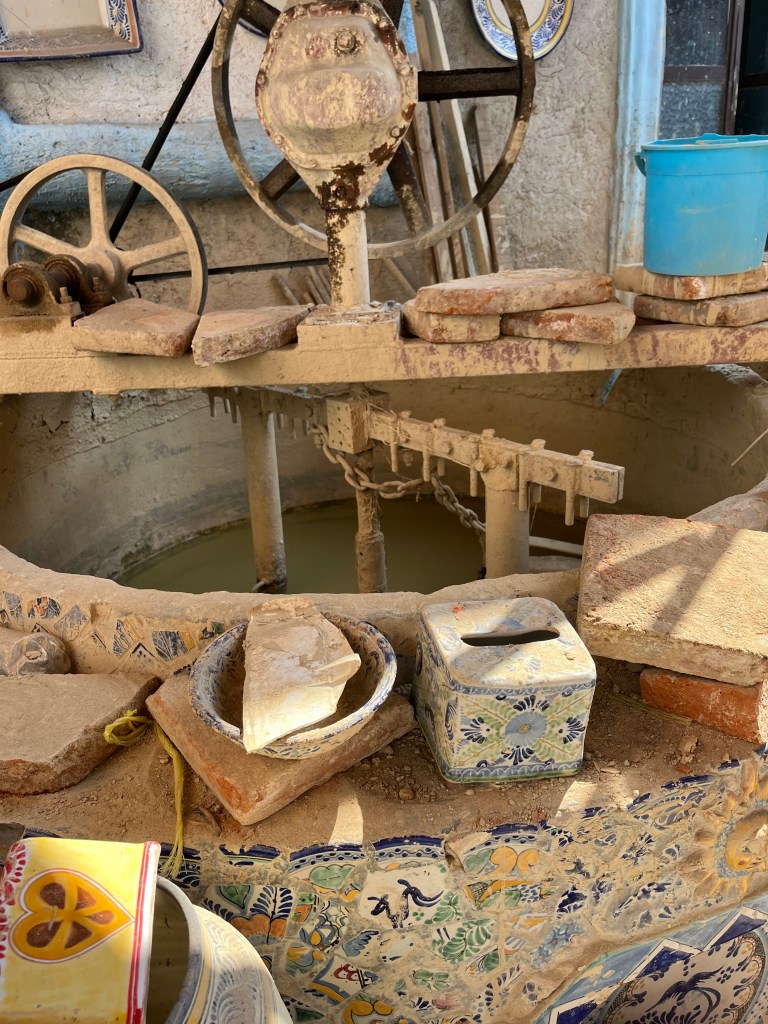
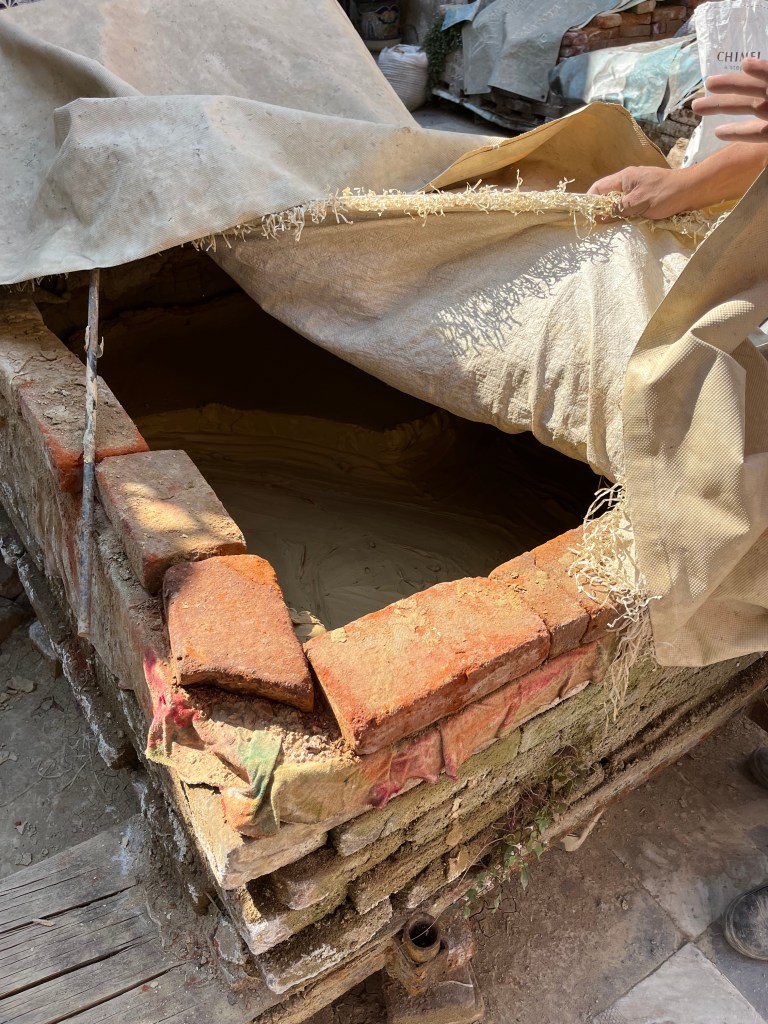
There are two colors of clay which come from this earth, and in order to use them, they must first have impurities removed. The raw clay is put into a tub of water, and it is stirred with wooden paddles. The paddles are powered by a cable which is attached to a rotating drum.
After a time, the clay-water mixture is placed onto a sieve where the water drains and the clay remains.
Once the excess water has drained, the clay is kneaded into blocks and is stored until needed.
Using a potter’s wheel or a mold, the clay will be shaped into whatever piece is needed – a plate, a cup, a vase or any number of other articles. Once completed, the pieces are put into a storage space which is unventilated to allow them to dry slowly and uniformly over time.
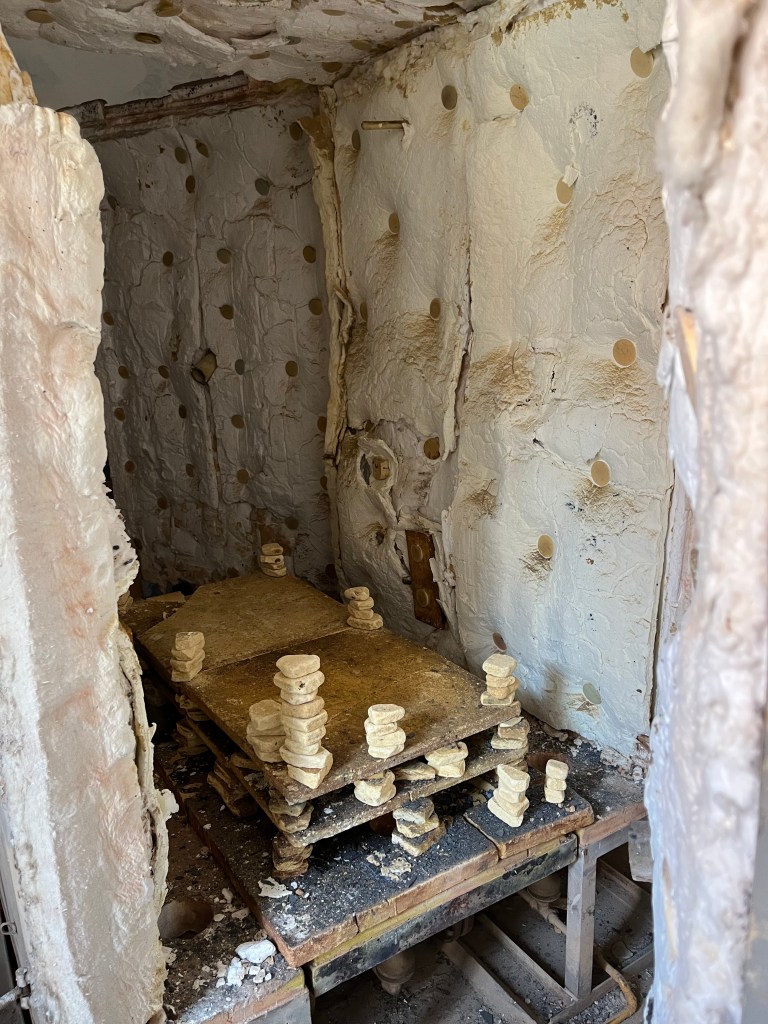
Once dry, they are put into a kiln at 800ºCelsius (1472ºFahrenheit) for 6 hours.
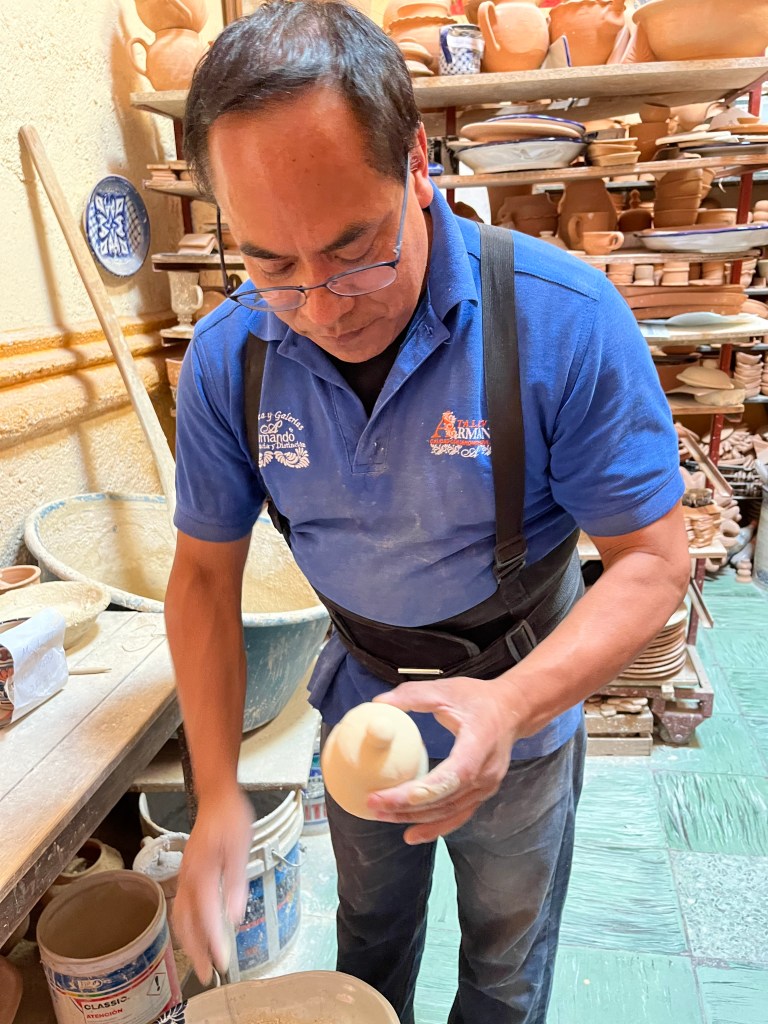
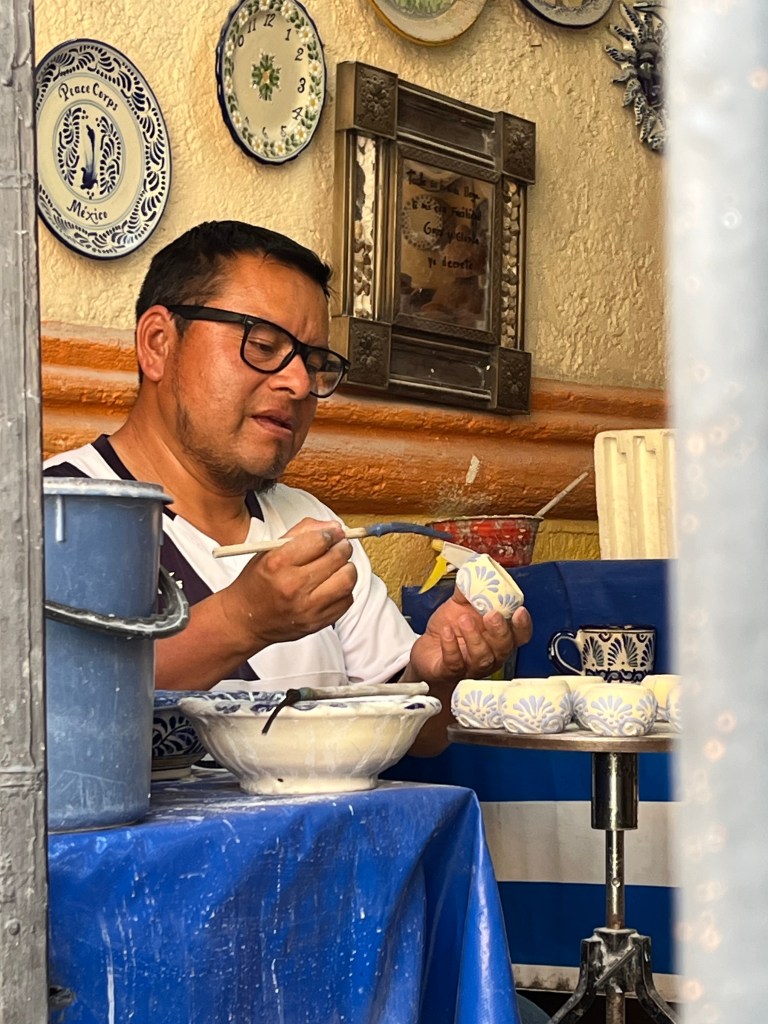
Once fired and cooled, they are dipped into a bath of an enamel made of tin and lead, preparing them to be painted. The traditional paint colors of Talavera are: yellow, red, blue, green and orange and the paints are made from local minerals.
Dipping the pieces into the enamel bath
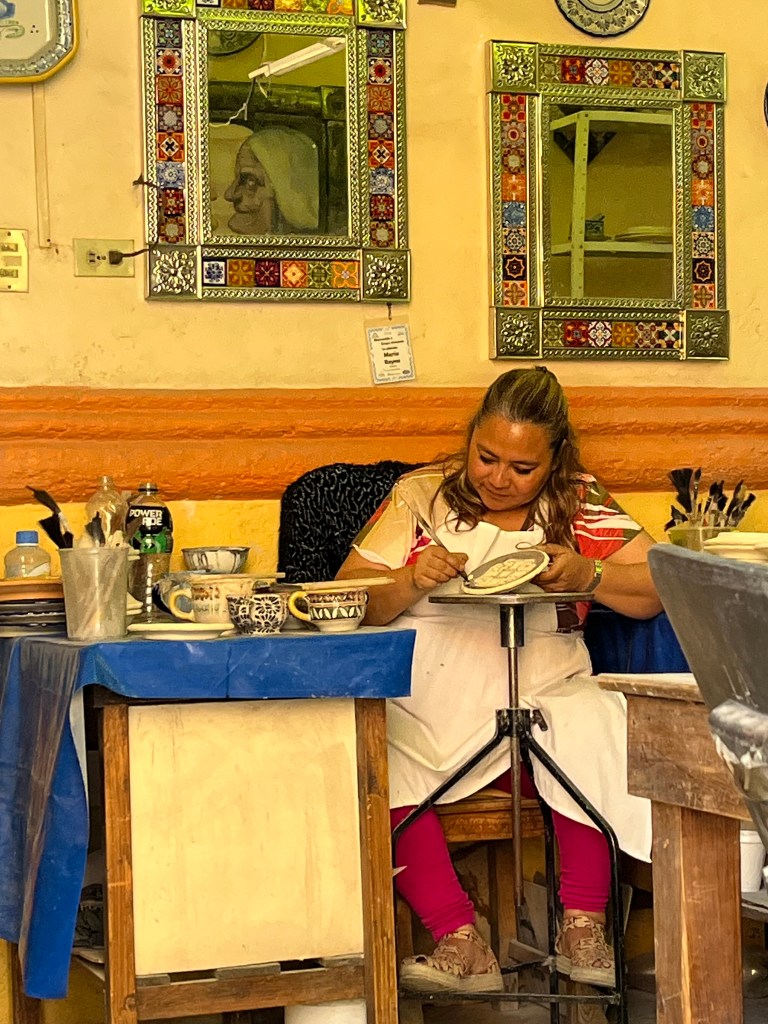
Every piece is painted by hand by the experienced artists and each piece is signed by the artist. Once the painting is done, the pieces are once again put into the kiln and baked at 1000ºCelsius (1832ºFahrenheit) for 8 hours. This firing hardens the glaze and also causes the paint to puff up, so that you can see and feel with your fingers that the paint is raised.
Some pieces are larger and/or more intricate than others and from start to finish may take from 3 to 6 months until completion. Viewing this process makes one understand why these pieces may be expensive. But ultimately, no matter how expensive, the time, labor and craftsmanship make it all worth the price.
It is July in Colima, and the rainy season is finally here – a few weeks late, as it usually begins by mid-June. We do have flowers all year round, but as the dry season comes to an end, everything is dry, parched and brown. When the rains begin, everything turns fresh and green. The air is fresh and sweet. And baby birds appear.
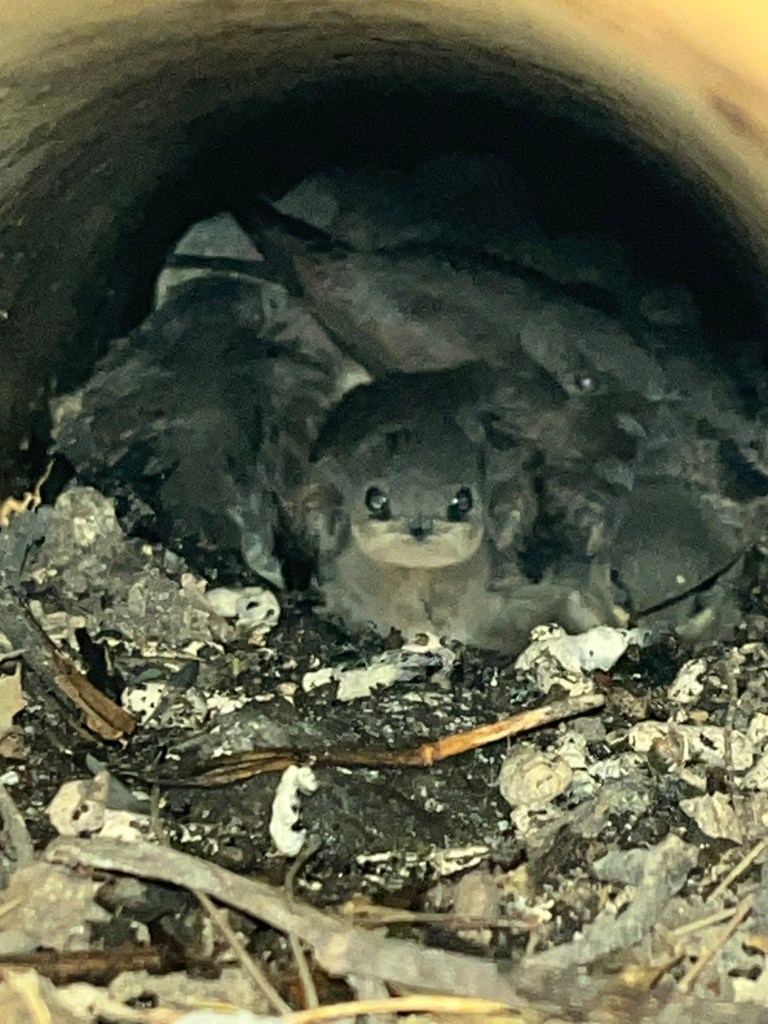
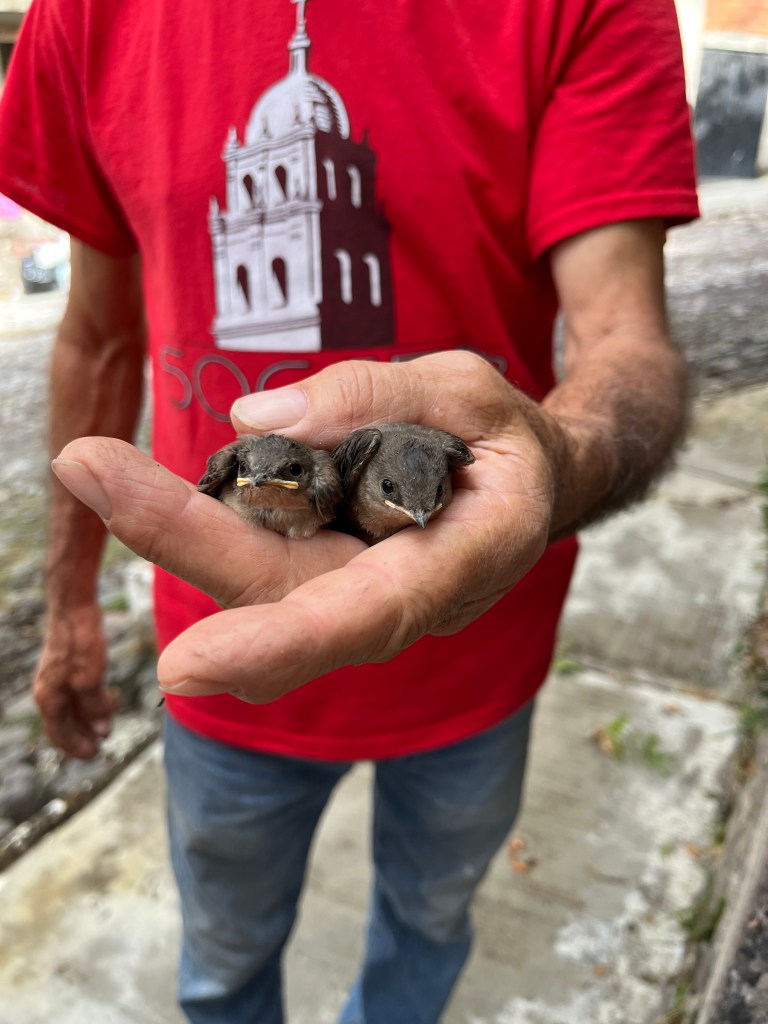
My land has drainage pipes throughout, leading to outside a brick wall where water can drain onto the street. This prevents flooding. One day, I was told that there were baby birds in a nest inside one of the pipes. Sure enough, there were baby golondrinas inside the pipe.
The baby golondrinas inside the drainage pipe
The drainage pipe exit
Two of the babies
As the rains came, I would check on them to make sure they were ok. And they were. But it seems as if they have grown sufficiently and flown away, because their nest has been abandoned. This was the first I had ever heard of birds nesting inside a pipe, much less a drainage pipe.
Chachalaca nest
High up in a tree next to my property is a chachalaca nest. Last week, two babies fell from the nest. One looked very weak, but the other was very strong, flapping its wings vigorously. I had no idea what to do with them, so initially, I put them in a cardboard box. The weak one just sat there, but its sibling kept flapping its wings and flying out of the box. The parents were flying and running around and squawking frantically, so finally I decided to let them take care of the babies.
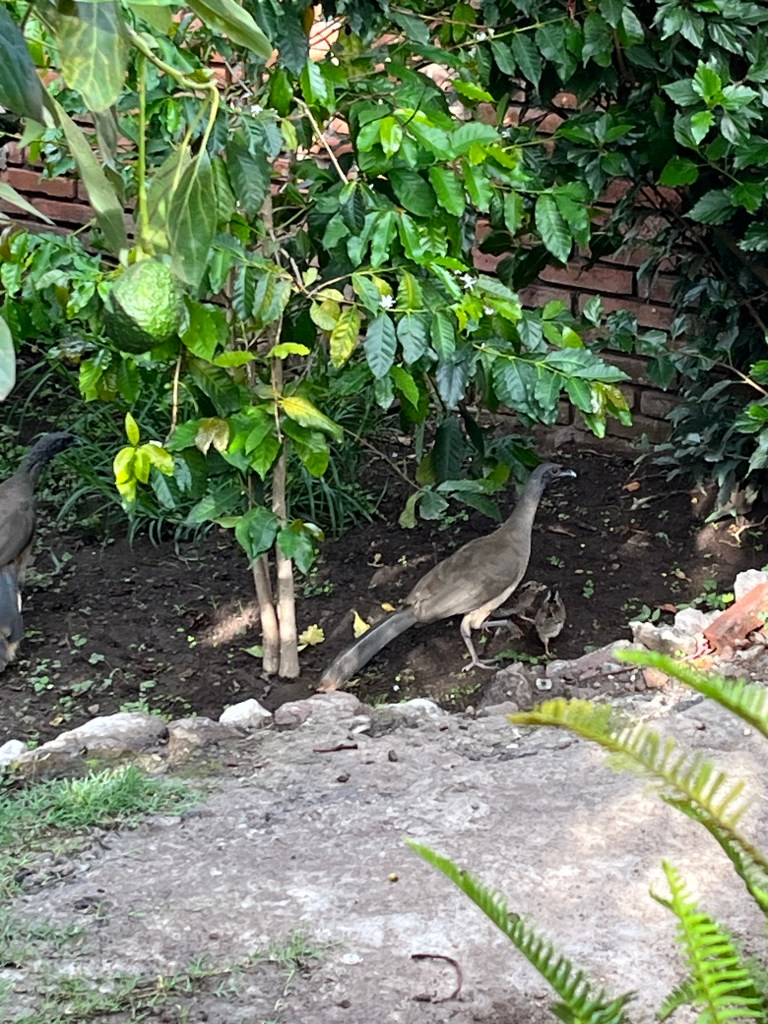
Parent and two babies
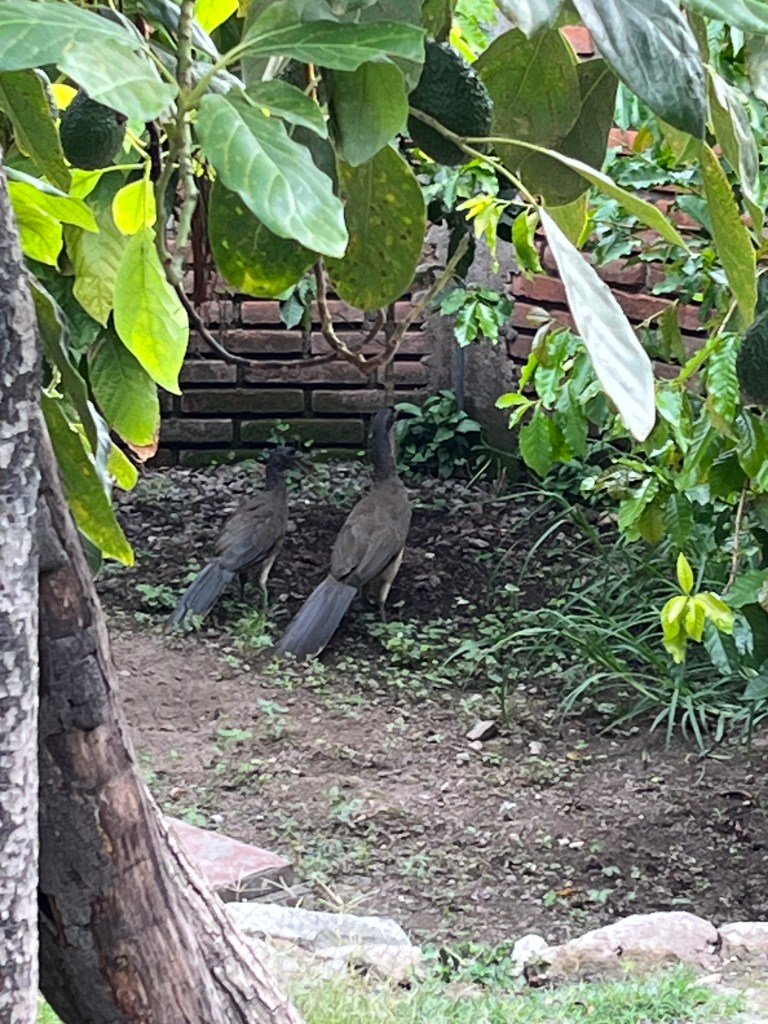
That turned out to be a good decision, as the parents are fierce protectors. I see two or three adults daily walking with the little ones. The little ones, when not walking with the adults, hide among a cluster of dense foliage.
The babies’ hiding place
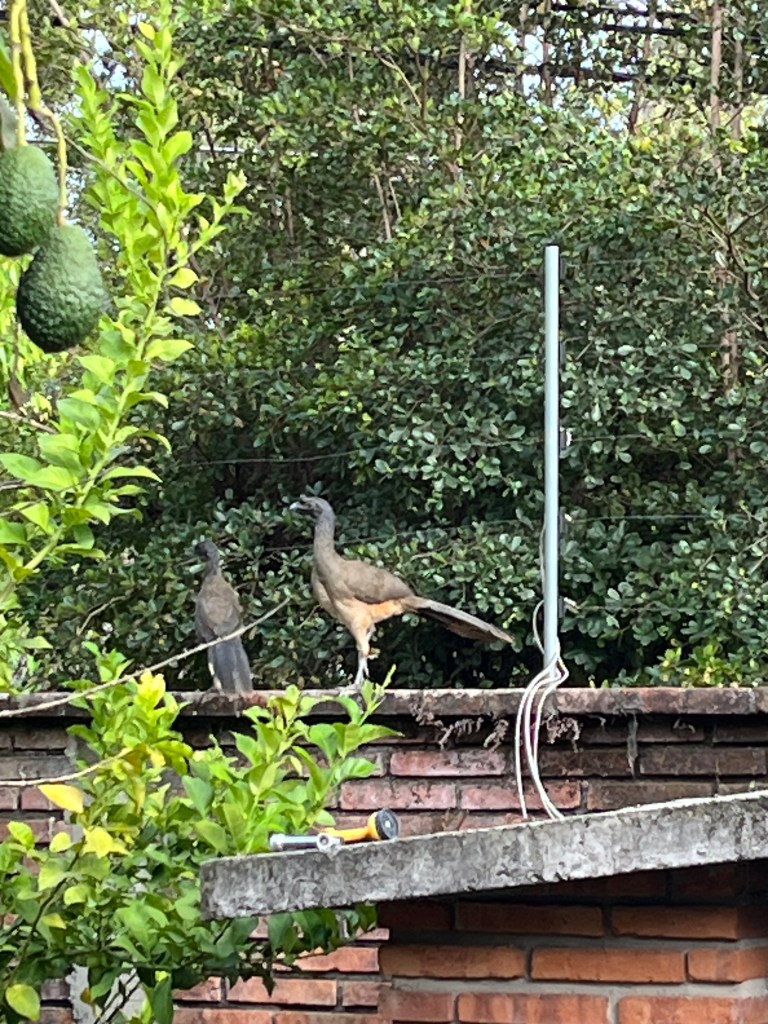
The parents are almost always nearby, either on the ground or on the wall. One time I heard them squawking and saw one of my cats running away as fast as she could, which gave me more confidence that the parents can definitely protect their young.
Adults standing guard
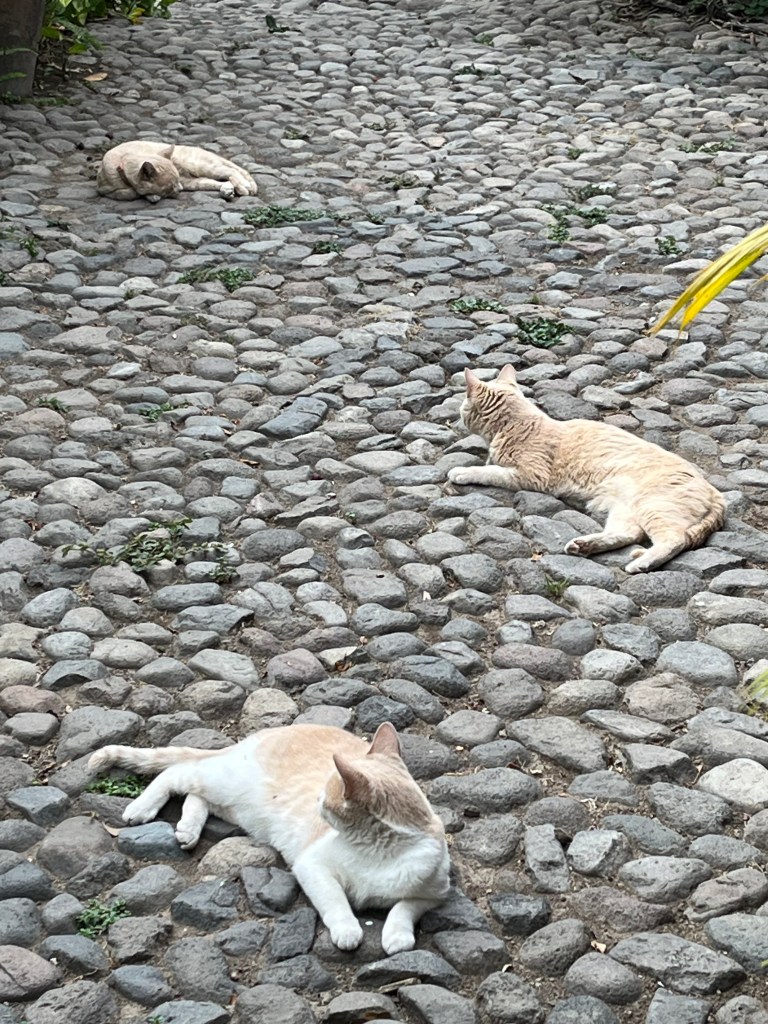
My kitties, Peach and Ginger, in the foreground and a neighbor’s cat, Raúl, who likes to hang out with mygirls. They’re smart enough not to bother the cane toads and not to tangle with Momma Bird.
I do not have my camera at the ready 24/7, so the photos I managed to take do not show what I actually witness as much as I would like – but they will have to do.
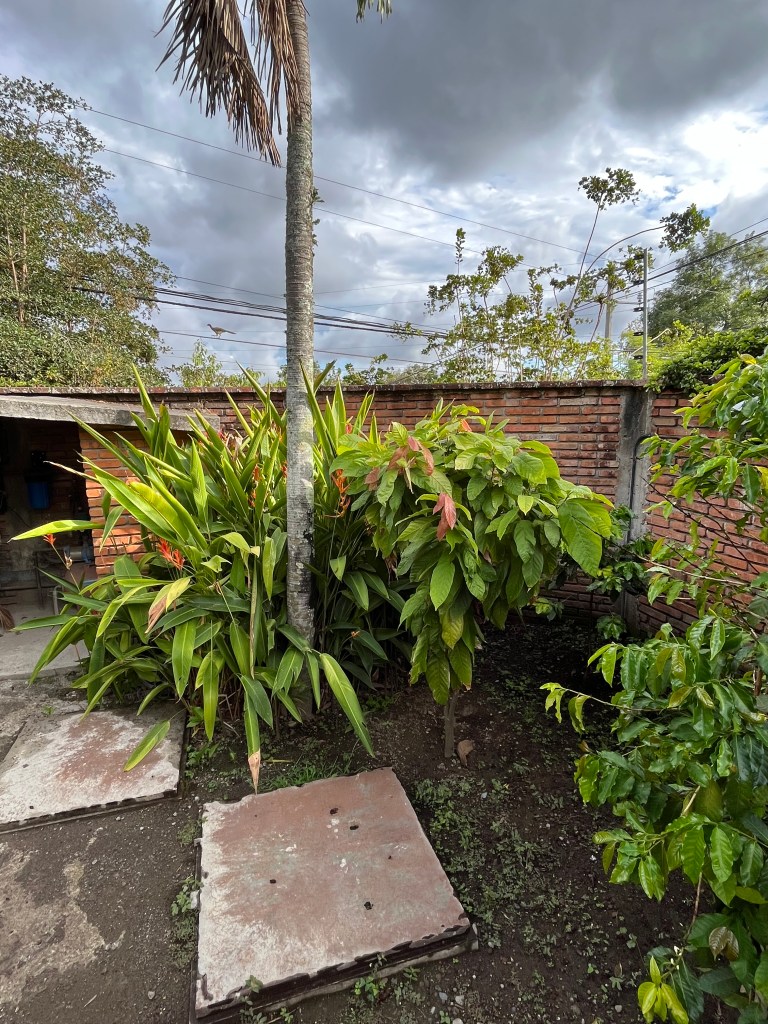
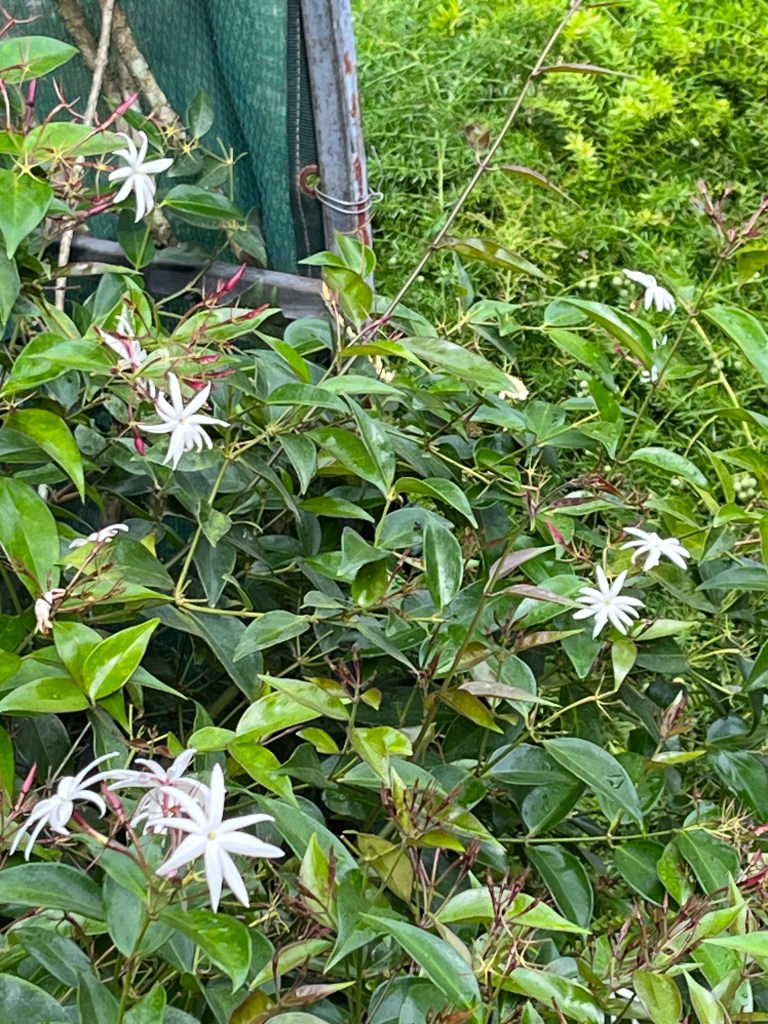
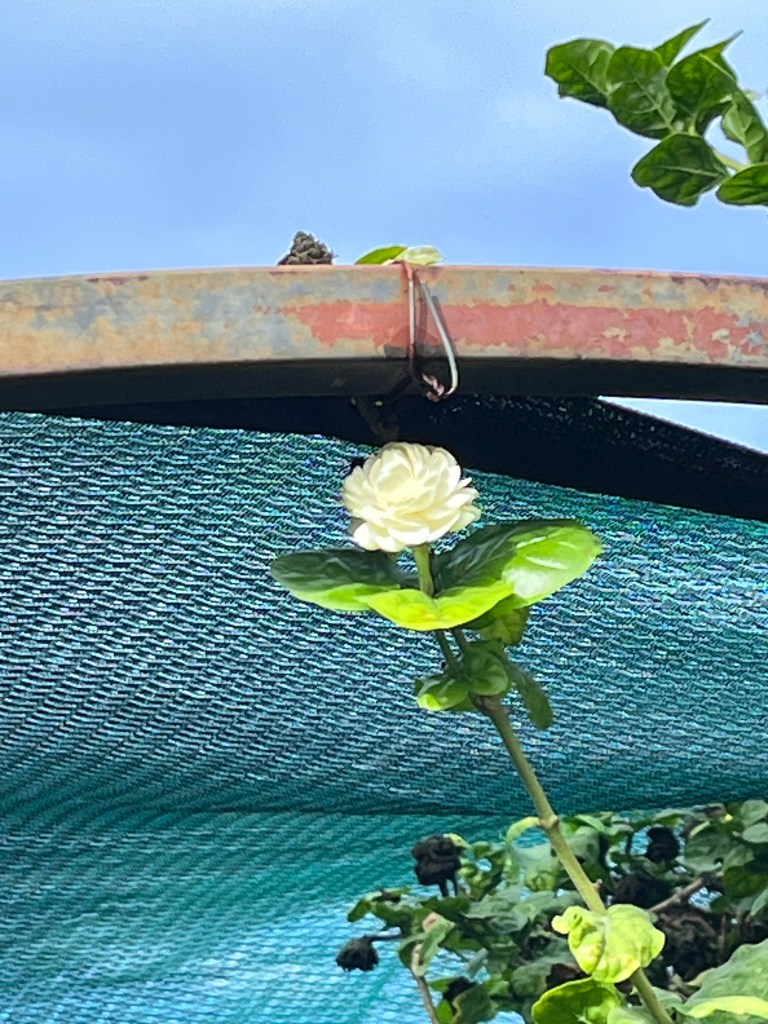
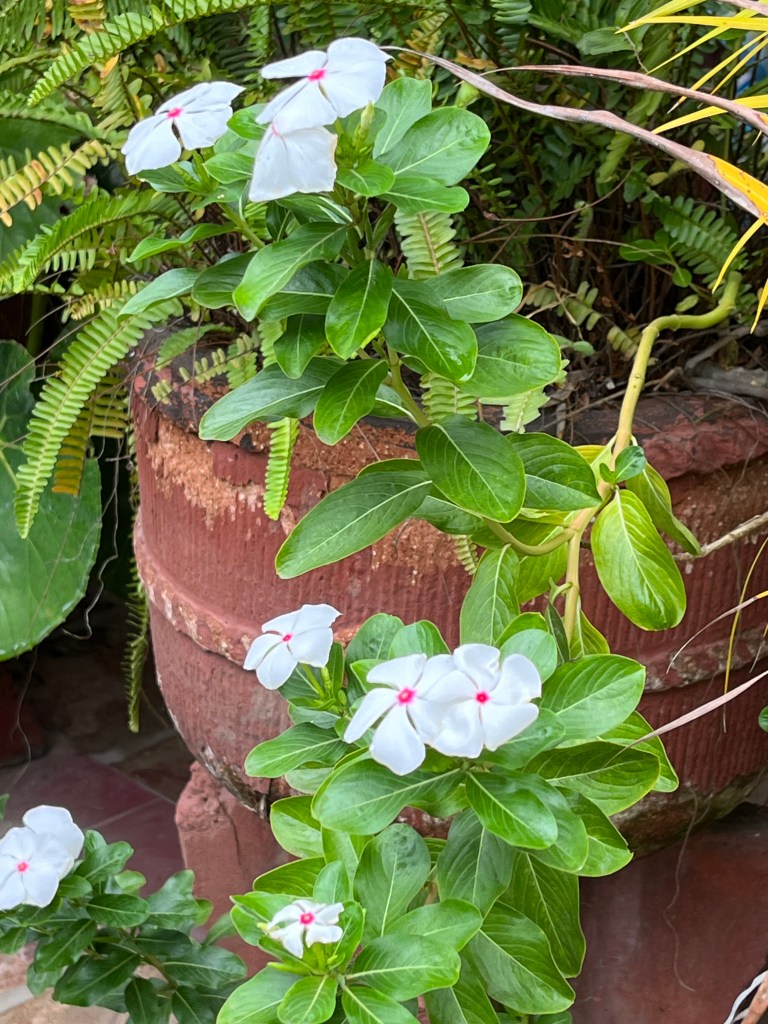
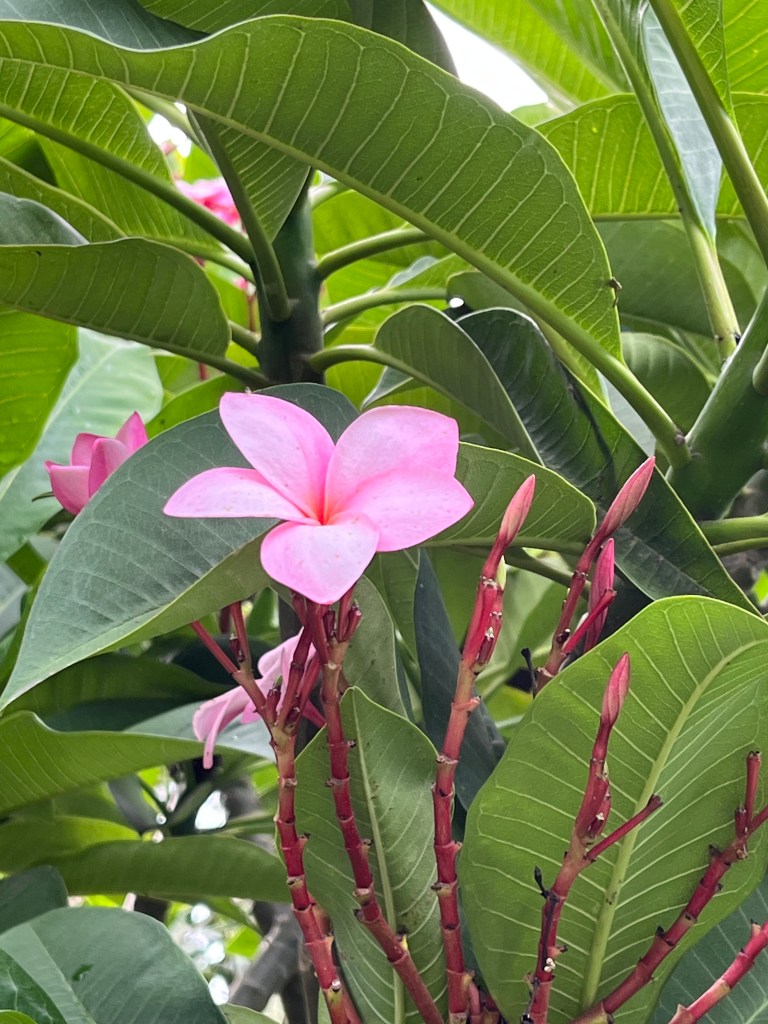
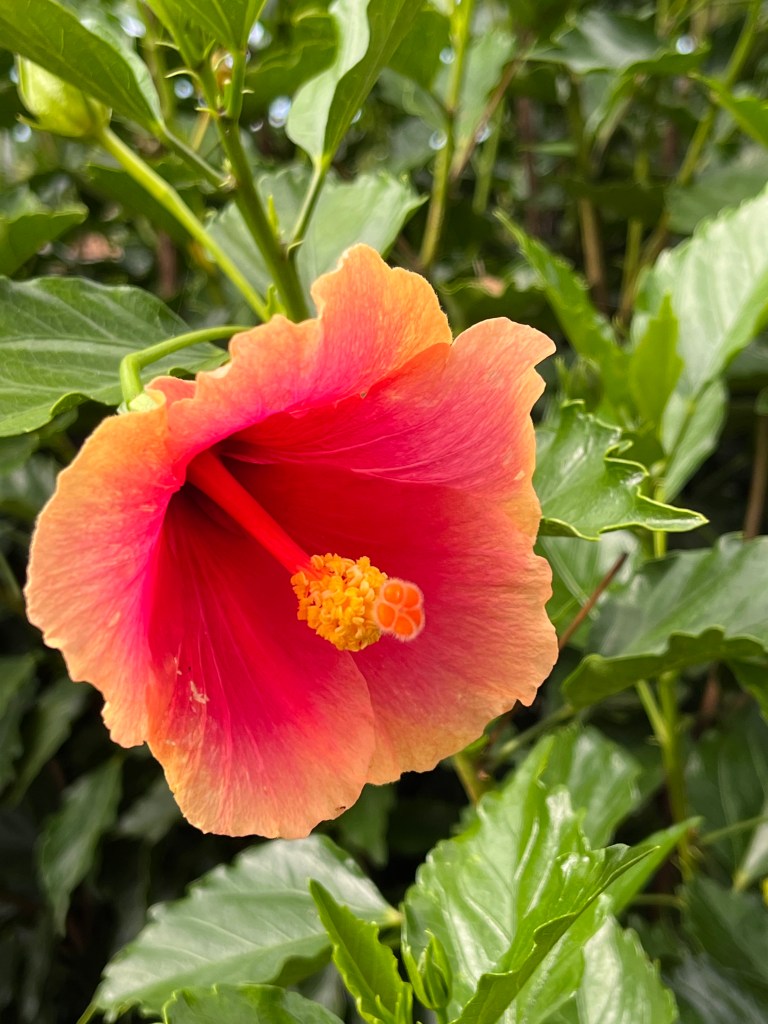
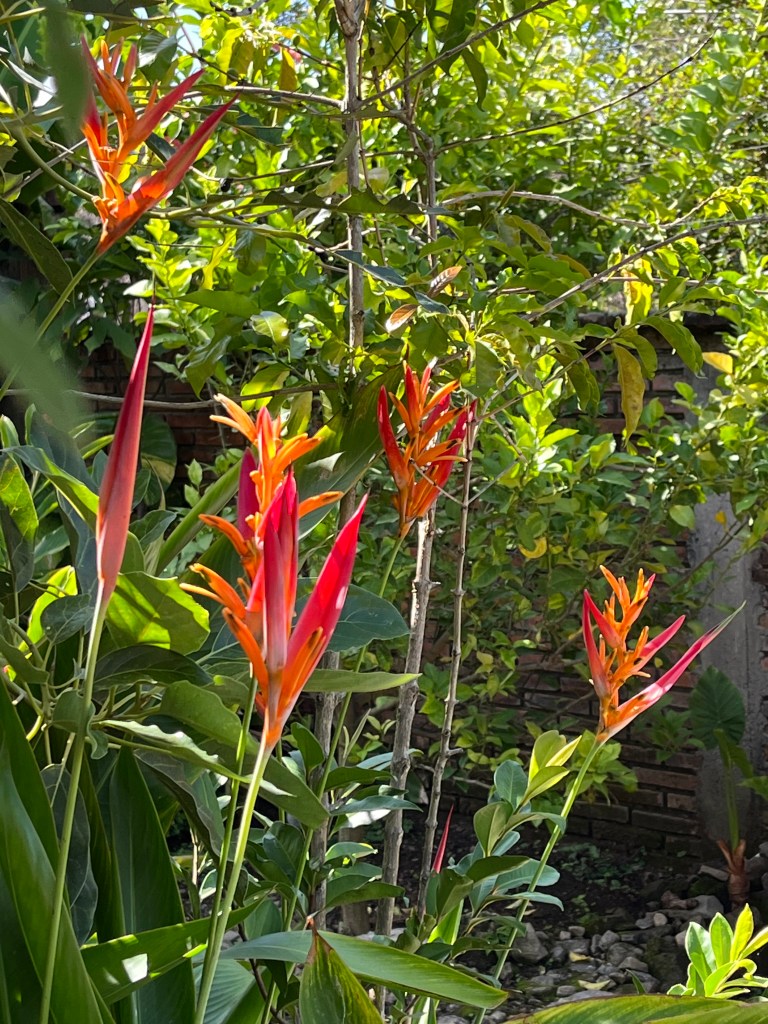
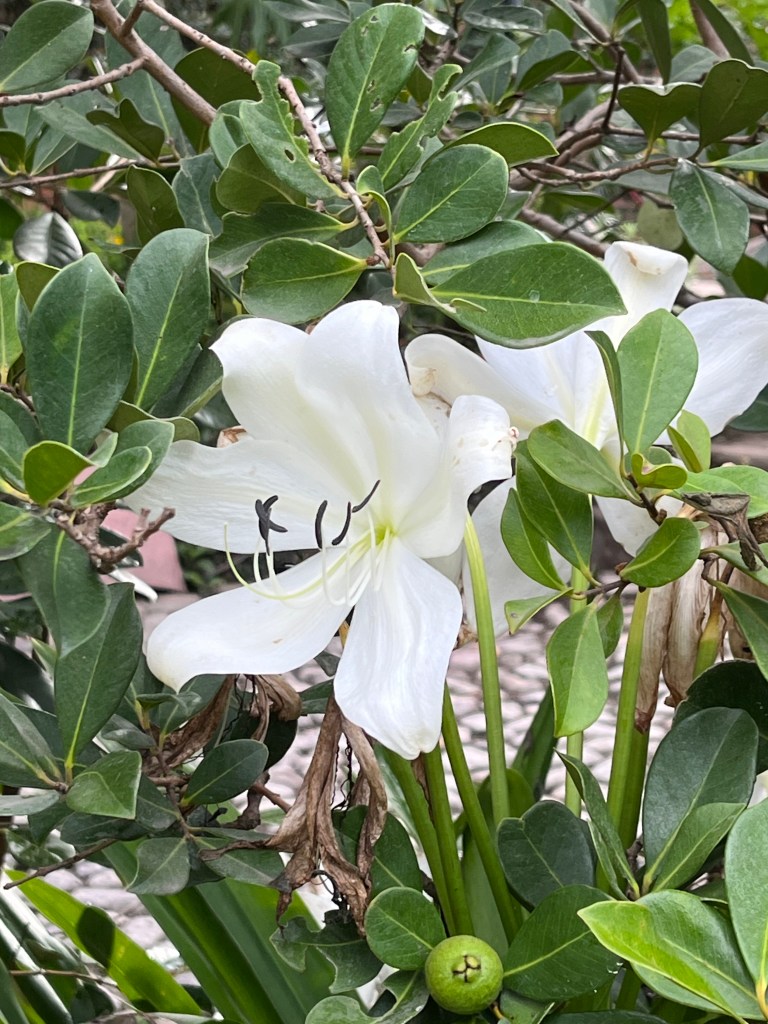
Meanwhile, I am also posting photos of some of the flowers on my property. Some were already here when I arrived almost 7 years ago, and many I planted over time. Central Western Mexico is quite different from New York when considering what to plant, so it took a great deal of experimenting with many plants dying before I came up with plants that would actually thrive.
I have many types of flowering plants that give off a nice perfume, which I really love. After living in a basement apartment and working nights for many years, I am now living in my own Garden of Paradise. So, until next time, stay safe, stay well, and discover all the little things that can bring you joy………..
I have been very interested in volcanoes, and when my friend Martha told me that she lives near the world’s smalled inactive volcano, and that we could climb inside, I said, “Yes, I want to do that !!!” So during my stay with her in May, we went there.
The name Cuexcomate comes from the Nahuatl word Cuexcomatl which means “crock pot” or “place to keep” (because those who discovered it would use it to store seeds.). It was part of a geyser that was formed in 1064 as the result of a massive eruption of the volcano Popocatépetl and it is located in the neighborhood of La Libertad in the city of Puebla. It is formed from hydrogen sulfide water and lava.
The dimensions are:
Diameter of the crater – 8 meters (26.25 feet)
Height above ground – 13 meters (42.65 feet)
Total height from crater to inside base – 23 meters (75.46 feet)
Diameter of the base – 23 meters (75.46 feet)
Approximate weight – 400 tons
There is a small natural waterfall and a stream inside.
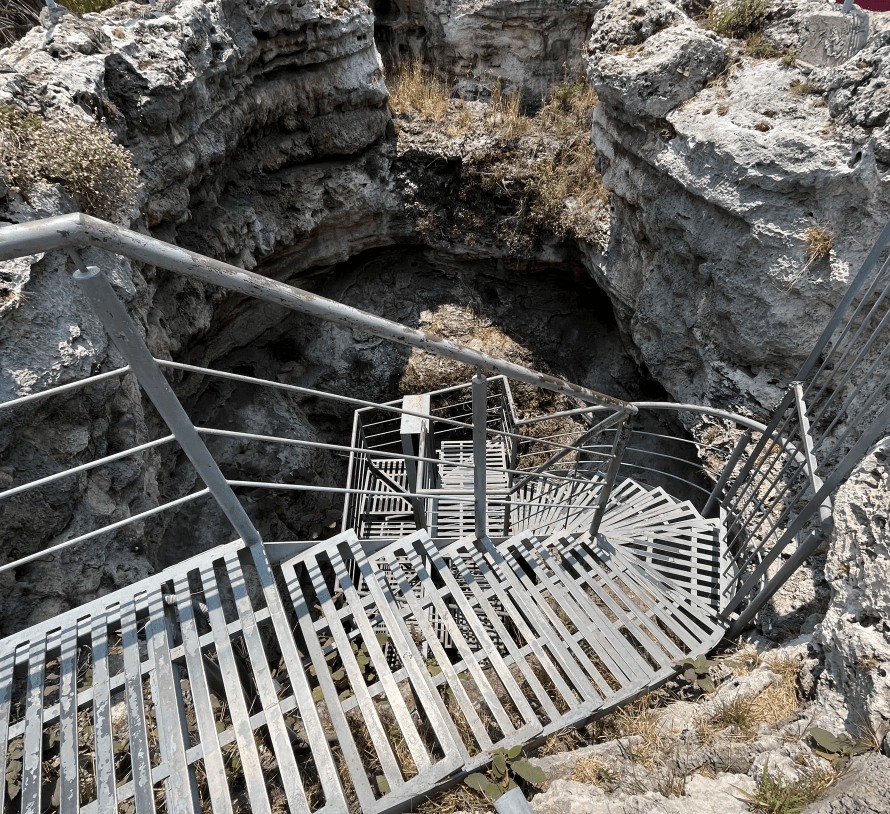
When we arrived, I wasn’t sure what to expect, and it certainly didn’t look like my idea of a volcano. It was more like a pile of cement from the outside. After paying our entrance fee, we climbed up a metal staircase to the top of the caldera. Looking down into the caldera was a staircase in a tight spiral. During the descent, I realized that it was much deeper than it appeared to be from the outside.
It was a very hot, dry and sunny day, but once inside it was cool with a little bit of humidity. Water was trickling down some rocks and there was a stream flowing under some rocks at the base. The base itself was paved over and chairs were situated where you could sit and relax while contemplating the fact that you were sitting inside a volcano that had formed almost a thousand years ago.
Descending the outside of the volcano with my friend Maby
Well, there’s really not much more that I can say, except – if you ever get the chance to visit Puebla, you might want to make some time to visit this unusual site. Until next time – ¡ nos vemos !
First and foremost, let me just state that there is no perfect place in the world – not to visit, not to make your home. You just have to decide what you are willing to deal with in order to have the life that you want. Tornadoes, floods, droughts, earthquakes, deserts, snow and ice. These are just some of the things to consider.
I loved living in New York. Grew up there, lived there all my life, but as retirement approached, I decided that I would buy a house somewhere else. For years, I had no idea where, but it had to be someplace where I would never see snow again, except, perhaps, on top of faraway mountains. And here I am in Colima, Mexico with my preferred “what I’m willing to deal with” things being earthquakes and volcanoes.
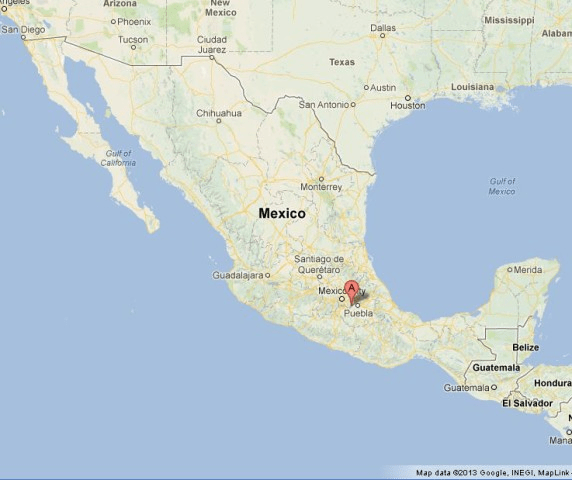
The first half of this month I was on a long-planned trip to Puebla, to see a friend, and to the U.S. to visit my family. The first stop was the state of Puebla, the city of Atlixco, in the foothills of the volcano Popocatépetl. Fittingly, its name in the Nahuatl language means “smoking mountain,” and smoke it did every day that I was there.
Map showing the locations of Mexico City, Puebla and Popocatépetl.
I had picked the first half of May to visit Puebla because Puebla is where the battles of May 3rd, 4th and 5th (Cinco de Mayo) took place, and therefore I could witness any celebrations. The first half of May was also a convenient time for my family.
Every day, my friend Martha and I hoped that the ash level would be low enough so that flights out would not be affected. I recall when I was still working, one of my co-workers visited family in Ireland. The volcano in Iceland erupted before his return flight and so he had an extended stay with his family.
My flight was scheduled to leave Mexico City Airport on May 6th. After a half-hour ride to the bus station and a two-hour bus ride to the airport, I was finally waiting to board when the announcement came – flight delayed – flight delayed – then flight cancelled. There were various reasons given for the delays and then the cancellations – first they said that weather in Houston was bad, but other people were going to other cities, so that didn’t make sense. Finally, they said it was because Popo was spewing ash into the air and the planes could not fly.
We were then directed to go to another part of the airport to have our flights re-booked. The next flight they gave me was for 4:40 am in two days – on May 8th. OK – so one problem solved and two more to go. I sought out people to try to find a place to stay for two days. My friend lived 2½ hours away, and already had other guests staying with her. I was finally told to find “Manuel the supervisor” and so I went back to the United Airlines area and found Manuel.
He explained that since it was not the airline’s fault, I would have to pay for a room. I explained that I didn’t care, but just needed a place to stay for two nights, and even joked around that I COULD hang out at the airport, but after two days with no shower, the passengers next to me on the flight probably would pass out from the smell from my unwashed self.
God Bless Manuel – he made some calls and got me a room at the Camino Real hotel, attached to the airport, for two nights at the employee discount.
Final problem – my hotel in Houston. In order to not stress about missing connections on an international flight, I like to stay in a hotel at the port of entry and continue my journey the following day. I had made a reservation at the hotel at the Houston Airport, and it was pre-paid, non-refundable. Two considerations regarding this reservation:
Because my son worked in hospitality years ago, I knew that the employees at hotels want to be informed if you will be arriving after midnight for your reservation. This will save them a major headache, as I believe they close their books at midnight and then start a new day with their bookkeeping. Another tip from my son – when at a restaurant, it is better to tip the waitstaff in cash.
Because it was a volcano and not a whim that I would not be arriving in Houston, I would throw myself on their mercy while explaining why I would not be there. The worst they could say is “No refund.” So, when I finally arrived in my beautiful hotel room in Mexico City, I immediately called the Houston hotel and explained the situation. I even tried to soften the blow by saying I would agree to a credit for a future stay if they couldn’t refund my money. The woman discussed it with her supervisor, and they agreed to give me a full refund. Yaaaaayyyyy!!!!!
Problems solved, I had a nice dinner and a good night’s sleep, and a full day to relax the next day.
THIS happened after I left Mexico. I have not heard of any injuries from the lava, but people need to wear masks when outdoors. While I was there, it was just ash falling from the sky, no flying, glowing hot rocks nor any lava.
Monday morning comes, and I board my plane for the flight to Houston knowing that I have to make a connecting flight a little less than two hours after landing. Now, when you enter the United States from a flight from a foreign country, you pass through immigration, then collect your checked bags, re-check your bags and go through security again to reach your connecting flight.
OK, no problem. Until after I had checked my large suitcase and went through security with my carry-on suitcase. I already knew my back brace would set off the alarm in the walk-through metal detector. Familiar with the drill, I let them know what I was wearing and that it would set off the alarm. When the alarm went off, they called over a female officer who patted me down, and I did lift my shirt a bit to show it to them (I wear double layers of clothing, one under the brace and one covering it).
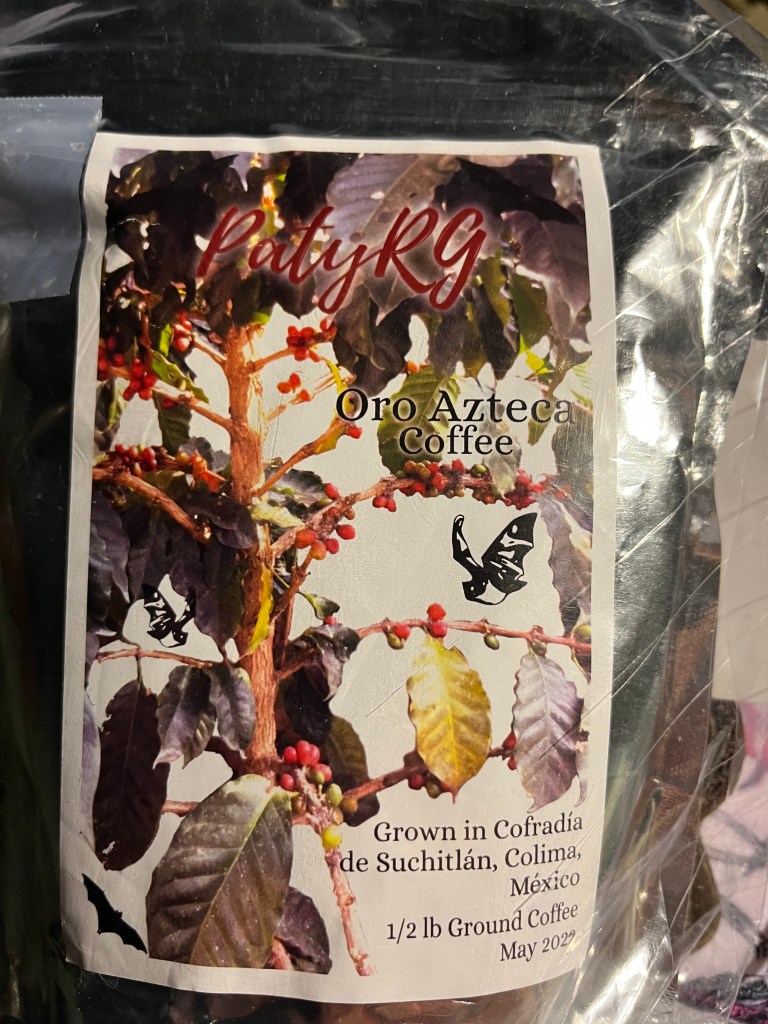
Then – they decided to check my carry-on bag, which had 14 bags of my home-grown coffee complete with my own label.
They swiped a bag with some kind of cloth, stuck the cloth in a machine and BINGO ! – it came back positive for explosive residue. Huh??? What??? Immediately I thought, that just can’t be. Second thought – Oh, NO – they are NOT confiscating my coffee that I spent months growing, de-pulping, drying in the sun and then having it roasted.
Visions of spices that were confiscated from my son’s luggage at an airport in Cameroon, and a tiny violin-shaped glass bottle of blackberry brandy ALMOST confiscated at an airport in Vienna (at which time I swore I would drink every drop of the contents before allowing them to take the bottle) swirled through my brain. PS – they took pity on me and let me keep the bottle AND the brandy.
Anyhow, back to Houston. They called over a female agent, and I explained that there shouldn’t even be a hint of fertilizer on the bags. She was very nice, explained what they would do, and then swiped every one of the 14 bags individually, then my suitcase, then me and everything came back negative. Yaaaaayyyyy!!!!! Oh, and they did open ONE bag just to make sure it actually contained coffee.
Fortunately, it did not take much time, I did not miss my connection, and landed on time at the BWI airport where my sister collected me and my luggage.
I was so fortunate in many ways that, for me, while a bit stressed from straightening things out, I could still consider it an interesting adventure. I didn’t have a boss waiting for me to return to my job, I didn’t have young children with me who might not understand what was going on, and I speak English and Spanish, so I wasn’t stranded in a place where I didn’t know the language. I was able to turn lemons into lemonade and have a pleasant and interesting experience that I certainly wasn’t expecting.
All I can say right now is – Wow. Just the traveling part of my 16 days away from home took up a whole blog post. Soon I will write about my stay in Atlixco, Puebla, including Cinco de Mayo celebrations, climbing into the world’s smallest extinct volcano and a visit to a Talavera factory.
So take care, stay safe and I hope that in your life, you will also be able to turn lemons into a delightful lemonade. ¡ Nos vemos !
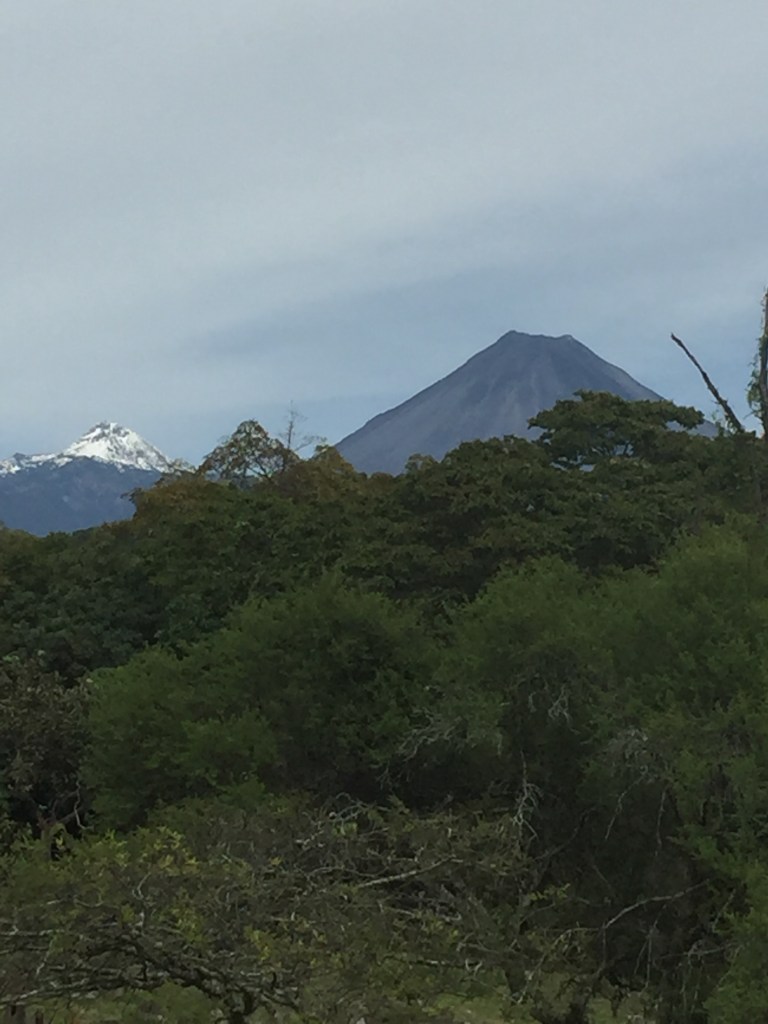
One of the first things, if not THE first thing, that one thinks of when they live in Colima or has heard of Colima is our volcano. Actually, there are three current volcanos in the CVC – Colima Volcanic Complex. The most obvious is the Volcán de Fuego, or Fire Volcano which sits on the border of Colima and Jalisco states. Further north is the Volcán Nevado, the inactive snow volcano. A third volcano, north of Nevado is El Cántaro, the existence of which I was unaware until I was researching the internet for this post. El Cántaro is the oldest, is inactive and eroded.
More than 38,500 years ago, the Paleofuego volcano began to form out of lava flows. This volcano collapsed at least 5 times, producing debris avalanches and pyroclastic-flow deposits. The last collapse happened 2505 years ago, producing a 5-km-wide caldera, inside of which grew the Colima Volcán de Fuego.
Throughout Colima you can see photographs and paintings of our Colima Volcano, businesses named after the volcano and tourism around Fuego and Nevada.
Here are a few views of Nevado and Fuego taken during various times of day and temperatures. Nevado is on the left and appears smaller than Fuego because it is farther away, but it is actually taller. We do not have snowfall here in Colima, but because of its height, Nevado does have snow when the temperature drops here. The coldest I have experienced here is around 50ºF (10ºC).
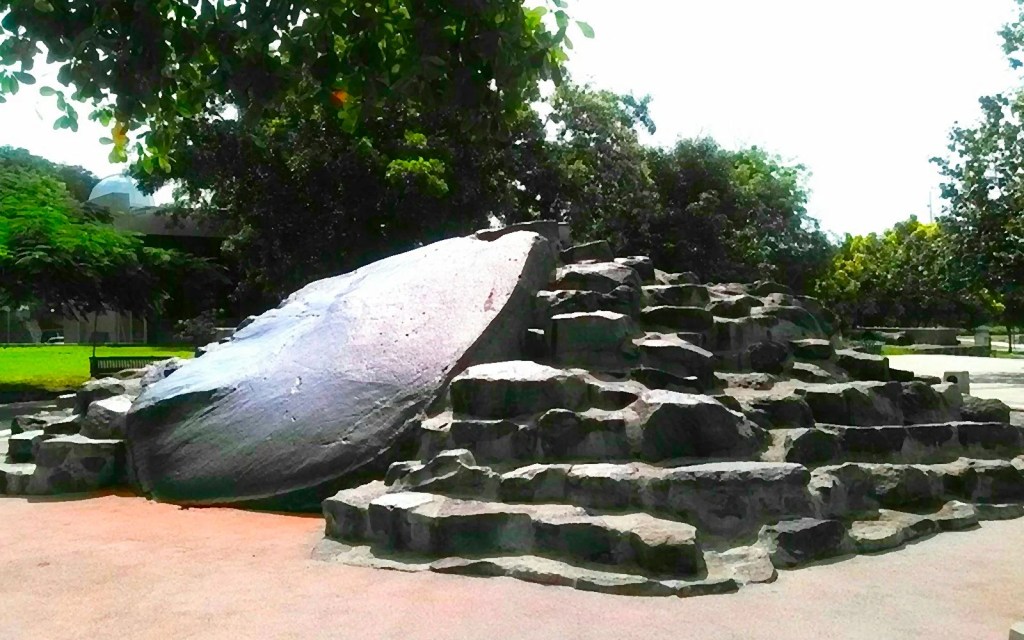
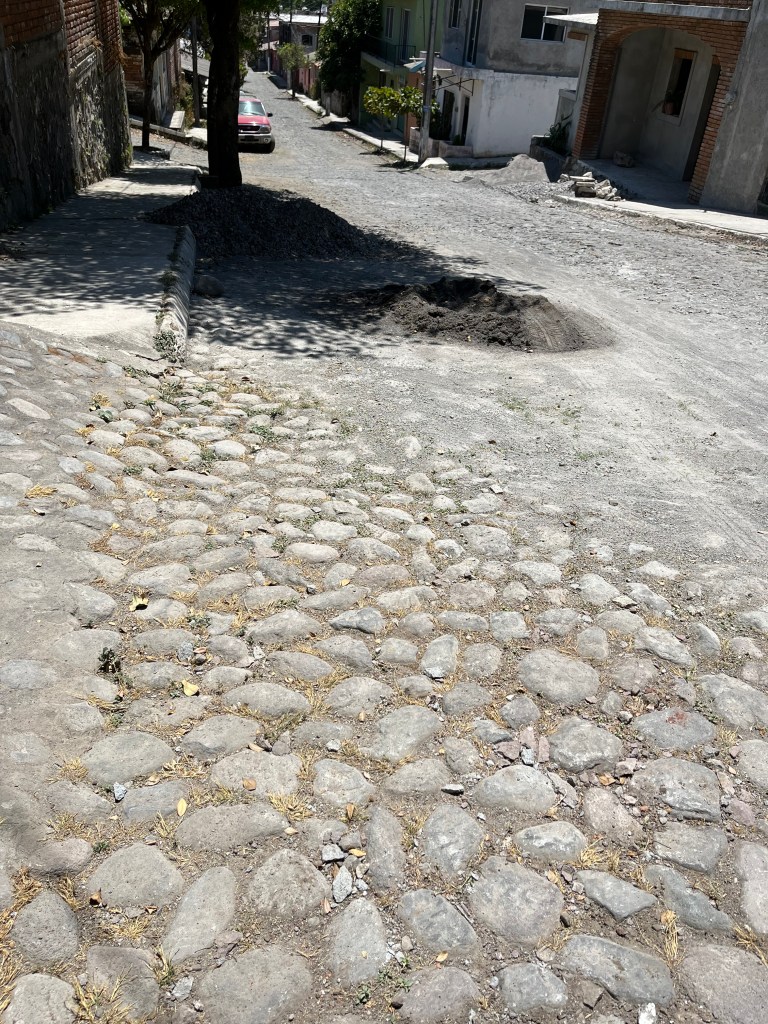
You can’t help but notice all the rocks within Colima State – cobblestone roads, rock walls, and a famous tourist attraction the Piedra Lisa, which translates to smooth rock. It is in a park in Colima, and legend is that if you slide down the Piedra, you will never leave Colima, or maybe you will return.
Photo of the Piedra Lisa
My driveway on the left and my street on the right. Some of the stones are obscured by gravel in the street being used for construction.
In the past, I’ve only thought about all these rocks in passing, but since I have started construction of a small guest house on my property, I have come face to face with the extent and enormity of these rocks and began to wonder about their origins. On Long Island, New York, where I grew up, we learned that Long Island was formed by glaciers pushing the rocks as they advanced. When the glaciers retreated, Long Island was left behind. I always hated how rocky the beaches were there, compared to the nice sandy beaches we would read about in the Caribbean, for instance.
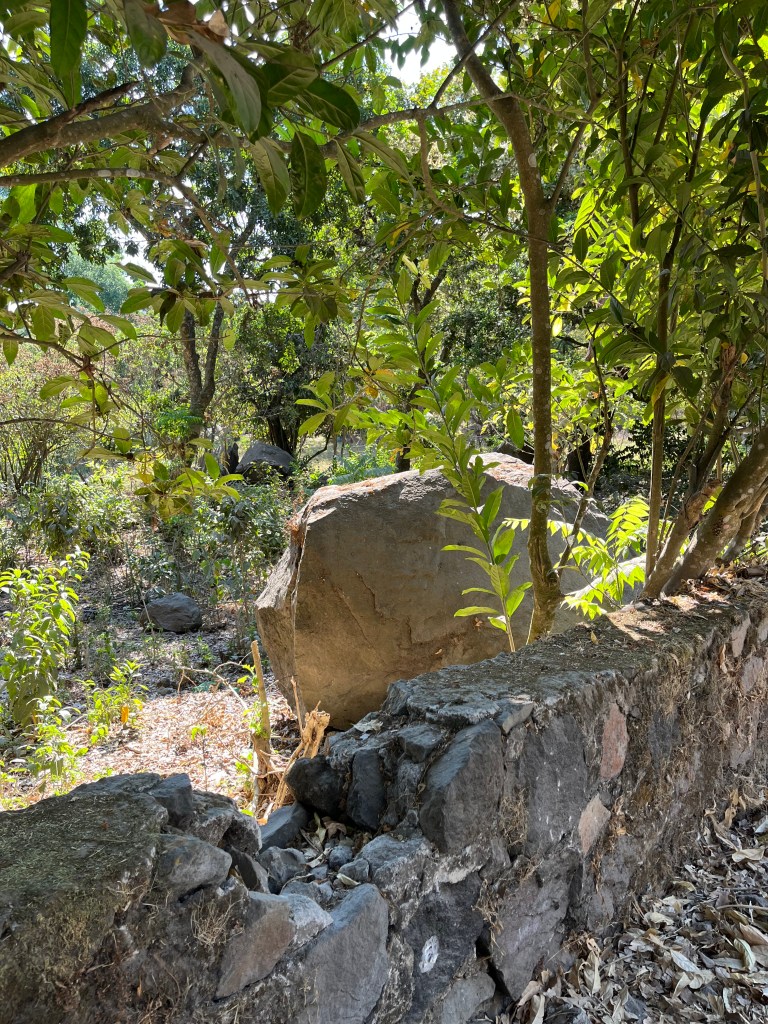
One of the large rocks (boulders?) and a rock wall which illustrate the terrain of many parts of Colima.
The first obstacle to the construction was a large, dense rock sticking up out of the ground which would block one side of the building if it was not moved. I had hoped that it was shallow underground and would be easy to move, but it turned out that, like an iceberg, 90% of its mass WAS underground. It was nearly impossible to move, a jackhammer did almost nothing to break it up, and it was decided that if the workers were unable to move it, we would need to blast it apart.
Actually, I was curious to see the blasting activity, having heard from my civil engineer father stories about having to blast things apart by drilling small holes, inserting the blasting material and then setting it off.
Anyway, they were able to construct and use a lever to move it out of the way, though they may have to move it a little further as the construction progresses.
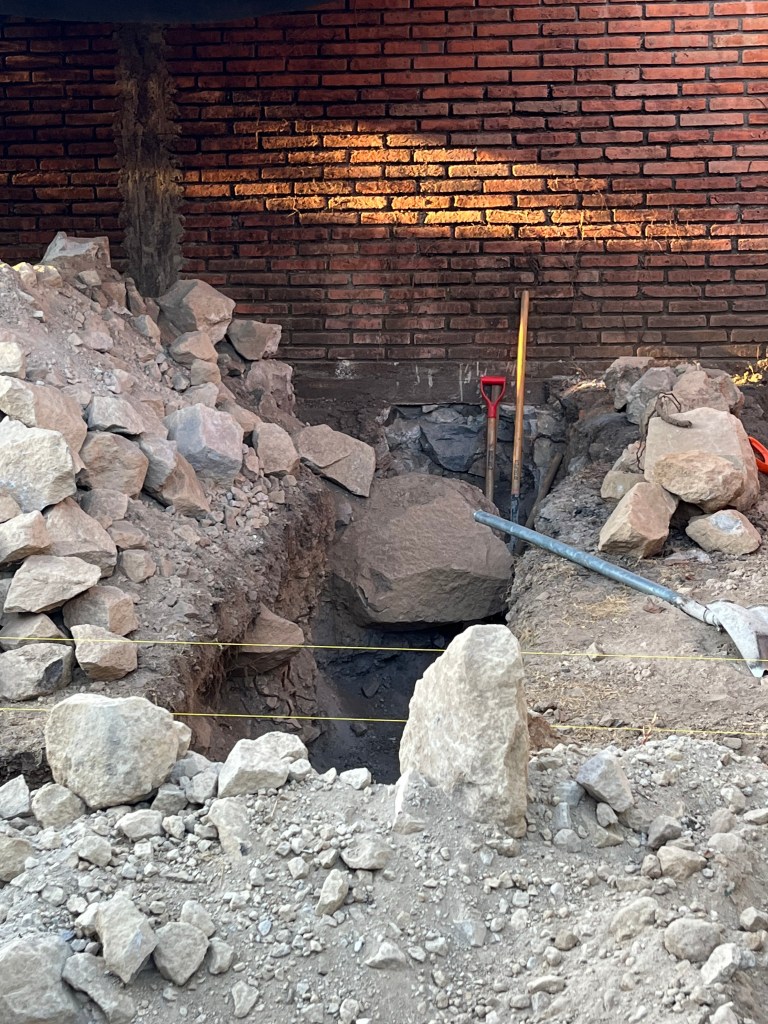
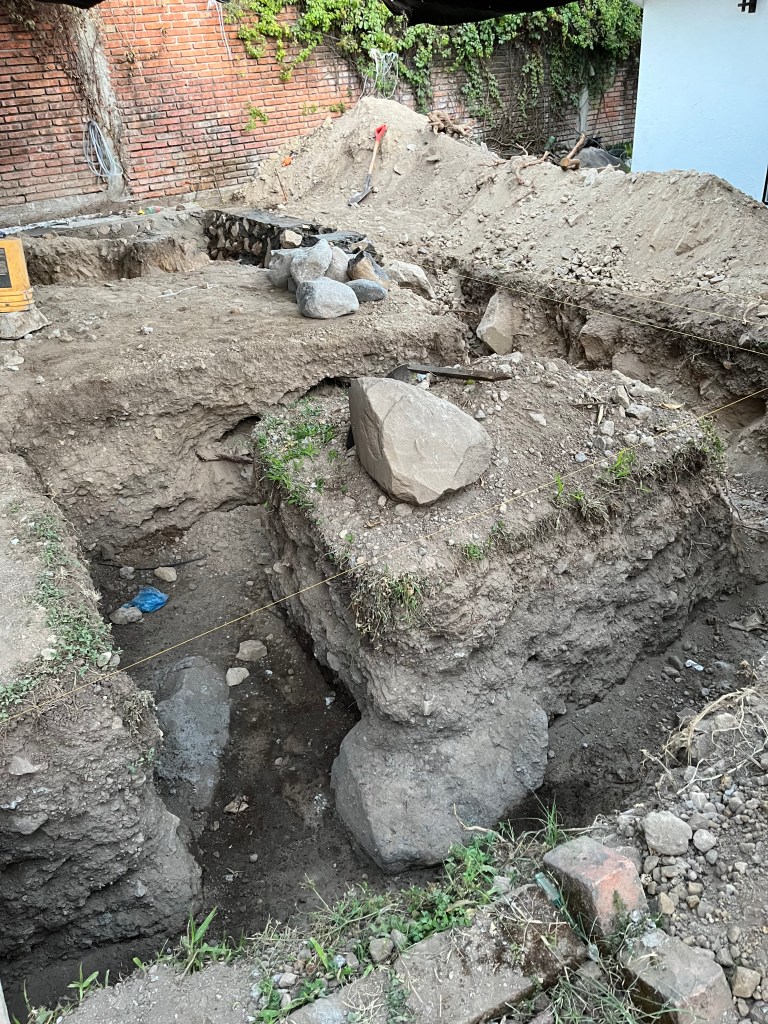
As the foundation was being dug, there were even more rocks, but fortunately, we could use them as part of the foundation, leaving them in place and pouring cement around them.
Meanwhile, my search for the source of Colima’s geology continued. Now, I am not a geologist, so if anyone is more knowledgeable about this, please leave a comment.
It seems as if these conditions ARE a result of our Volcanic Complex. From debris flows to debris avalanches, to pyroclastic-flow deposits, as well as lahars, we are blessed with more rocks and boulders than we know what to do with. To clarify, a lahar is a destructive mudflow on the slopes of a volcano, which continues to happen to this day.
So right now that is about all I have to say about the geology of Colima. For me, when I see something curious, I love to research it to find out more and then share what I have discovered. It was also why I loved helping my son with his homework, even up through high school when he took courses such as geology. No one knows everything and there is always something new to learn, so we family members can learn alongside our younger members. Lifelong learning is a joy for me.
And so, I will conclude this post with a famous photograph of our Volcán de Fuego erupting with lightning bolts inside the ash cloud. We can all decide what climate conditions with which we prefer to live and no matter where you go, there are benefits and downsides – tornadoes, droughts, floods, heat, snow, etc. For me, I decided that I would rather deal with volcanoes and earthquakes than snow, ice and cold, and in the seven years I have been living here, I have never regretted it for a minute.
April 1st has just passed – April Fool’s Day in the United States – and this reminded me that Mexico also has a day in which pranks are played, but that day occurs on December 28th and is called Día de los Inocentes (Day of the Innocents). While the custom on both days is to play pranks, the origins of the two holidays are dramatically different.
The origin of the Mexican day is more straightforward, so I will begin with that.
Mexico is a very Catholic country, and according to the Catholic religion, when the baby Jesus was born the Sacred Family was visited by the Three Magi. On the way to visit the family, the Magi informed King Herod of the birth of Jesus. King Herod asked the Magi to return to him after the visit and inform him of where he could find the child, so that he might also worship him. However, King Herod’s true intentions were to find and kill the child because he thought Jesus would depose him from his throne and become a king himself.
After the Magi visited the family, they were warned in a dream not to return to King Herod and so they returned to their homeland by a different route. When he realized that he had been tricked, King Herod ordered that every male child under the age of two years to be murdered, thinking that one of the murdered children would be Jesus, thus securing the safety of his position as king.
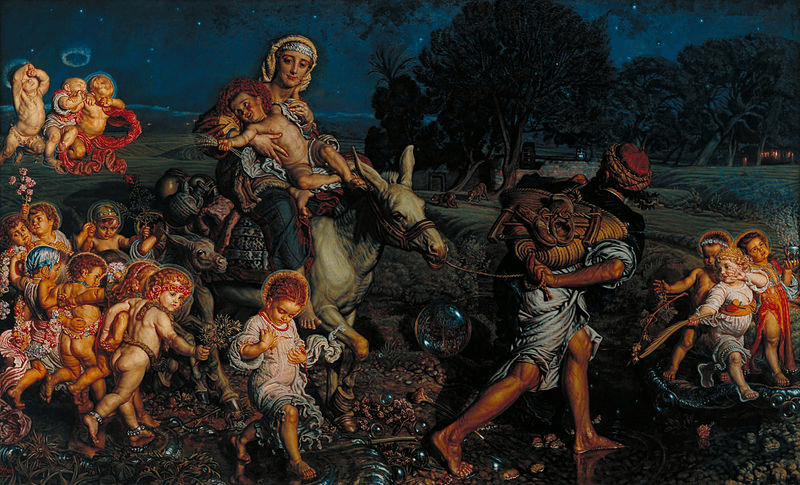
While there have been many paintings depicting the slaughter of the Holy Innocents (the innocent children murdered by King Herod) the current practice here in Mexico is to play pranks on people – a reminder of the deception of the Magi with regard to King Herod and how they fooled him by returning home without giving him the information he requested.
One of the few non-gory paintings of the Día de los Inocentes
Unlike the Día de los Inocentes, the origin of April Fool’s Day is still a mystery, although there are many differing theories. One theory posits that the origin was in 1582 in France, when that country switched from the Julian calendar to the Gregorian calendar. The Julian calendar, implemented by Julius Caesar in 46 BCE, miscalculated the length of the solar year by 11 minutes. While eleven minutes doesn’t seem like such a big deal, over the years it results in the seasons becoming disconnected from their traditional months at the rate of 1 day every 128 years.
In France, the New Year began with the spring equinox, around April 1st. With the implementation of the new Gregorian calendar, the New Year began on January 1st, thus people who inadvertently celebrated the new year during the last week of March through April 1st became “April fools” and the recipients of jokes.
Other theories are that the tradition began with the festival of Hilaria (Festival of Joy) in Ancient Rome or began with the celebration of the first day of spring in the Northern Hemisphere, when Mother Nature fools people with changing, unpredictable weather.
While the actual origin has been lost in the mists of time, the tradition of jokes and pranks continues to this day in many countries.
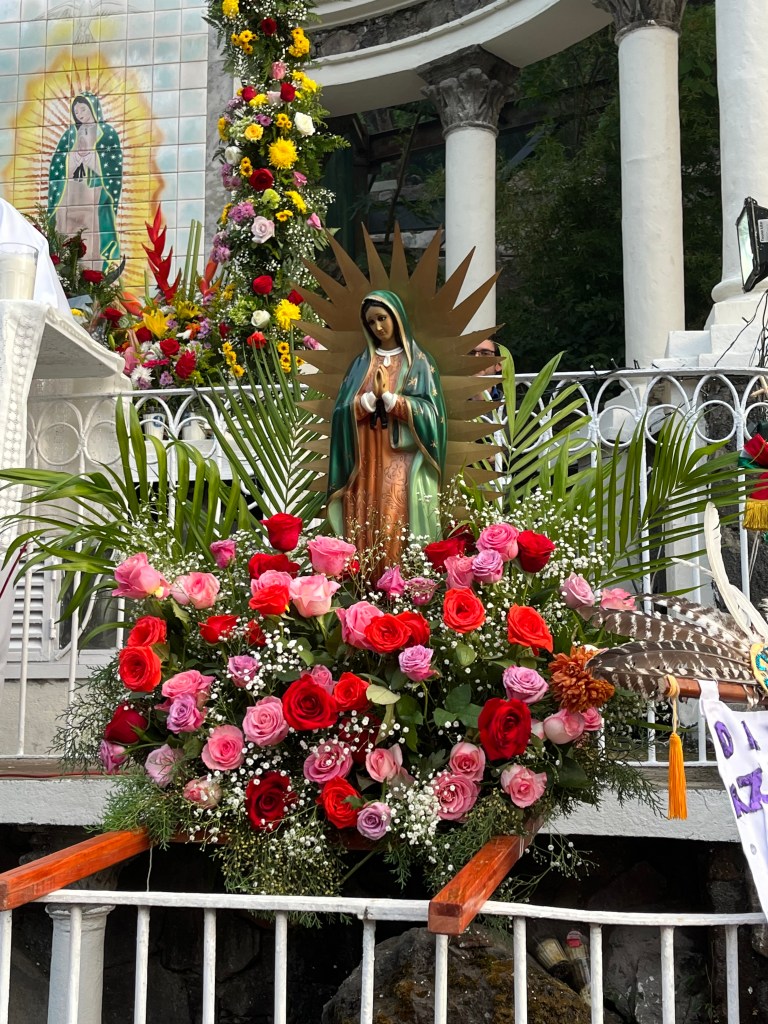
Covid is still making its presence known, and some offices still require masks and distancing, but after 2 vaccine doses and 2 booster shots have been available, life is somewhat back to normal. December 12th is the Celebration of the Virgin of Guadalupe, and we here in Cofradía were able to go out and have our traditional festival.
It was held for our village and several other villages in the surrounding area in a large open area owned by a local restaurant. In this area is what is called a plazuela – on one side are cement stadium-style seats across from a platform. While the festivities did not last as long as in previous years, it was still a great day.
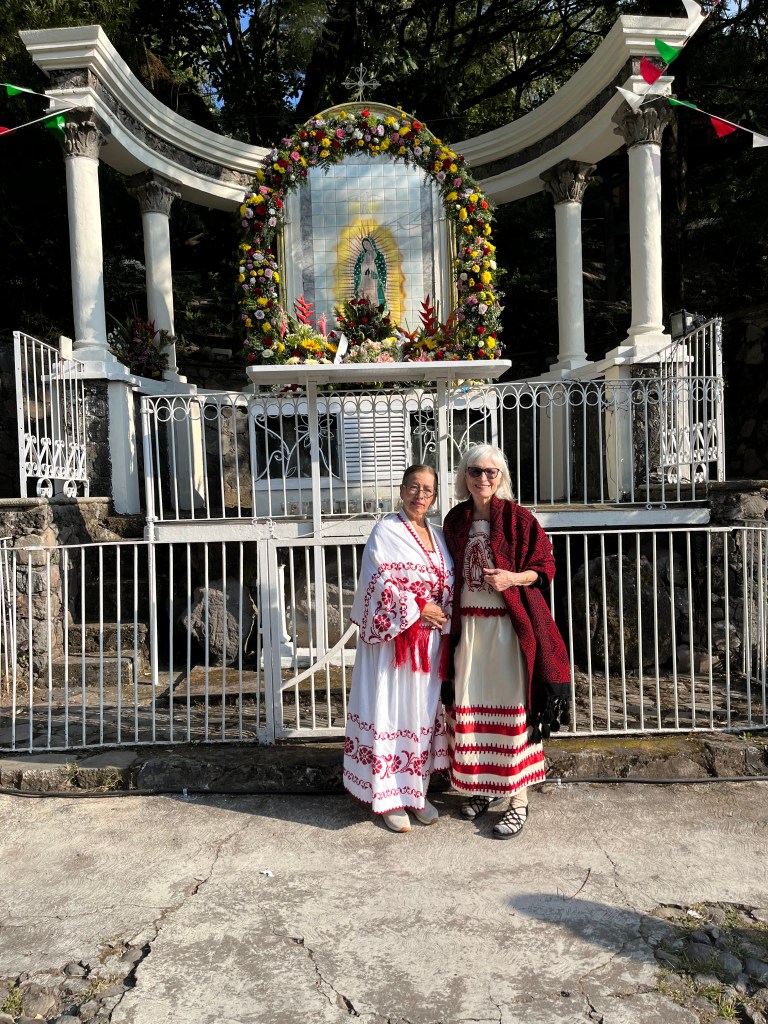
Women and children dressed in traditional red-and-white clothing and pilgrims and traditional dancers marched into the venue from the road. Police cars protected the pilgrims and dancers from oncoming traffic. After entering, a painting of the Virgin of Guadalupe along with roses was placed at the bottom of the platform.
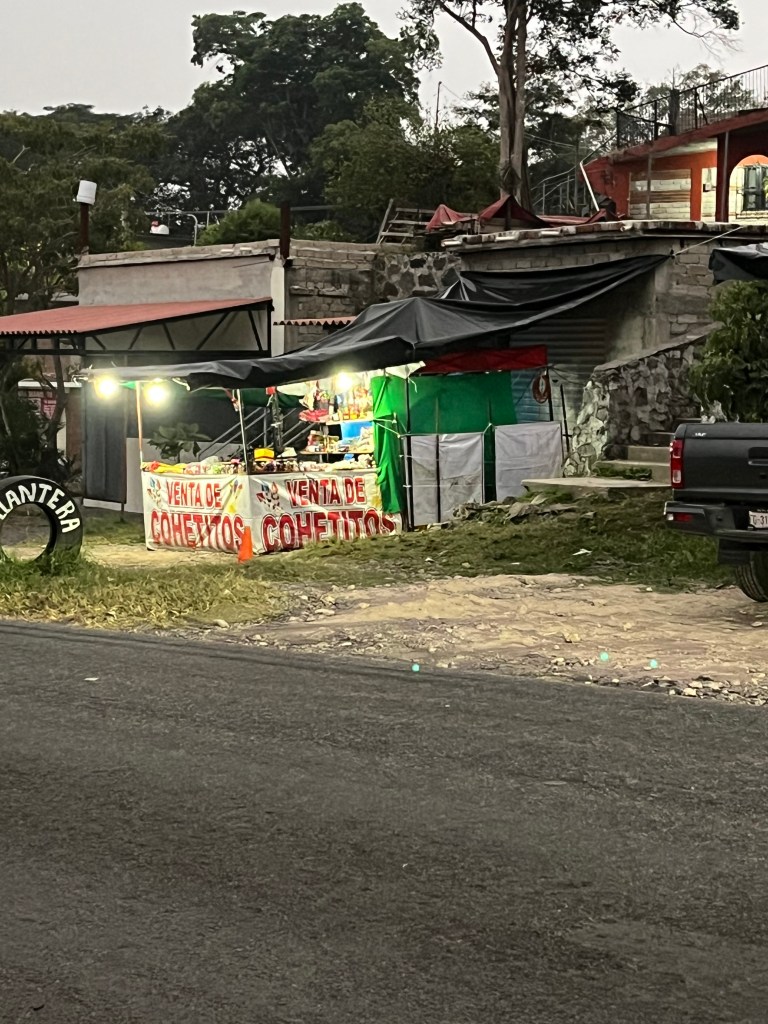
Of course, no celebration is complete here without firecrackers (cohetitos). Like clockwork, in anticipation of every event that needs a “bang” the vendor sets up shop on the highway at the entrance to Cofradía.
Singing “La Guadalupana”
Playing “La Mañanita” which is the Mexican birthday song as they enter.
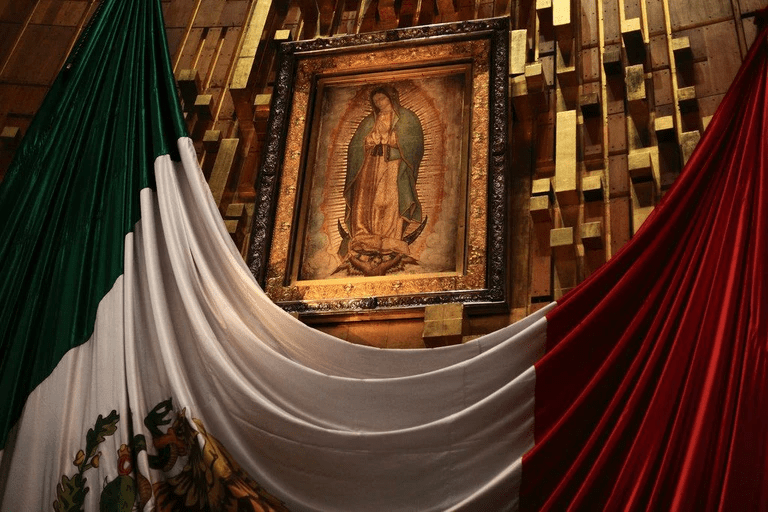
According to tradition, Mary, described in the history as a young woman with black hair and dark skin, appeared to Juan Diego, an Aztec convert to Christianity on December 9th and December 12th, 1531. She requested that a shrine be built at Tepeyac Hill, where she appeared to him. He told the bishop after he had his first vision. The bishop didn’t believe him and asked for proof. Mary told Juan Diego to collect flowers at the top of the hill and bring them to the bishop wrapped in his cloak. Since it was December, it was a miracle that flowers were there. He wrapped them in his cloak and when he opened the cloak in front of the bishop, there was imprinted on the material the image of the virgin. Upon seeing this, the bishop ordered the building of the Basilica in what is now Mexico City. There is a frame that is said to contain the cloak of Juan Diego in the new Basilica in Mexico City.
Image on the cloak of Juan Diego in the Basilica of the Virgin of Guadalupe in Mexico City
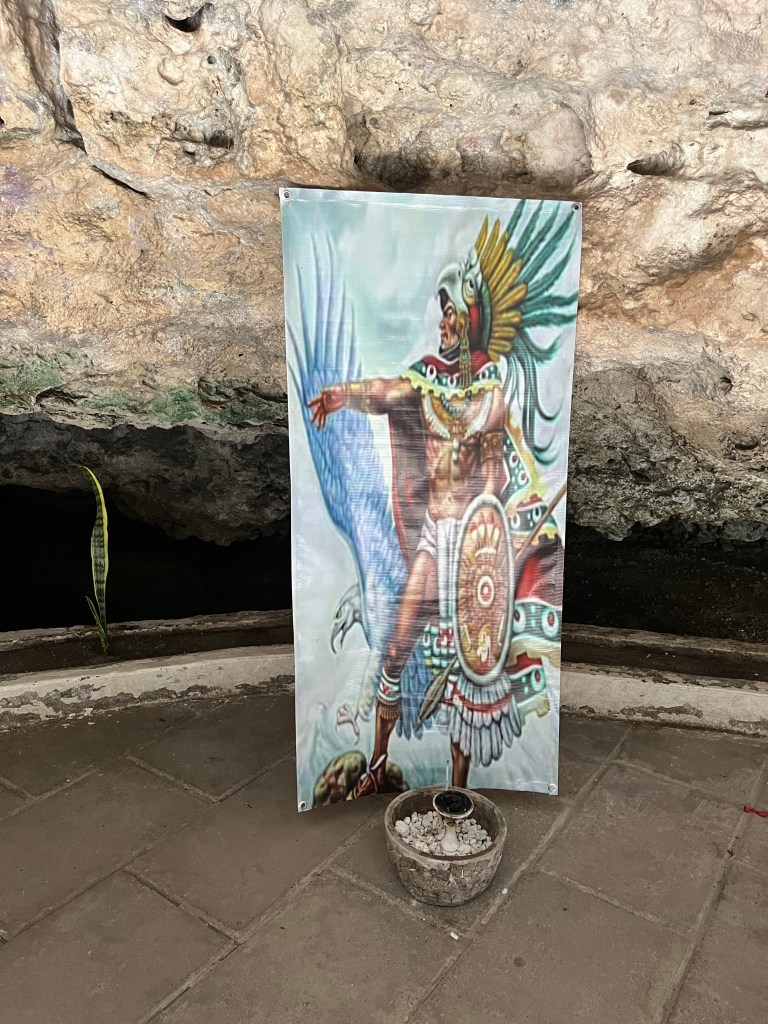
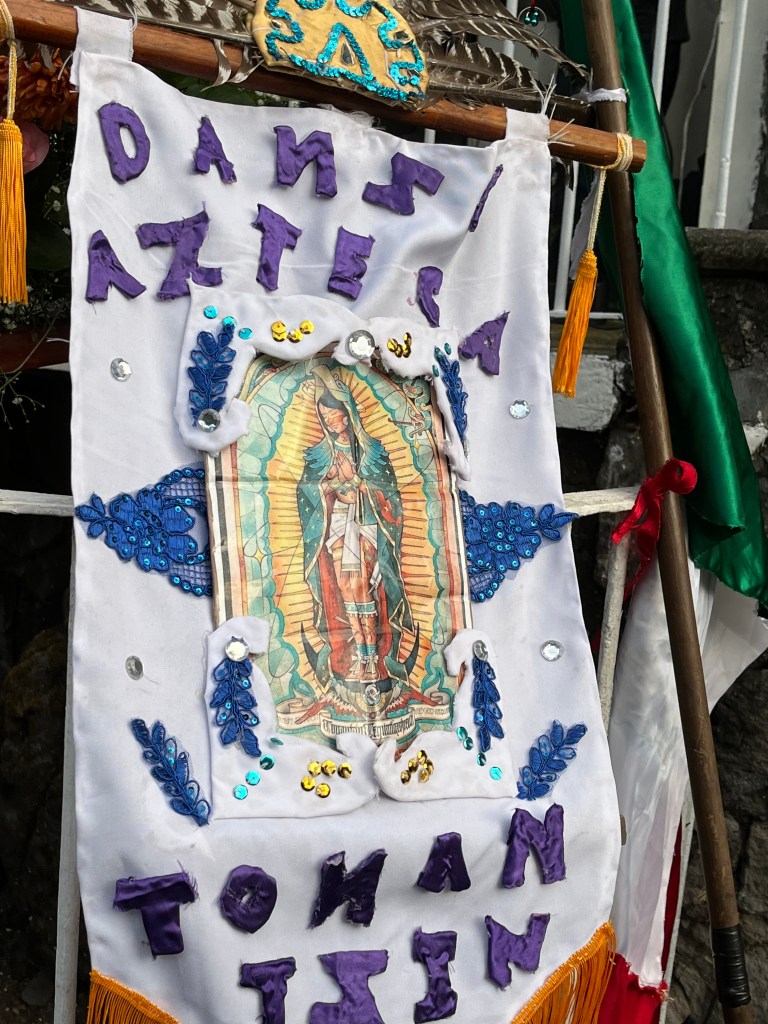
The traditional dancers in our area are called the Danza Azteca, and their headdresses reflect a combination of traditional clothing and Christianity – it is a headdress of feathers with a picture of the Virgin of Guadalupe in the center.
Banner of the Aztec Dancers
And so I’ve come to the end of this post, with more to follow. I wish you all the blessings of the season for whichever holidays you celebrate. Until next time – ¡ Nos vemos !
There’s nothing like practicing conversations with a native speaker when you are learning a foreign language. For many years, I took Spanish classes and came to the realization that, while I could read and write just fine, I still had trouble speaking the language. I had been practicing my Spanish with a neighbor who was originally from Mexico City, but that still wasn’t enough.
I realized that I had to be surrounded by people who didn’t speak any English for me to be forced to learn to converse in that language. I explained this to my friend, who suggested that I spend time with her family, as none of them spoke English – so I did just that. I spent two weeks with her family in Mexico City. My mini dictionary was glued to my hands, and I managed to get by.
Since I moved here in January 2016, my Spanish has greatly improved and aids to speaking have also improved. Google translate is so much better now than it was then. I can look up words and phrases that I do not know, which eliminates having to carry around a bulky paper dictionary. And – I am still taking Spanish lessons, but my needs have changed. Rather than rote classroom learning, I have online conversations with a friend in Puebla, and she can then see from our conversations where my needs are. Sometimes I need to learn more vocabulary and sometimes I need to work on sentence structure. Other times I need to learn colloquial expressions. There are so many areas where there might be a need to improve, and these are detected through normal conversations.
Meanwhile, just by looking at me you can see that I am a gringa, and there are many people who want to practice their English with me. In addition, the students in my village are also studying English in school. So now, three days per week, I am helping 3 primary school students and two adults learn and practice English.
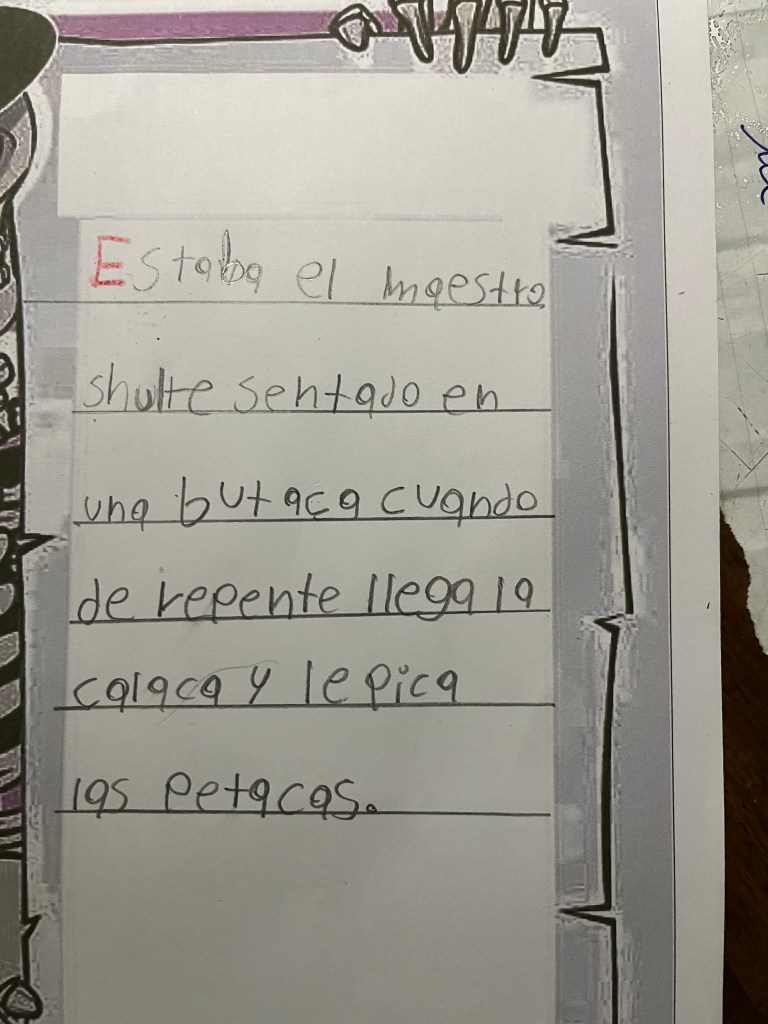
But before this happened – I was using my printer to print out their homework during the pandemic. During the pandemic, teachers would send lessons and homework to the families electronically, and one of the families didn’t have a printer. Sometimes, upon realizing there were words and phrases in these papers that I wasn’t familiar with, I would make extra copies for myself. Here is one example:
The Teacher Shulte was sitting in a seat when suddenly a skull arrived and poked him in his butt.
So now I am learning about several things from this boy’s homework:
1 – A literary style called Calaverita literaria corta (literally “short literary skull”), similar to limericks.
2 – Learning new words specific to this geographical area – “petacas” for buttocks, which would also be called pompis or nalgas, butaca for seat and calaca for skull.
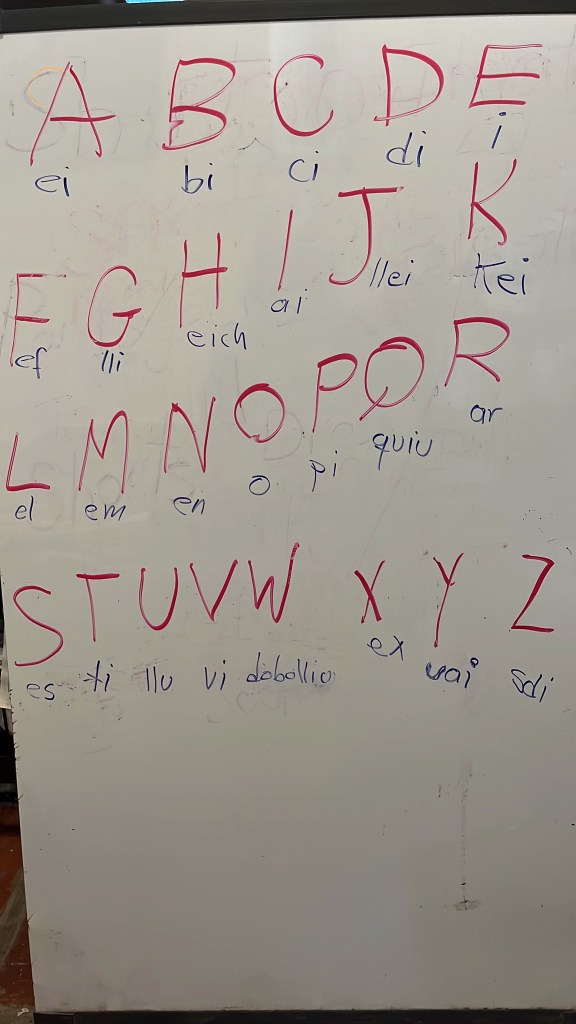
Now it has progressed from the families wanting me to help their children with their English to two adults also wanting to learn. With the children, I use their textbooks and homework as a guide, but with the adults, it became apparent that first they would need to learn the alphabet in English, as the pronunciation is so very different that they would have great difficulty pronouncing the written words correctly. So, I got out my white board, wrote out the alphabet and one of the women wrote how to sound out the letters as Mexicans would pronounce them:
There is no “W” sound, nor a sound for “Z” in Mexican Spanish, nor is there normally the “th” sound and words don’t normally begin with an “s” sound (school, student) but rather with an “es” sound (escuela, estudiante). So, there is a lot of work to be done with pronunciation, which is why I need to begin with the alphabet for the adults.
One thing I do let them know is that they will be learning to speak English with a New York accent as they are learning from me. My accent is not as strong as it used to be, but I still pronounce walk, talk and coffee with my NY accent (as in “wawk” “tawk” and “kawfee” with a strong “W”). As far as accents, there is more – Tuesday can be pronounced “tooz-day” or as the Canadians and some British pronounce it “chooz-day”, so I think that there might still be problems for the students when it comes to completely understanding English. Hopefully with time, it will all work out.
Meanwhile, the two brothers that I am helping have a baby sister, and the girl I am helping has a baby brother, so I am only speaking English to the babies, which hopefully will help them to be bilingual once they begin talking. I also try to make the lessons fun, using various methods – songs, etc. At first, the children were hesitant and somewhat withdrawn, but have gotten used to me now. They are more relaxed, realizing that I am not their teacher in school, not going to give them grades, and they are having individual attention.
So, all in all, this has become a wonderful new chapter in my life, bringing me closer to my neighbors, helping me with my Spanish as I help them with their English, and keeping my mind active and improving life in general.
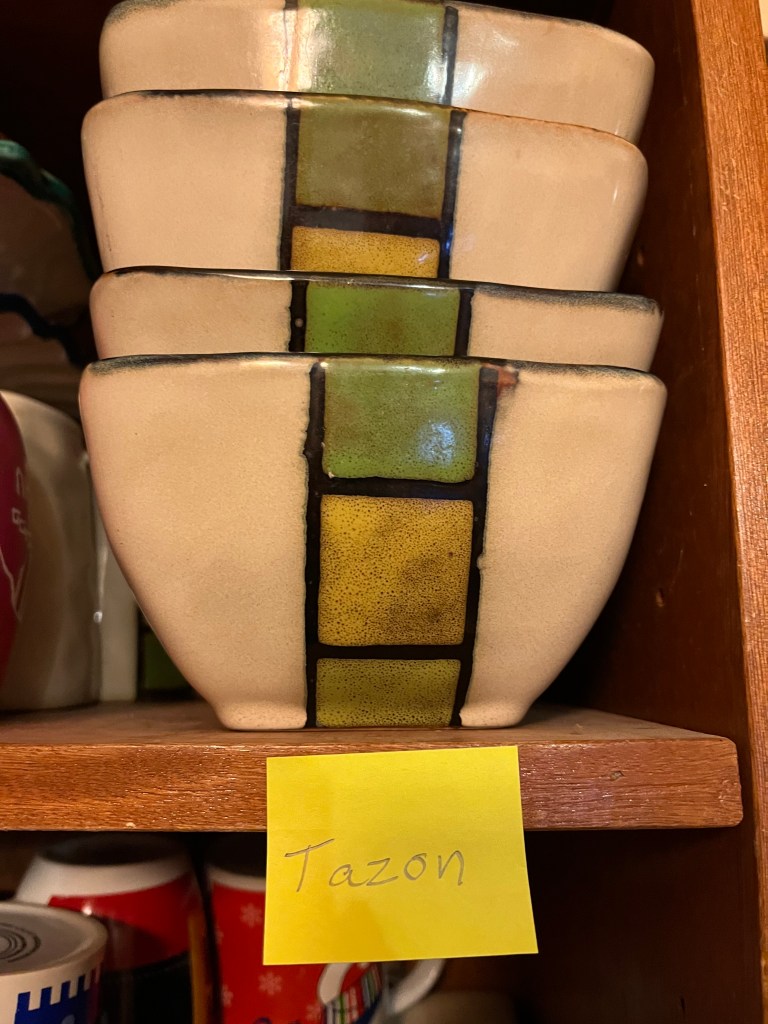
Another word I learned from one of the children – Tazon for bowl. Normally, I would just hear them called platos, for plates.
It is now towards the end of 2022, and while some restrictions are still in place – masking in some areas and stores, for example – village life has basically returned to normal. It has been time to celebrate the Day of the Dead/ AKA Día de los Muertos, and for this year I have decided to stay in the village to celebrate.
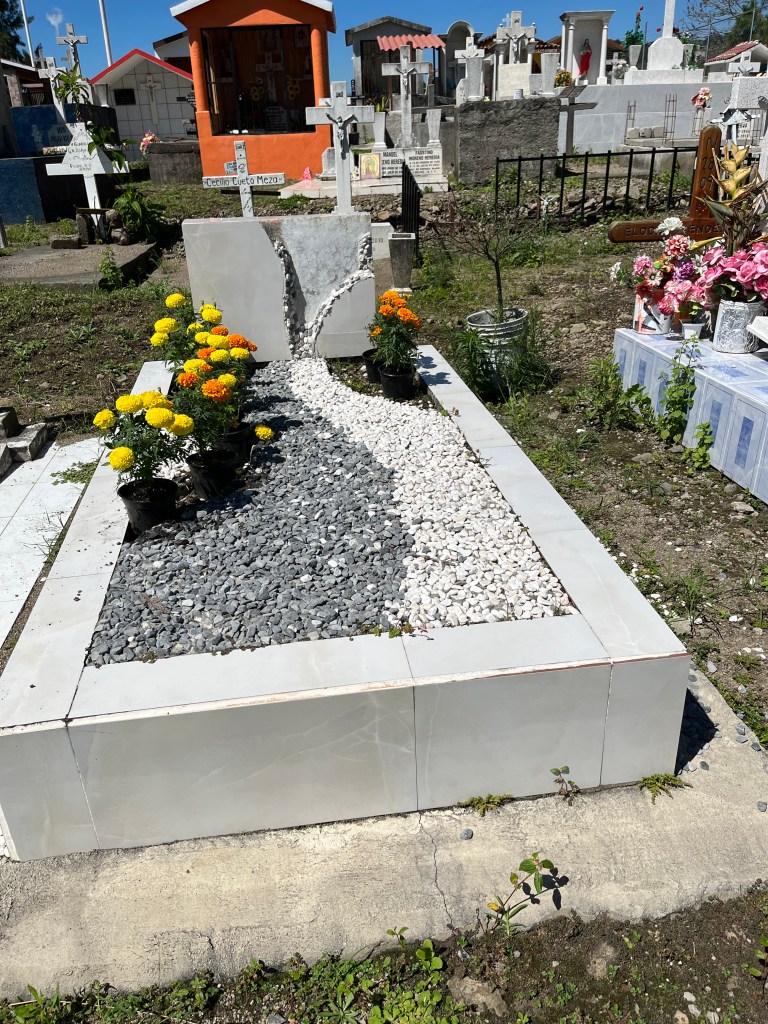
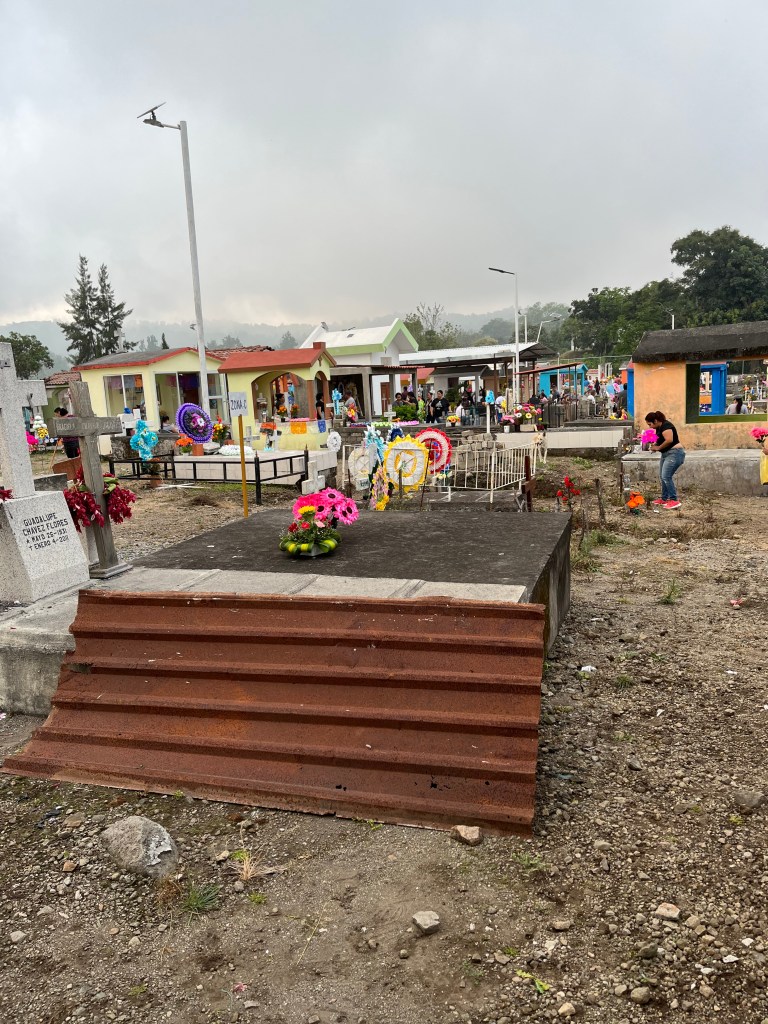
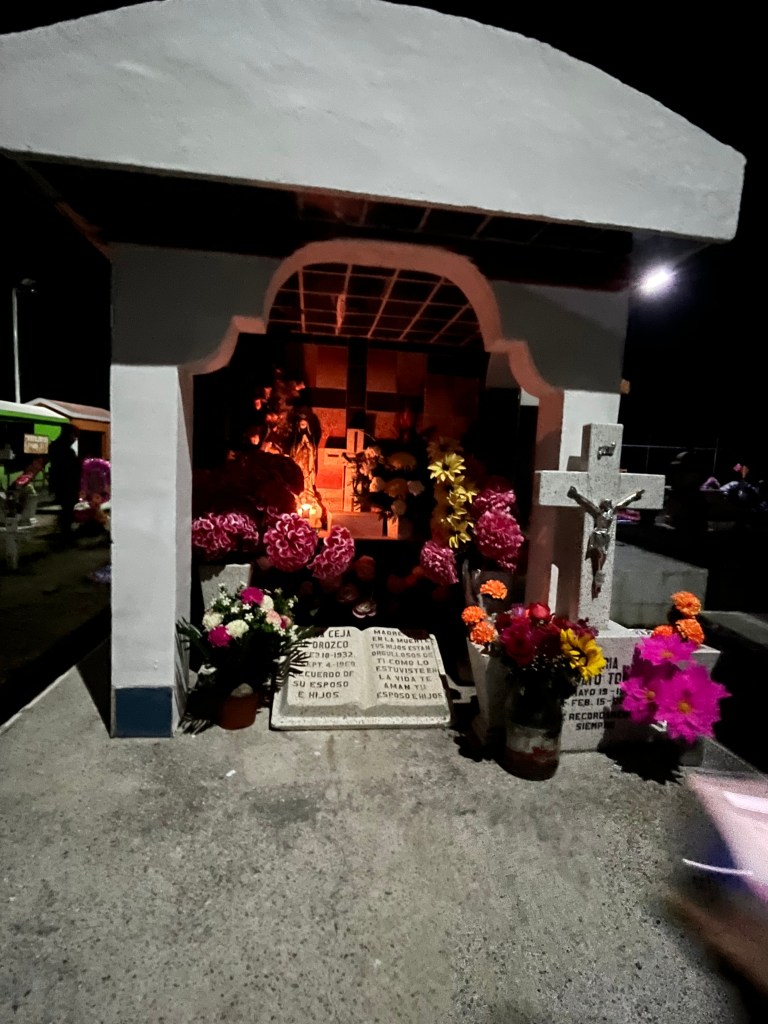
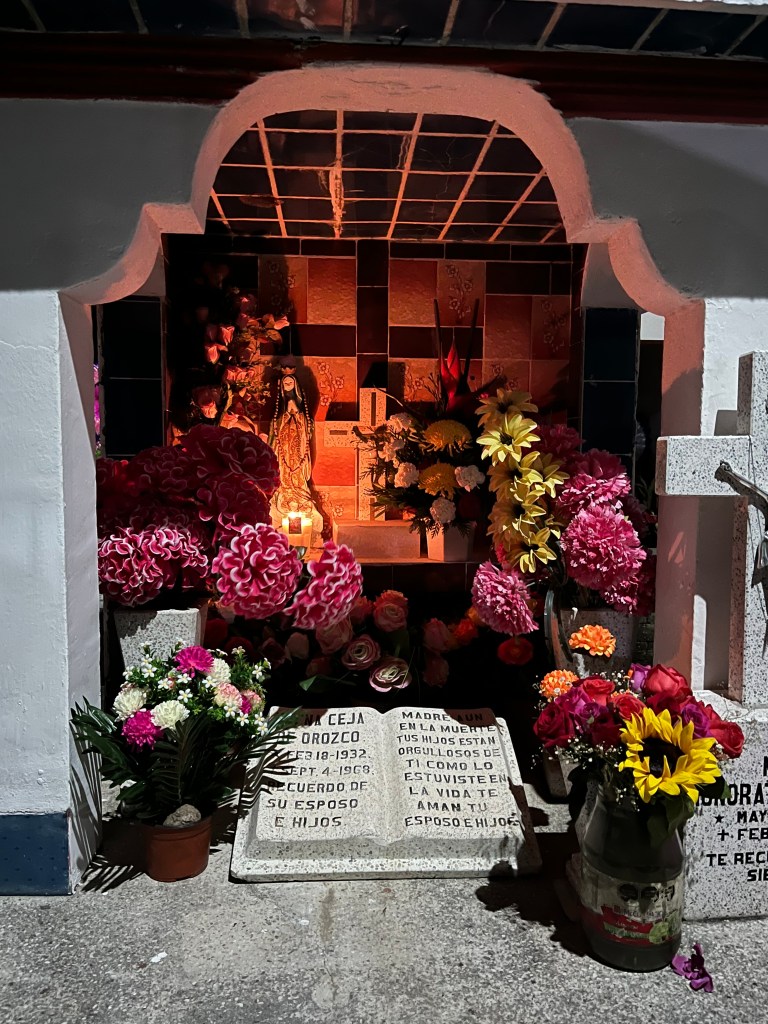
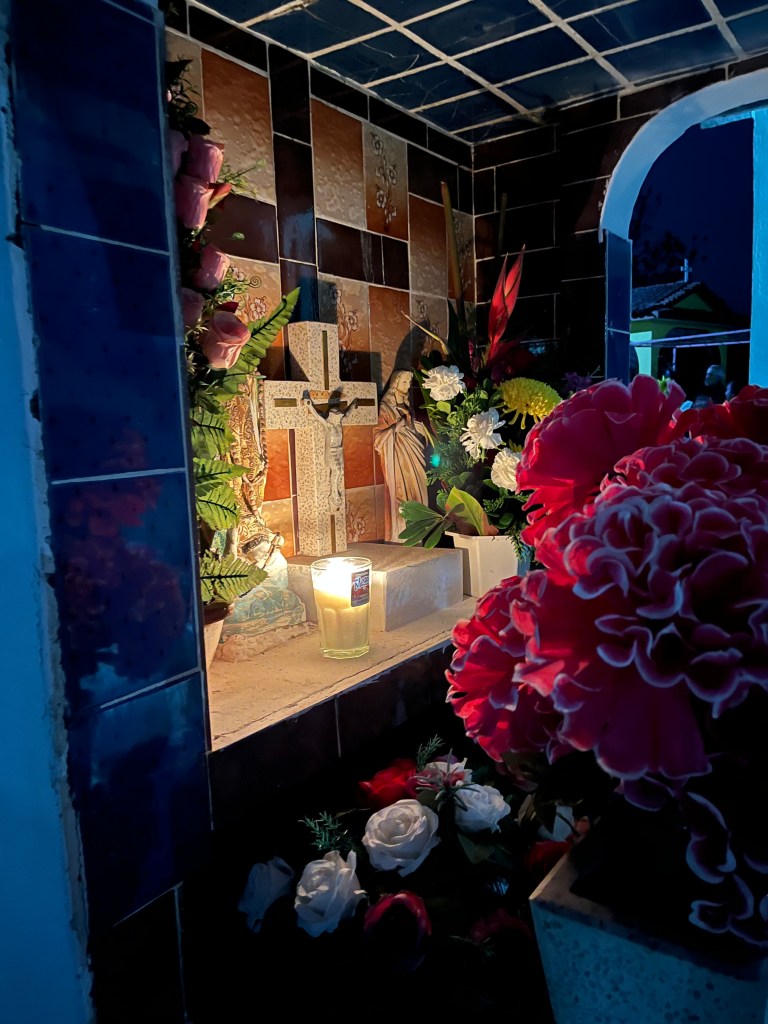
The week before, many of us went to the cemetery to clean the graves and then place flowers and wreaths there. Some of the larger tombs have been re-painted or broken tiles replaced. The cemetery is also becoming very crowded, and I imagine that before very long will run out of space. I heard that they will be building a columbarium with niches for cremated remains to deal with this lack of space.
Halloween comes a few days before Day of the Dead, and that even has not really caught on here. There were a few children who did Trick-or-Treating, but not many. I heard from a neighbor that some of the children had come to my property, but I didn’t hear them, as my house is at the back of my garden, far from my gate. This is the opposite of most properties here, where you first enter the house from the street and the garden begins at the back of the house.
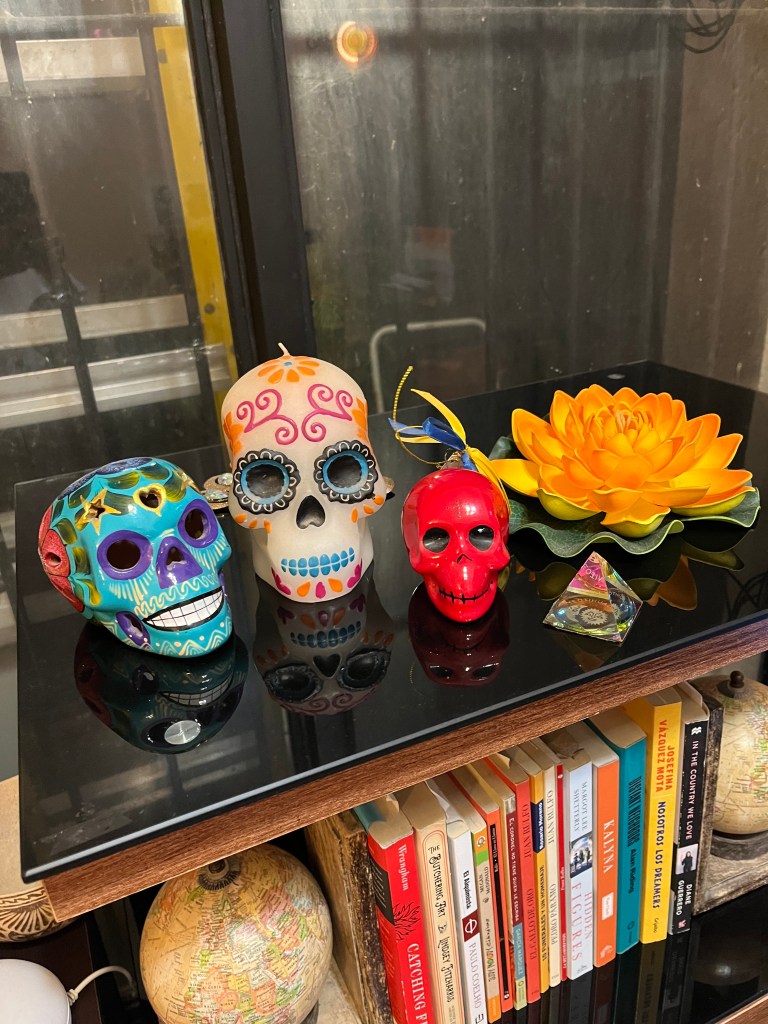
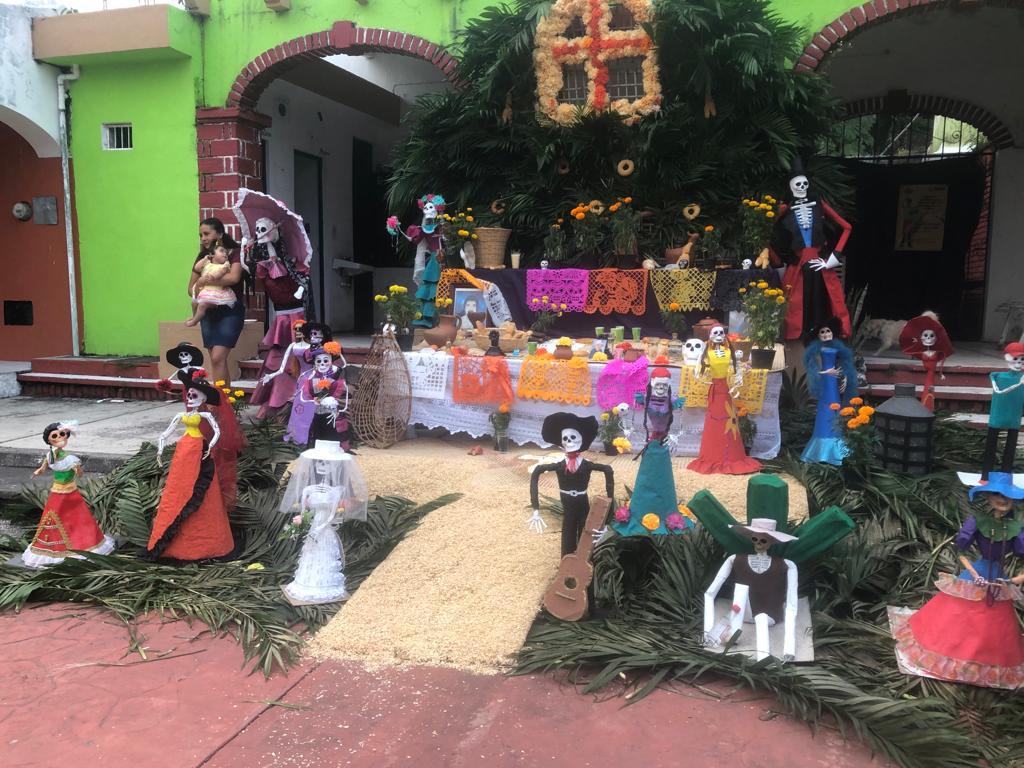
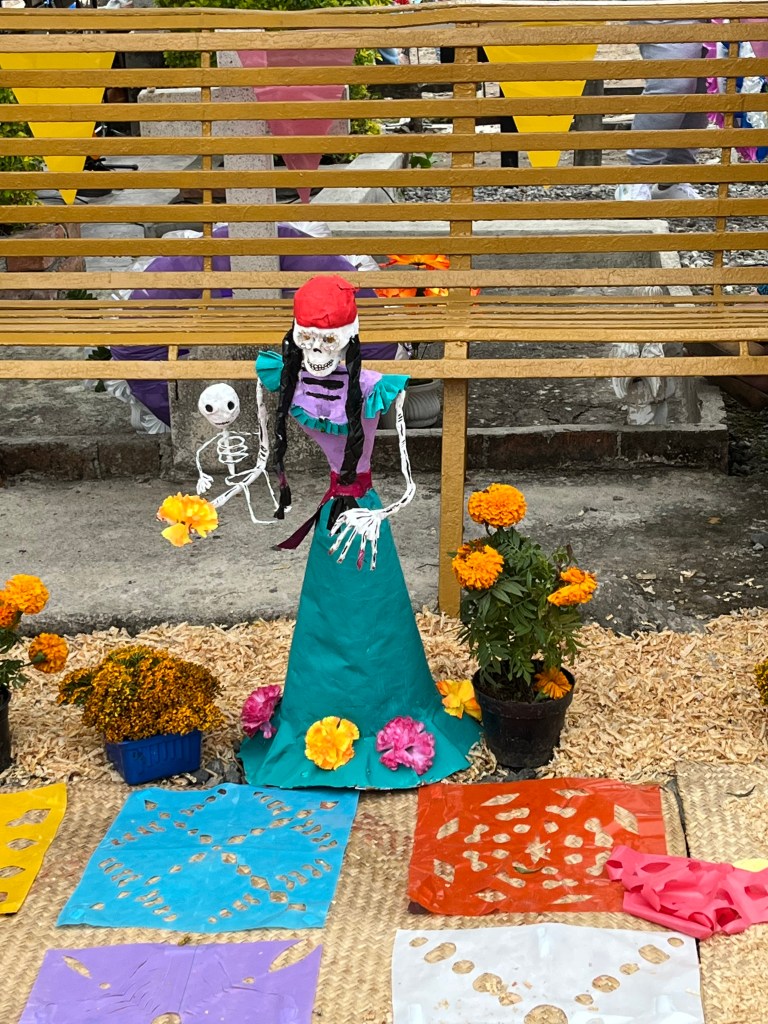
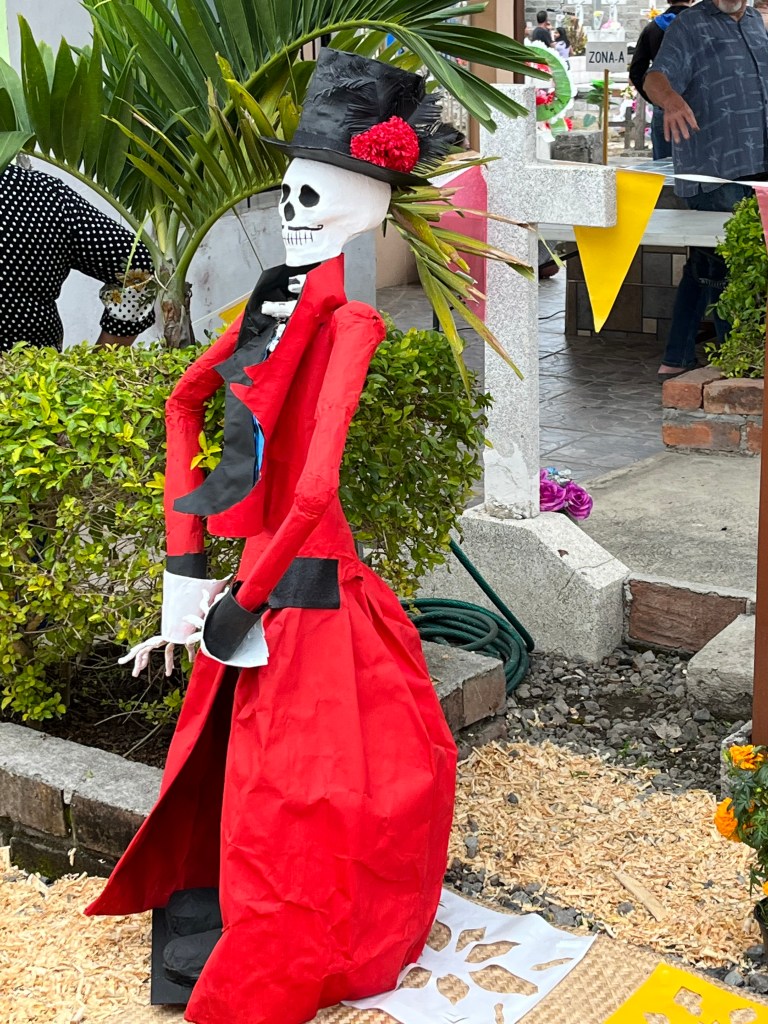
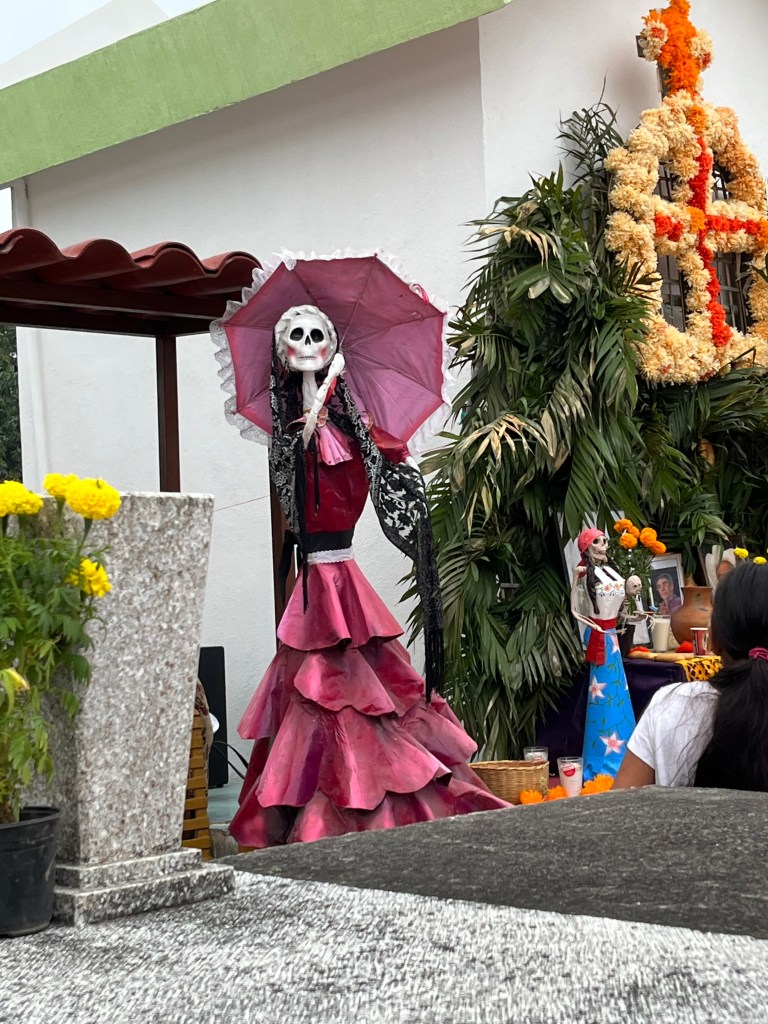
Anyway, a few days before November 2nd, some college students set up a nice display of Catrinas in our village square and fortunately my neighbor took photos, since the display was taken down the next day.
Enjoying a cappucino and toasted bread during this season
On November 2nd, we all went to the cemetery, where the priest said Mass, people placed more flowers and wreaths on the newly cleaned graves and in general, people gathered with each other to remember their loved ones who have passed on.
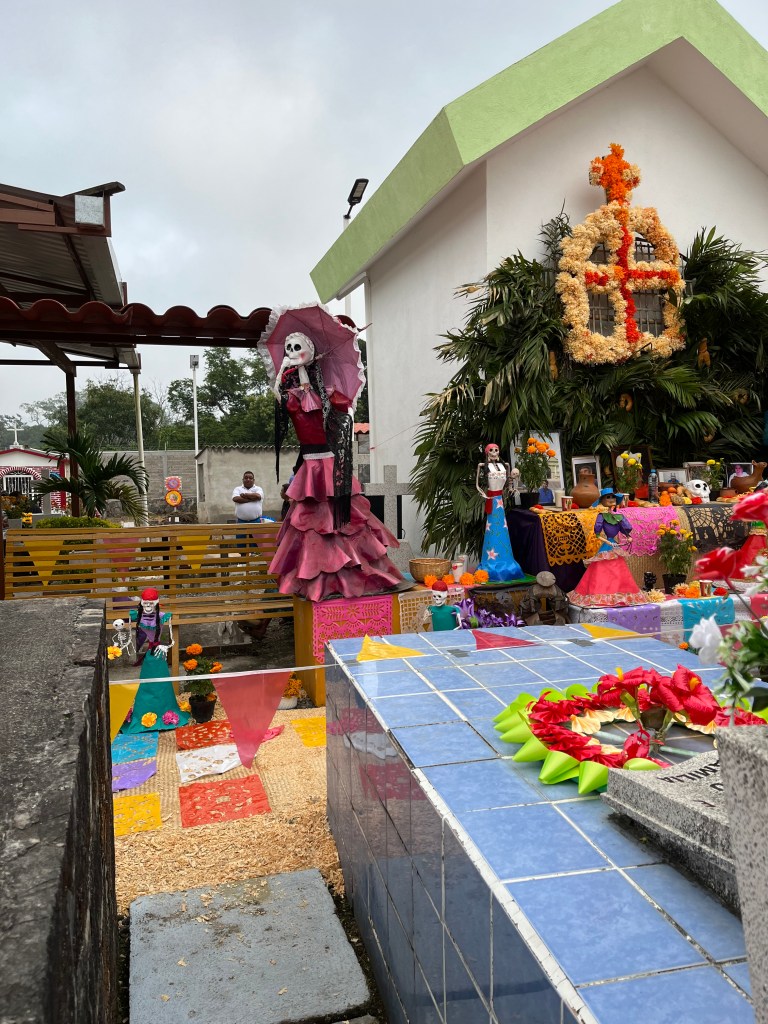
Catrinas on display as you enter the cemetery, called the Panteón
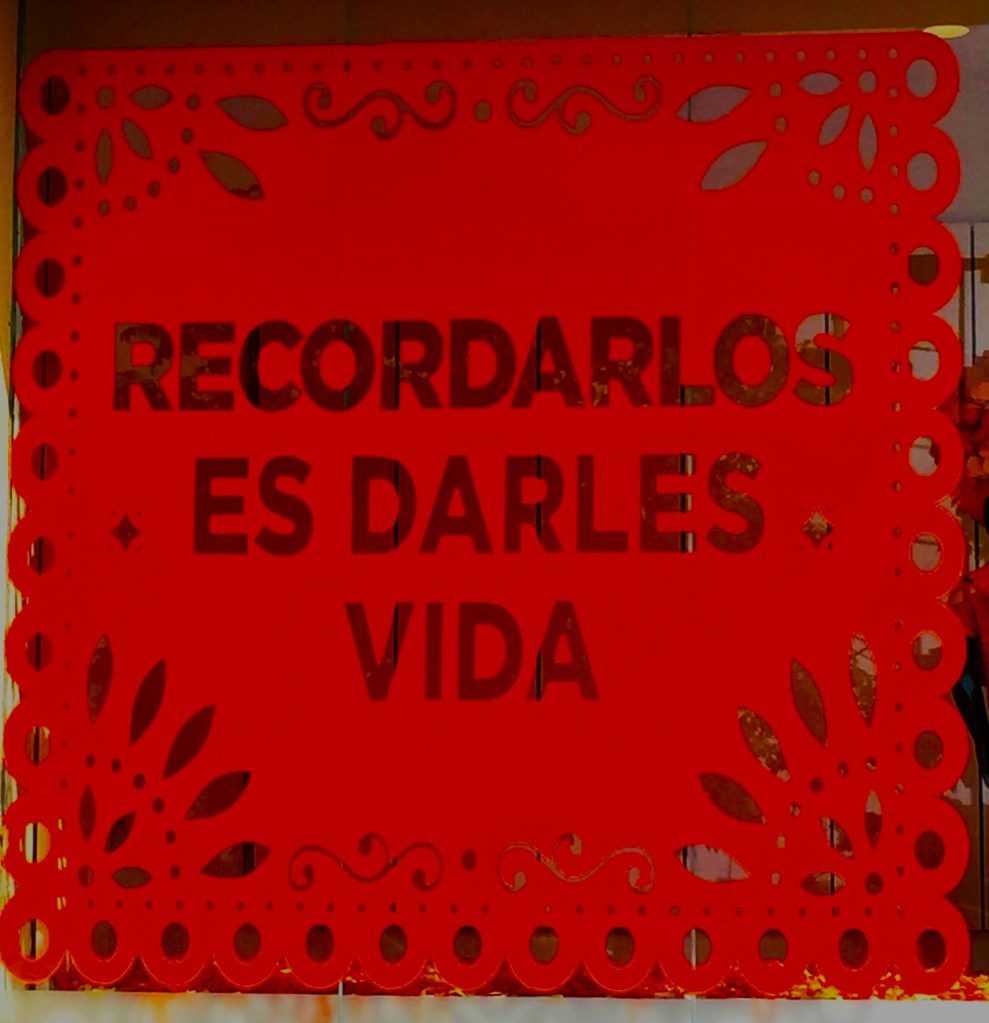
Outside the cemetery gates, vendors were selling beverages and snacks. The weather cooperated, and so it was a very nice afternoon and evening honoring our loved ones and acquaintances. As the papel picado says: “Recordarlos es darles vida” – Remembering them is giving them life.
In previous posts, I have described my journey through the Mexican legal system in my hunt to discover the documents needed if someone should die while in Mexico. This included obtaining an official replacement for my birth certificate, obtaining an apostille, presenting those two documents along with my marriage and divorce decrees and then having all of them translated into Spanish by a certified legal translator.
Following that, taking all of the documents to a justice and having a certificate drawn up and witnessed. The certificate states that the person listed on the birth certificate, and the person (me) holding my current legal name are the same person.
All of these efforts are required to ensure that my death certificate will be valid in both Mexico and the United States, saving my family and beneficiaries a mountain of grief when dealing with the insurance and other companies in order to obtain their benefits.
Only one document remained, and after much time investigating, along with many false leads, I finally have my Mexican Advance Care Directive, also known here as my Voluntad Anticipada.
Various states in Mexico have their own forms, just as it is in the United States of America. I was finding forms for other states, but not for Colima. Eventually, a friend found one for Colima, yet there was not much space for me to clarify my wishes. First, I filled out the Colima form in addition to a form from the U.S., thinking that the lawyer would combine the two into one form. What resulted was a translation of both stapled together which was totally inadequate, confusing and cost a lot of pesos for their trouble.
At that point, the lawyer explained that it would be best if I just created my own document, which I did with the help of a bilingual friend. We then took it back to the lawyer, along with my passport and another form of ID, which she photocopied to prove that I am who I said I was.
Now comes another twist to the story – specific to Colima State, where I live. With the final document prepared, the lawyer signed it to make it a legal document. However, no witnesses were needed. While it is a legal document, designating who can legally make healthcare decisions for me if I become mentally unable to do so, the document is not entered into the nationwide system, which is why no witnesses were required.
For other documents, such as my Mexican will, they are entered into a nationwide database. So, if I should die in another state, authorities would be able to enter my information into the system, and they can access my will. For a Voluntad Anticipada, that is not true. While Colima State has a document, the health department of Colima was supposed to also have a document prepared to be a part of the V.A. However, the health department has not yet created this document, so my V.A., while legal, cannot be registered with the government.
So for those of you living outside the U.S., or visiting other countries, please be aware that your documents such as Last Will and Testament and Advance Care Directive (also known as Healthcare Proxy) will probably not be valid outside of your home country. It is important to make sure you have accurate information and correct documents for your country of residence, so that there will be no problems for you or your loved ones if those unfortunate events come to pass.
If you wish to see a copy of my Directive (minus my personal information, of course) to use as a template, please write a comment with your request. My next post will be general education about Advance Care Directives, what they are, why they are important, and points to consider when creating one for yourself. I and some colleagues have created a presentation, which I can give on ZOOM, to educate the public on this topic, with possible modifications depending on your country of residence.
Or maybe way too much more than you want. If you don’t make your own decisions and put those decisions in the hands of someone you trust, those decisions will be put in the hands of an arbitrary person who may not share your values.























 mex-pat.org