¡¡¡Bienvenido a Mi Casa!!!

me (Paty), Lourdes and our finished pozole

Well, it’s been two months since my last post and a lot has happened, but I will start with the most recent event. I finally moved into my house on December 6, 2016 and this past Saturday, January 21st, I had a housewarming party – or inauguración as they call it here.

Since I had a gringo meal for my birthday, and then hosted a pre-Christmas traditional Christmas dinner as I would have had in the United States, I decided my housewarming would be completely Mexican.

On the menu was:

pozole

spaghetti (for the vegetarians and the kids who wanted it and any Anglos who couldn’t eat the spicy stuff)

ensalada

pollo a la Mexicana

carne de res a la Mexicana

frijoles

arroz rojo

tortillas

tatemado

and three cartons of cerveza, plus assorted refrescos, tequilla, vino, ponche and assorted licores (liqueurs made from macadamia, rompope, almonds, coffee) – basically lots of alcohol and soda (or “pop” as the Canadians call it).

Lourdes taught me how to make the pozole and I made the spaghetti along with a sauce of vegetables cooked in tomato puree.  Now for those of you who are vegetarian, you might not want to read this, as the soup is very heavy on the pork and didn’t waste anything.

Well, you’ve been warned, so here goes:

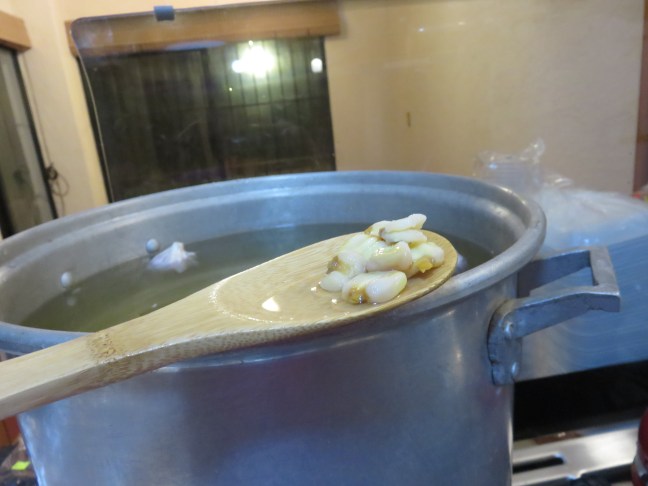
First was the corn, of which there are many types here. What I bought was 4 kilos of very large and hard corn kernels. They had to be soaked overnight, and then ended up being cooked for 7 hours on the stove. This is the same corn that is soaked in lime to break down the protein before it is eventually turned into the flour for making tortillas. However, pozole, which I personally call popcorn soup, only requires that it be boiled to death in water. And by the way, the next day, my tank of cooking gas was empty, so thank goodness I have a backup tank.
img_3885

here is a photo of the corn after soaking overnight

     We had gone to the local butcher to order all the meat for the party. For the pozole this meant: 2 kilos espinazo (the backbone), 2 kilos carne grues pura, 1 kilo bandera and 1 kilo curito.  I am not sure which English word corresponds to the rest of the Spanish words, but the meat was the skin, legs and meat below the ribs.

     At one point, I thought Lourdes had put my white dish towel into the sink, but it turned out to be the pork skin, which did look like a white sheet.

three kinds of hot chile peppers and 19 kilos of meat

         The fire was lit under the corn at 6am and two whole heads of garlic (not cloves of garlic, but the whole head, not even peeled) and some salt were added. Now you can tell when you’re in a gringo house by the salt and pepper shakers. I have never seen a shaker of ground black pepper in a Mexican household, and the salt is large-grained and served in a bowl, so you pick some up with your fingers to sprinkle on your food. I used my mother’s Ukrainian covered dish for the salt, and have my gringo salt and pepper shakers beside it for comparison.

bowl of salt, Mexican style in a Ukrainian dish next to my gringo salt and pepper shakers

     The meat was salted and then rinsed to get rid of any blood. Salt was also added to the broth to add flavor. Over time, the meat and skin were added to the mix to continue to boil for a total of seven hours. The corn kernels did expand and looked like popcorn with a chewy consistency.

Lourdes preparing the meat

adding meat and salt to the soup

adding the skin – you can see why I mistook it for a dish towel

     The garnish was chopped cabbage, limes (which they call limones, pronounced lee-MOH-nez, not LIE-mon as they do in Colorado), and chopped onions. I chopped up the onion just fine, but diced the cabbage instead of shredding it as they usually do here. Oh, well, live and learn and the taste was the same no matter how it was cut.

     Once all the food was ready, it was Party Time!!!!! Volunteer Michael brought the music, Tina brought the rest of the food and everyone else brought themselves…. We all had a wonderful time with way more than enough food for everyone, so everyone got something to take home, and I still have enough to eat for a week, plus froze a lot of it.

     Before moving into my house, I lived in the Project Amigo volunteers’ quarters for a year. The staff, and my future neighbors here were so kind and caring, helping me adjust to the language and customs, and when I was sick, making sure I had food to eat and even taking me to the doctor.  This was my THANK YOU to all of them, and I am so happy in my new home surrounded by honest, caring, hard-working GOOD people…

Mexico City – Part 3

In Part 3, we are still on the grounds of the Basilica of the Virgin of Guadalupe. Coming down from the church at the top of the steps are gardens and statues to commemorate Juan Diego’s vision of the Virgin and the conversion of the indigenous people.  After the fountains and statues is a miniature of the area, and resting on one of the rocks I saw a tiny lizard and snapped its picture before it scurried away. Finally, there is an enormous statue of the Pope and at this point, this is the end of my photos and commentary at the Basilica…

Take care – Saludos to All…


Mexico City Trip – Part 2

There will probably be another two posts at least, since there is way too much commentary and too many pictures to cram into only one. In these pictures, we are still on the grounds of the Basilica of the Virgin of Guadalupe.

In the previous post, I displayed photographs of the churches on the grounds, and the photos and commentary in this post will explain how this all came to be. From December 9th through 12th, 1531, an indigenous man named Juan Diego had several visions of the Virgin Mary. She told him to go to the bishop and to say that a church was to be built on that site.

The bishop did not believe him and asked for a sign. Juan Diego went back, but first spent time with his uncle who was mortally ill. The sign given to him was roses in full bloom, which was a miracle since this was a freezing cold December. Juan Diego put them in his cape and brought them to the bishop, and when he opened his cape and let the roses fall out, there was a picture of the Virgin imprinted on his cape. When he went home, another miracle had occurred – his uncle was cured of his illness.

I will now end my narrative – to be continued tomorrow…

Good night, All…………….


November 2nd, Remembering and Honoring the Dead

The next installment of my trip to Mexico City has been put aside for today as it is the holiday of Day of the Dead, or All Souls Day as it is also known throughout the world. As both names imply, it is a day to honor the souls of those who have passed on.

Yesterday, many people from the village went to the cemetery and spent the day cleaning it up and beautifying the grounds in preparation for today. Before 9am, almost the entire village walked to the cemetery carrying flowers and food, including the favorite foods of the departed. People were also lined up just outside the cemetery fence with food and drink to sustain everyone, and flowers for sale in case anyone had not already brought them.

First there was an outdoor mass said and people would go up to the altar and read off the names of all their loved ones who were in this cemetery. I was surprised at how much I understood of what the priest was saying, so I guess my Spanish is actually improving. I had to laugh along with everyone else when he told everyone to be seated, then quickly said not to sit, as we would all have been sitting down in the dirt!

After the mass, people gathered around their family’s graves, and then visited with other families. For some, they would pour a drink over the grave for their departed loved one. I was very touched to be a part of this – to listen to the memories of the lives of the family members and to know that they are more than just names on a headstone. They are truly not gone, nor forgotten, but continue to exist in the hearts and minds of those they left behind. I was also told that it does not matter where you are living when you die, but you are buried in the place where you are from, and so, except for some gringo graves, the people buried in this place are from here –  Cofradía de Suchitlán.

It is good to witness a holiday keeping to its original values rather than being commercialized and I am grateful to have been a part of it.


Basilica of the Virgin of Guadalupe

It’s been about 2 weeks since I stepped onto the bus to take a tour of Mexico City and surrounding areas, and it certainly was an adventure. The bus ride itself was 14 hours from Comala to Mexico City – or just “Mexico” as they call it here. There was so much to do and see that this will probably be broken up into at least two posts.

When not on the go all day from 5 or 6 in the morning until nighttime, there were 4 of us per bedroom in the hotels, which was probably why the cost was so cheap. We were all adults, but the end of the trip reminded me of traveling with children because something that had nothing to do with the wonders we were visiting was the most talked-about and laughed-about part of the experience.

That “something” was snoring. One of my roommates snored and by the second night, I finally took my pillow and blanket and camped out on the bathroom floor, eventually falling asleep where they found me the next morning. Years ago, I remember one of my Spanish professors saying that in this culture, people have no problem laughing at themselves or others and that turned out to be true. I felt so bad for this woman, but I couldn’t get any sleep at all in the same room. However, the women (including the one who snored) found this hysterical, and talked and laughed about it with just about everyone on the bus. Being brought up as I was, I was amazed at this, but grateful, too. They were laughing at themselves as much as my situation. The final night, we were given a suite, so I had my own bedroom and finally got a good night’s sleep.

So after 14 hours on the bus, we went directly to the Basilica, before even going to the hotel. I already knew that there were two churches, an old one which looks as you would expect a church to look, and a new one which was beautiful inside, but reminded me more of a round stadium on the outside. I was surprised to find that there is actually a third church, older than the other two, and that it was on a tilt due to instability of the ground, causing the second one to be built. Think of the Leaning Tower of Pisa, and you get the idea.

There was a delegation of us from Colima State, and during one of the several masses at the new basilica, there was a procession of Colimenses bringing food up to the altar to donate to the poor – sacks and sacks of produce from our state. The bishop was also there and before entering the church, as we stood outside, he liberally sprinkled holy water on us and anything we were holding in our hands.

As an aside, our local priest was on the trip with us. During some of our bus stops, vendors would come aboard and go up and down the aisle trying to sell various things, so it became a joke that when our priest would get on the bus, people would start asking him what he was selling.

This is an immense area, and a very busy pilgrimage site. In the plaza were whole families with their tents and sleeping bags set up with barely room to walk between them. Tents were also set up along the walkways. I also noted that some of the faithful would crawl into the church and down the aisles on their knees. I had seen that before while visiting a church in Montreal, where they actually had roped off a pathway up the stairs just for these pilgrims who do that.

As I said in the beginning of this post, there is way too much to tell all at once, so I will leave my commentary right here and add some photos, with more to follow tomorrow. You can click on each picture for more of an explanation.

And so  good night until tomorrow…..


Moon Photographs and more about Village Life

Most of this space tonight will be my recent photographs of the moon, with commentary trailing off onto various other paths. Many years ago, one of my friends from the U.K. remarked that my photography is mainly concerned with composition, and she was definitely correct. Two mornings ago, as I walked out into the common courtyard, I noticed the moon above one of the apartments, along with branches of trees and immediately had a vision of what a beautiful picture it would make. So upstairs I went to retrieve my camera.

Unfortunately, especially at such a distance from a heavenly body, the camera needed to be held very steady and focused exactly right. So I grabbed a chair and dragged it around the floor, sitting down to test the angle three times before I was satisfied that I was in the correct place for a good photo.  Then I sat down, scrunched down in the chair and steadied my arms on the arm rests and fired away with the camera, using one of the special settings.  While not as good as some other people’s photos, it is fun to play with, and is certainly a lot easier than the old days of celluloid film, dark rooms, hanging the negatives up to dry after being bathed in chemicals under a red light and then making pictures out of the negatives.

I definitely give a lot of credit to the good and great photographers of times past who produced extraordinary and extraordinarily beautiful photographs the old-fashioned way. And let’s also not forget the radiology people developing patients’  x-rays. This is where the expression “wet reading” comes from – having the radiologist “read” the x-ray film  before the film had dried during a medical crisis.

Having many areas of this residence open to the outside lends itself to many visitors and one decided to rest on my sofa – a beautiful blue butterfly, a type I had not seen here before. I was able to snap a few pretty good pictures of it, including one close enough to see its proboscis curled up under its head.

It then decided, as many winged creatures had before, to try to leave through the skylight windows. Even with the balcony doors open, the stairwell door open, and a large open area below the skylight which would allow it to fly directly downstairs to the open-air kitchen and therefore be literally outside, it continued to try to fly through the glass above us, illustrating the saying “…..continuing to do the same thing while expecting different results.”

Unfortunately, its poor little brain wasn’t powerful enough to change the instinct which was telling it to head up towards the light, even though this happened in broad daylight, so there was light coming through all the paths to the outside.

One comment about village life here, and then I will close to go and re-pack my carry-on suitcase, which I had diligently and proudly packed two days ago and must now empty out and re-pack. I will be going on a 4-day tour of Mexico City, Cholula, Hidalgo and another place whose name I can’t remember. I had packed for the warm weather of Colima State, and was informed tonight that it gets really cold in “Mexico” so I’d better pack socks, sneakers, sweaters, etc. – whatever I would need for cold weather. I had forgotten that Mexico City is of a higher altitude than Denver!

So – back to village life. Every evening I go to my neighbor’s house where she gives me Spanish lessons and I teach her English. Coming out of her house after “class” I saw a little boy on a horse coming down the street. I was told he is 3 or 4 years old, and his grandfather was driving his truck slightly in front of and to the side of the horse.

I had seen them about 2 weeks previously, and at that time, the boy was on the horse and Grandfather was holding the reins through the window of the car while he was driving, so that the horse was trotting very slowly and Grandfather had complete control. Tonight the boy had the reins and was in complete control, even though Grandpa was nearby driving his truck.

That boy was SO CUTE and so confident, it would have made a wonderful photograph. If I do get a chance to take a picture, and have my camera with me at just the right moment,  I might ask permission and give the photo to the boy and his family.

So I will close for now and leave you with my latest photographs, and “see” you again after next Monday, when I will return with more photos, possibly videos, and lots to tell.

¡Adiós!  ¡Hasta luego!


Life in the (Ash) Clouds

Ever since the last eruption recently, I had been planning to write about our volcano, but through my natural inclination to procrastinate, plus other duties in my life, I kept putting it off. Since I will be going to the First Fiesta of Coffee and Chocolate today, I can no longer put this off.

I think my brain was also trying to tell me to get going by having me dream about the volcano in the early morning hours today – a dream in which I was in a hotel looking at the volcano with some other people. Strangely, I have been in this hotel before, but it is in New York overlooking a river. As we stood there, there was a massive explosion from the volcano with immense black ash clouds spewing from its crown, and instead of being afraid, I was annoyed that my camera battery had died, and I needed to find the extra battery. It all seemed so real that I woke up physically exhausted – and was even more exhausted after completing my morning 6-km walk after waking up.

So, without further ado, I will begin my article about our volcano…

No matter where you live on this Earth, you will have to live with imperfect weather. Sometimes you will need to be prepared for dangerous situations, such as earthquakes, tornadoes, floods, etc., and sometimes just deal with uncomfortable weather, such as heat, cold and humidity.  My geography of choice is a volcano and earthquake zone.

First, a little education about volcanoes, which also touches on earthquakes, here: http://mexiconewsdaily.com/opinion/eruption-a-reminder-mx-land-of-volcanoes/

There are two volcanoes within sight of Cofradía de Suchitlán, here in Colima State – the Volcano of Fire (active) and Volcano of Snow (inactive). As the article states, there are sensors in the area of the volcanoes to predict/monitor the activity. The civil defense organization here is very active regarding the safety of the people.

A few months ago, we visited some families right here in Cofradía whose lives had been impacted by natural events. I was told that their homes had been endangered by volcanic activity in their villages which were close to the volcano, and so the government had built them new homes in a safer area, and some of those home were built here.

Civil defense has a number of safeguards in potentially endangered villages – among those safeguards is a color-coded warning system – red light for evacuate, yellow for prepare, and green for safe. During one of my trips, I watched paramedics and civil defense personnel conduct educational demonstrations to a small village, teaching them what to do in case of a natural emergency.  They ran practice drills followed by explanations of what went wrong, then repeated the drills so that everyone would learn by experience what would be the safest way to behave. I was very impressed with their teaching techniques and knowledge.

When this latest eruption happened, the police and civil defense sprang into action, evacuating about 300 people and preventing people from going back in before it was safe to do so. The perimeter was set up 12 kilometers on the Colima side and 7.5 kilometers on the Jalisco side (the Colima volcano sits on the border between Jalisco and Colima states, with each state claiming ownership). Here in Cofradía we are safely about 15 kilometers from the volcano, but still experience some of the effects resulting from the ash and sulfur dioxide.

The ash is blown by the wind and covers everything where it lands. You can see it on cars and sweep it up from the floor. Looks like fine gray dust, but when you rub it between your fingers, it is gritty like fine sand, not at all like normal ash from burning paper.

When there is a significant amount of ash in the air, warnings are broadcasted not to go out, and people who must be in those areas, such as emergency workers or the people being evacuated, need to wear masks, otherwise it is like breathing in cement dust.

Does anyone remember talks about acid rain years ago? I am posting some pictures from our garden of damage that I was told was from the acid in the air – leaves turning yellow, damage to foliage. I only hope that the coffee plantation near the volcano did not sustain too much damage to  its coffee plants.

As you can probably tell, the volcano is a major focal point of life – from beautiful paintings and photographs to place names. Here in Cofradía we have the Ferretería los Volcanes (Volcano hardware store), the Panadería los Volcanes (Volcano bakery) and, of course, our Dos Volcanes agave spirits (it’s tequila, but when it’s made in Colima State, we’re not allowed to call it tequila – but that’s a story for another day.).

So please enjoy the following photographs, etc. and click on the link to an article and video below  of our Volcan de Fuego – much beloved and treated with respect…..


http://www.dailymail.co.uk/video/news/video-1153454/Mexico-s-Colima-volcanos-eruption-caught-camera-timelapsed.html


Spanish for ADL (activities of daily living) or, My Face-Palm Moment

I am beginning this post with the video above. Being a perfectionist in some areas of my life, I was never happy unless I got straight A’s in school or 100% in everything. The one exception was college algebra, in which I was ecstatic with a grade of B, happy just to have passed the course.

Anyway, I have studied Spanish for many years, and while I can read and write it perfectly well for my needs, my problem is with speaking the language. I despaired of ever being fluent, and then one day I happened upon this video and breathed a huge sigh of relief.

I realized that fluency depends on your situation in which you are speaking, and therefore no one is truly 100% fluent, even in their native tongue. I did perfectly well speaking with adults at our clinic – checking their blood pressure and blood sugar, asking about their medications, were they taking their meds, if not – why not, etc., etc.  No major problem at all.

However, when 2 years later I was part of a health fair directed at children to teach them brushing their teeth, washing their hands, healthy eating and exercise, I was at a loss. I was not familiar enough with the vocabulary of dentistry, teeth-brushing, chewing the disclosure tablets, and so on.

And then yesterday I experienced the situation that the speaker in the video referenced – technical vocabulary versus the vocabulary of daily living. I went into Soriana’s and made some purchases. I had already been told by my Mexican bank that if I used my ATM card, I could get cash back without a fee. I handed my card to the cashier and waited to enter my NIP (what Mexicans call the PIN), only it appeared that the machine would be counting it as a credit instead of a debit.

The cashier then said a bunch of words, including the word “efectivo,” which was the only word I recognized. In my mind I was wondering why she was saying the word “cash” when I gave her my card and she had the card and machine, so I could not read what she was referring to.  After a minute or two of me not understanding her – I kept saying something about the NIP and she kept telling me no – she completed my purchase and gave me my receipt.

On the way back home on the bus, it suddenly hit me and I had a strong urge to smack myself really hard on my forehead and call myself stupid. She was asking me if I wanted cash back!!!!  I HAD wanted cash back but wasn’t familiar with how such a conversation was conducted….

I relayed all this to Lourdes, so my Spanish lesson last night consisted of play-acting all possible conversations at a checkout counter. I also learned some differences between Mexico and the U.S.   In the U.S. sometimes customers are asked if they want to donate to a particular cause and have it added onto their bill. Here in Mexico, they simply ask you if you want your bill rounded up. I was told the answer to that is “for whom?” If they say for the store, my answer should be “no,” but if they mention a cause, such as an organization that fights cancer, I can say “yes.” The other thing is that we tip the people bagging our groceries here, a couple of pesos each and also tip the people who work in the parking lot.  In addition, I learned how to get a Soriana store card and get points on purchases.

So that is our lesson for the day – fluency itself is a very fluid concept, and even though I had a smack myself-in-the-head moment, remembering the video calmed me down and let me realize what I had to do to prepare for the future.


An Upside-Down World

Living in Mexico is certainly different than volunteering for one week per year. There are many things you start to notice when you have that much more time. One of these things is the wildlife, often getting up-close and personal.

Among the creatures one can get to know are the creatures of the night and those that do not walk upright, or keep their heads up. Upside-down can have two meanings – either head down, as in bats, or belly-up and back down, as in lizards or ants who can defy gravity by walking along the ceiling or under surfaces such as stairs.

My little bat has been an off-and-on visitor with inconsistent hours. Sometimes, I know that it has been here by the seeds and chewed-up leaves or fruit I find on the stairs in the morning. Sometimes I see it, but often it doesn’t appear until late into the night, and by that I mean around midnight or 1am. It’s almost 5am right now and I see it up there for the first time tonight. .

I do wonder, though, about its physiology and body mechanics. It hangs head-down, so its circulatory system must be quite different from creatures which live with their heads upright. I also wonder about how their feet keep a tight grip on whatever they’re hanging onto while they sleep. Our hands and feet relax, which would be fatal to them. Oh, well, more to research some day when I’m not busy and remember it.

Since being back in the Hacienda residence, I have heard a sound that is hard to describe – almost like clicking, but not exactly. I didn’t recognize the sound, and couldn’t find any creature that could be making that sound. When someone was with me and it occurred again, I was told that it was a lizard, and that lizard eats insects and scorpions. Well, anything that eats scorpions is fine with me and can stay as long as it likes.

I finally saw it the other day and managed to take two photographs before it scurried away into a space between the beam and the ceiling. It was a gecko, exceptionally fast, and earlier this year I also saw an iguana that lives in an outdoor wall space at a couple’s house near here. I saw it on the roof, and before I could get a photo, it has disappeared between the walls.  They certainly must have very flexible bodies with feet made especially for gripping/clinging.

The very large butterflies that seem attracted to our common space here also took up residence on the ceiling for a while, but with the recent rains, it seems they have found another space to stay. For  while, one of them was up in the ceiling, near where the bat usually hangs, so I do not know if that kept the bat away or not, but at least it was in the hallway, on the ceiling near the chandelier.

Many times, dragonflies, butterflies and assorted other flying creatures get into the common space and try their best to fly through the skylight. The windows of the skylight are fixed within their frames, unable to be opened. These poor flying creatures don’t seem to understand that if they cannot fly through it after multiple attempts they need to find another way to get back outside.

At this point, I will open the balcony doors and the stairway door, making sure to keep MY bedroom door closed. They also don’t seem to realize that it would be easy to just fly down to the ground floor as there is a railing directly below the skylight and a large opening where you can look down directly to the open-air common space and kitchen.

Many mornings, I have found dead butterflies and dragonflies, among other flying creatures, who apparently have either starved to death, dehydrated to death or just died of exhaustion while unsuccessfully trying to escape.

More lucky are the ants, which seem to have no problem navigating this world no matter what position their body is in. More fascinating than that is how they work together as a team, or as an army, for a common purpose. They truly seem to be the garbage collectors/cleanup crew of nature. I have watched as they gather around and under dead dragonflies, etc., lift it up and carry it away including over and under the lip of the stairs – never breaking their stride, never missing a beat, walking upside-down, all the while carrying their load. I should also mention that these ants are extremely tiny and the carcass that they carry might be compared to a human carrying a body the size of a room or larger.

There are so many varied forms of life here, if only you take the time to look instead of walking past. The world is so much more than the larger creatures that we see, and if you spend some time observing, whether that involves bending down or looking up, or even getting close to a flower, it can be a wonder to behold the variety of life in this world. It makes you realize that children have it right when they get down into the dirt and are fascinated by what they see, and have a million observations and questions. We should be encouraging that and not trying to extinguish their natural curiosity. They will be the naturalists, scientists, biologists, doctors, etc. of the future!

Well, enough preaching for today – Enjoy the photographs, and have a nice day!


Just Volcanos

Today, I’m going to be a bit lazy and will just be posting pictures and videos of our famous Volcan de Fuego – our volcano of fire, and the Nevado, the nearby, inactive volcano of snow. While the inactive volcano is actually higher than its active cousin, from our viewpoint here in Cofradía, it appears smaller.

Besides deciding to be lazy, I also played around with various settings on my new camera, so this is also a chance to show off all the neat pictures I have taken on various days and various times of day.

During the one week per year that I was here in 2012, 2013 and 2014, I didn’t see much activity at all, only an occasional wisp of smoke coming from the caldera. The summit of the active volcano could be seen as a straight, horizontal line. You can notice this in the following video from You Tube, and you can see the dormant volcano to the left:

There were several eruptions during the 2015 year, with a massive one in the summer that blew out the side of the crater, so you will see in my pictures a V-shape at the crater. I was told that here in Cofradía that ash was coming down for about a week after the explosion, and that things were manageable here and not as bad as conditions in villages and towns nearer to the volcano, but luckily, there was no loss of life.

So – without further ado, here are my pictures, and I hope you enjoy the view…..