The Animal Kingdom

Well, the rainy season is upon us. With the rain comes an explosion of green, growing things – grass, trees, flowers, and clean, fresh air. It may be cloudy during the day, but mostly the rains come during the night or late afternoon and evening, leaving daytime free to do chores.

view from my porch in the rain


There are no more scorpions to be seen.  They have been replaced by hordes of flies, and of course the little geckos are still around.

However, there are now two new creatures – toads and something that looks like a miniature iguana.  I had seen toads as road kill during my walks last year, but now I am in my house and hear them in the dark, calling to each other, and in the darkness I can see their silhouettes on my stone driveway and sometimes hopping around on my porch.

20170626_084953 (2)This one was resting between a flower pot and the edge of the porch. I almost didn’t see it, nor get a photo of it. They seem to know when they’ve been spotted and disappear by the time I can grab my camera.

     This particular one was larger than my fist. The kitties didn’t seem to interested in it, but they definitely WERE interested in this guy:


IMG_4602

I was startled when I came upon it. My neighbors tell me it is not an iguana, but couldn’t decide what it IS called. I’ve seen iguanas up close, and I know they move exceedingly fast, and this creature was just sitting there, very still, and was a lot smaller than an  iguana.

At one point, I thought it might have died, as I saw ants crawling over its body and it still wasn’t moving, so I threw water on it to get rid of the ants. Then Peach started pulling on its tail,  it inhaled a deep breath, so obviously it was alive.

Glad Ginger didn’t get bit, as you can see from one of the photos that it has some nasty teeth. After a while, they lost interest in this new creature – or else simply became more cautious – and left to play in another part of the yard.

I went inside the house and came out after a while to find that it had disappeared. I had feared that it was sick, but maybe it just took that opportunity to escape our prying eyes.  That was a huge relief, as having to bury it if it had died was not a pleasant thought.

So here ends my tale of the newest seasonal creatures with whom I share this land. Until next time, have a pleasant week wherever you are…..

The Worm Poop Farm

If you have read the book or seen the movie The Martian, you would remember that the stranded astronaut Mark Watney (played by Matt Damon) planted potatoes on Mars to increase his food supply until a rescue mission could be launched. Since the soil of Mars was lacking in nutrients because there is no life on Mars, he fertilized it with his own body waste and the dessicated, sterilized waste of the crew which had been discarded by the them during their mission. It was mostly scientifically correct – the soil would have had to be washed first to rid it of chemicals poisonous to humans  – but the basic premise that growing things need nutrition was accurate.

Around the world over the millennia, feces (the medical term for poop) has been a source of fuel and fertilizer, among many other uses. And why do I bring this up? Well, I’ll tell you…..

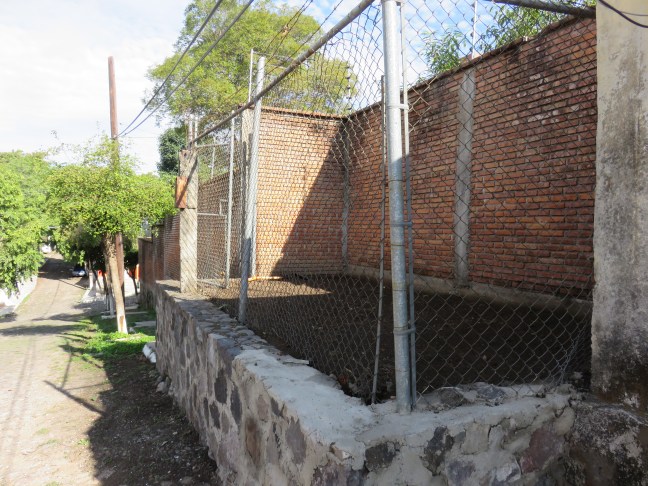
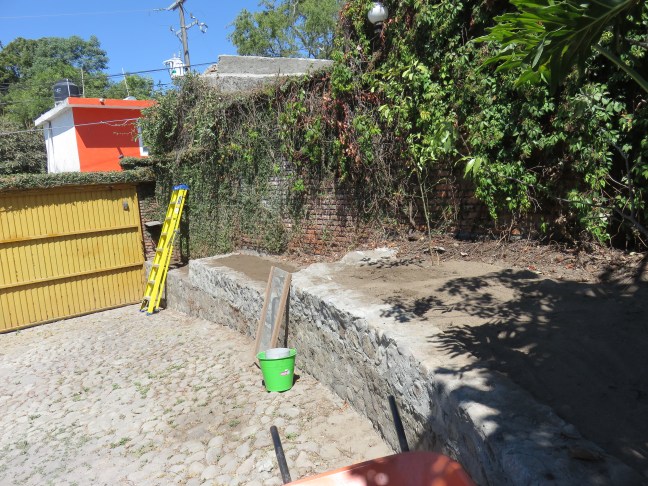
There is a small patch of ground on my property on which I set my sights for my next project. After clearing out the weeds, we realized that there was no drainage system installed in that particular area, so we needed to fill it in and raise it up to the level of the rock-and-cement wall with extra dirt so excess rainwater could run off the top.

IMG_4607

My neighbor had piles of dirt on his property as a result of construction, and he allowed us to take as much as we needed. The problem was,  the soil was devoid of the nutrients plants would need to survive and thrive.  His solution? Go to the worm farm.

So off we went to the worm farm, and what I saw and learned were quite amazing.  Long, deep tanks made of cement blocks greeted me after I entered the property. When the lids were lifted, I could see they were full of soft black dirt with millions of worms wriggling about.

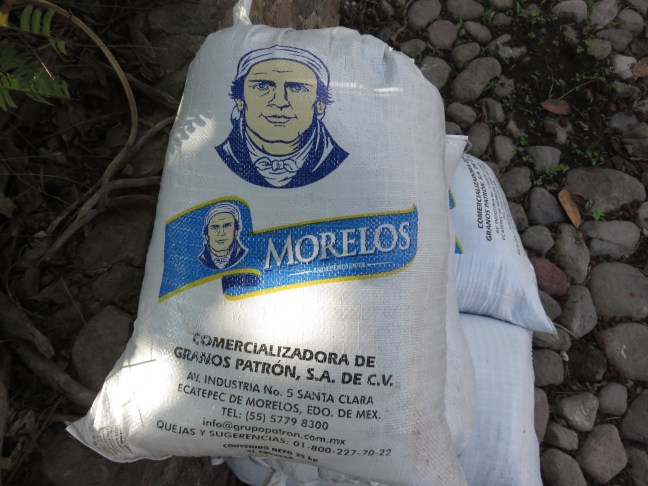
The owner told me that they put dirt and organic matter in these tanks –  mostly the unused organic material from sugar cane and the pulp and skin from the coffee cherries (which are removed from the coffee bean during processing), and some organic matter from other fruits and vegetables, but never any animal matter.

The worms are then allowed to eat, poop, and make little worm babies to their hearts’ content for 8 months, and then the process begins to remove them, so you end up with pure, rich soil.

To preserve the lives of the worms while separating them from the dirt, the workers begin to place their food in one area of the tank. As the worms migrate towards the food, the worm-free dirt is extracted. This continues until all the rich soil is separated from the worms.

It is then bagged and sold to people like me to allow our plants to grow happy and healthy, courtesy of the circle of life.

IMG_4606

And there ends your biology/organic farming lesson for now – so enjoy your day, wherever you might be, and catch you next time!


Greetings from Atlanta, Georgia !

Although this is a blog about being an ex-pat living in Mexico, it is not entirely about the country of Mexico, but rather about my experiences AS an ex-pat, no matter where I happen to be at the moment.

I often find myself at a loss for what to post, so if you have any suggestions, please write them in my comments section. When I first arrived in Mexico, there was so much to experience, and therefore I had tons of material to work with. Now, I often think that I would be repeating myself and have writers block, so suggestions and questions that have not been addressed are more than welcome.

So now, I am in Atlanta, Georgia for the Rotary International Convention. I absolutely love these events, as I can meet and interact with people from all over the world, find out about their lives and learn about their projects.

I was last here in 1996, passing through on the way back from Florida with my family. We didn’t have tickets to any of the events, but wandered around the venue anyway. I remember the fountains spurting from the ground, and my son playing in them, as it was incredibly hot at the time. We returned to our car by way of the metro. Being from New York, I have been calling it the subway, and have to explain to people what I mean when I get a puzzled look in reply to my queries about where the “subway station” is.

I wonder if my son, who was 8 years old at the time,  remembers any of this, including the child who was continuously singing while we were on the train car.

One of the things I had been wanting to do for many years, was visit the Carter Center, founded by former President Jimmy Carter, and I it was one of the first things I did, after registering at the Georgia World Congress Center for the convention.

It was a 3-mile walk from the GWCC each way – and I am eternally grateful for the modern technology that brought us Google maps, as I notoriously have absolutely no sense of direction.

The center had beautiful gardens outside, a research center and an incredible museum dedicated to Jimmy Carter’s life and his dedication to serve humanity. I do remember many of the things from my lifetime, such as the peace talks between Menachim Begin and Anwar Sadat.  It was noted that after the Camp David Accord, there has not been any incident of an Egyptian killing an Israeli, nor of an Israeli killing an Egyptian.

He has also been the leader in the fight to eradicate Guinea worm, a painful disease which has plagued mankind for millenia. I had thought it was eradicated, but apparently there are still a few cases. I listened to an interview he did one time describing this campaign and how he was privileged to use his status as a former president to coerce leaders to join the fight.

Apparently, this disease had already been eliminated in Guinea, where it was first discovered. President Carter was trying to convince the head of Ghana to join in the effort to eliminate it in his own country, and the leader was resistant. President Carter then told him that if he did not commit to eradicating this condition, he would be forced to re-name it Ghana worm, and this tactic did work. He said that if he had not had the status of a former president, he would not have been able to talk to the Ghanian leader in this way.

At 91 years old, he is still actively involved in lifting up humanity and making the world a better place, including Habitat for Humanity and eliminating other diseases and promoting world peace efforts.

For those of you who would like to learn more about his life, I would suggest you read the books “A Remarkable Mother” which describes his life growing up and the influence his mother, Lillian Gordy Carter, had on him. I believe she is the reason he is such a humanitarian.

I would also suggest the book “Letters from Home” written by Lillian Carter and her daughter Gloria Carter Spann. It details her decision to join the Peace Corps at the age of 68, and what it was like as a nurse in the Peace Corps in India.  “Miss Lillian” was a great inspiration to me, and I have given these two books as gifts many times.

After visiting the Carter Center, I walked the 3 miles back to the Georgia World Congress Center.  I like walking when I have plenty of time, because you see many things you would not notice when in a car, bus or airplane.  So please enjoy the pictures, and there will be more about the convention in the next post.


Paying Bills and Playing Hide-and-Seek in Mexico

Perhaps it is because I am in a small village. Perhaps it is different in larger cities and municipalities such as Comala, Colima and Mexico City.  Paying bills here is a whole other world from what I was used to.

In the United States, paper utility bills are delivered to your home via the United States Postal Service. The bill usually arrives within a business day or two after it is mailed. Even across the country mail doesn’t even take one week. In these modern times, you can even arrange to receive and pay your bill online. Not so here, in Cofradía de Suchitlán.

We have neither a bank, nor a post office here in the village.  The electricity bill (or cuenta de luz – light bill) is paid every other month, beginning in February. The bills for electric for the entire village go to one person in one house. Hopefully, someone tells you when they arrive (fortunately for me, I have Lourdes).  Once the bills arrive, you have one week to go to that house and pay the bill. From what I understand, if you don’t pay it, then you must go to the main office in Colima to pay it.

When I moved into the house in December, the person collecting the bills lived on the next street over. She would post a sign on her house to let everyone know the bills were here and when was the last day to pay.  In February, things changed. No sign on the house and I was told by Lourdes that the bills were being delivered to ANOTHER house halfway to the crucero (the crossroads at the highway leading away from the village) and one street over, so it was not visible from the main thoroughfare.

So – fortunately, I went with Lourdes, since there was no sign on the house.  This is where the bills were paid for February and April, and hopefully it remains so – at least through the end of this year. By the way, for my house, the bill came to 595 pesos. That is about $30 USD for 2 months, or about $15 USD per month.

The water bill is turning out to be the serious game of Hide-and-Seek. I hadn’t received a bill and wasn’t sure how that worked. I asked Richard, the previous owner, and he told me that you pay the water bill once per year and, just as you do with the electric bill, there is one person in the village who collects the money.

Apparently, you just have to pay once per year, but they would prefer that you pay in the beginning of the year. I seem to recall that, in New York, you paid twice per year – or maybe that was the sewer bill. I can’t recall, and I haven’t owned a house since the year 2000, so who knows if it’s even done the same way anymore.

In any event, the search was now on to find out who collects the water bills. Apparently those bills also changed hands, but then someone told me that the owner of the local hardware store knows or is related to the right person. The woman at the store told me that the family in a house across the street were the proper people. I went there, the door was open, but no one answered when I shouted a greeting several times.

I then decided that I could try another time. Then I was told that it was the owner of the house next to the taxi driver’s house. Went there, and in her rapid-fire Spanish I THINK she said that the woman was no longer there, and gave me the name of the person who is now in charge.

Well, this morning on our walk, I mentioned the name to Lourdes, who knows this person and showed me the house – the same house across the street from the hardware store that I had tried before. So – this being the weekend, I will try again during the week.

When I finally pay the bill, I will let you know how much it is.  I do live alone, and it only takes me 5 minutes to shower, the kitties don’t drink a whole lot of water, but I DO do a lot of cooking, which entails a bit of water. And – most of all – I do irrigate the fruit trees, flowers, plants and vegetables daily (I will be using MUCH less during the rainy season, which begins towards the end of June). I was concerned about that, but Richard tells me that everyone is assessed the same amount for water. I don’t know if that is good or bad. Thanks to the filters and ultraviolet light for my water supply, I can actually drink the water straight out of my tap.  Everyone else has to buy their water.  I am also not sure how they figure the amount of water used throughout the village, but I am told also that we have greater water security (secure in the knowledge that we will have an adequate supply) than in the city.  I suppose it all evens out in the end for everyone in the village.

The phone is much simpler, at least for me. I do not have a landline, preferring just to use my smartphone.  I paid the Mexican company for a new chip for my phone – I don’t remember how much it was – and received a personal phone number. Now I just walk a few blocks to the “Ciber” and pay however many pesos I choose for more data when I run out.

So, that is about it for now. Sorry, no pictures this time. But I did get all of my white flowers, the frame is up for the ones that climb, and I will be writing a post about that soon, with lots of pictures of my beautiful moon garden.

¡Adios, y que tenga buen día!   ‘Bye and have a great day!


After Easter

Easter has come and gone, and I posted about Easter, complete with videos, last year. The story will be in the archives of this blog, if you care to see the celebrations and weren’t following me at that time.  After Easter was a celebration in the jardín specific to Cofradía de Suchitlán. There were vendors selling food and drink, speeches were made and poems read about the people who founded the village and were important in its history.  I recognized a few of the names, but my Spanish wasn’t good enough to understand the details and nuances, and I am not familiar enough with the history to understand the references about each of the people named.

There was also a dance troupe from Suchitlán – a different village than Cofradía de Suchitlán.  They had different colored costumes than the Cofradía dance troupe (Danza Azteca de Cofradía) but performed the same pre-Hispanic/pre-Columbian dances.  I was also impressed with the man who provided the music; he played the flute while simultaneously beating the drum, and he did this while walking around and through the dancers.

After the dancing, a group of men performed the ritual of the Paspaques. This was already performed throughout the streets on the Tuesday before Ash Wednesday – our version of Mardi Gras. It originated in pre-Hispanic times, and the word “paspaques” comes from the Náhuatl word papaquiliztli which means happiness and joy.

The mission of the gang of paspaques is to enliven the carnival with games, and the carnival in ancient times was to celebrate the coming of spring and rebirth of nature. Part of the ceremony is an effigy of a bull, which “runs” and tries to hit spectators and the gang with its horns.

Another part of the ceremony, in ancient times, was that the gang would go to the house of the Prioste (the steward of a brotherhood or confraternity) where they would do an offering of a song and offerings to different deities. If the wife of the Prioste was pleased, she would paint their faces with pinole (ground roasted corn), distribute gifts and then they would all eat stew.

There was flour on the faces of the performers, but they did not throw the flour at us, as they did the day before Ash Wednesday.  Unfortunately, I also have no idea what they are singing. Perhaps if I play this back enough, I will be able to understand most of the words…


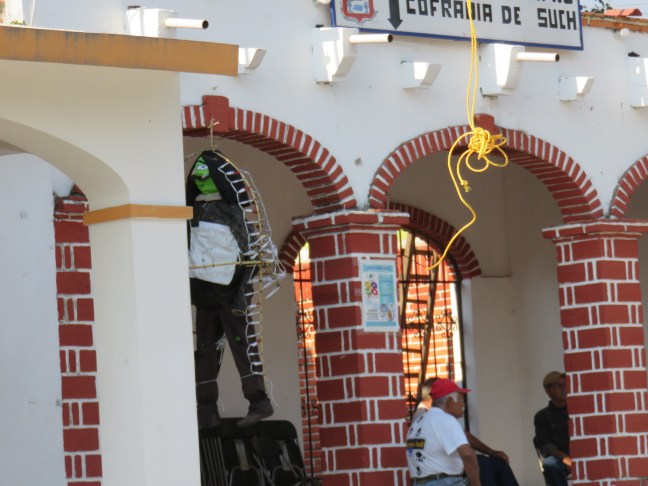
Finally, at the end of the evening was the fireworks – after all, this IS Mexico !!  A rope was strung across the jardín from which an effigy of a man was suspended, surrounded by a frame of fireworks. The man was in a suit and had a piece of paper visible in his jacket pocket.

We were all ushered away from the effigy and the fireworks were set off, and nothing was left of the poor “man” in the end. My friend Gloria explained to me that this represented Judas. In olden times, he was wearing biblical dress, but these days he was dressed in modern clothing.  The story Gloria told me is the note in his pocket represents a note that he wrote before he hung himself after betraying Jesus. I suppose the fireworks represent his destruction.

IMG_4349

Effigy of Judas suspended in the comisaria (town hall) before it is brought out into the jardín

And so ends the celebrations. Good night to all and to all a good weekend !!!

Making Paletas

Okay – so this will be more of a cooking lesson today, which should interest any of my readers out there who are foodies.  Paletas are frozen treats and can be made from fruits, nuts or other foods. They can have a milk base or a water base, and therefore can be described as a popsicle or a frozen fruit bar.  With the heat during the day reaching the 80’s, and the availability of a tremendous amount of fresh fruit, I decided to start making paletas.

The initial flavors were strawberry, blackberry, guayaba, jamaica (made from hibiscus petals and it tastes like a slightly bitter fruit punch, so it is loaded with sugar), lemon and peach.  As different fruits come into season, I will experiment further and flavor them to the local taste. I am told the milk-based paletas contain milk, cinnamon, sugar and vanilla.

Whenever I find lemons, they are imported from the U.S. I believe some lemons do grow in Mexico, but much further north, as the lemon trees need cooler weather to thrive. My lemon paletas were basically frozen homemade lemonade, and I label them lemon-ada to differentiate them from limonada, the local drink made from what we gringos call limes, but are called limones in Spanish.

One thing my friend Lourdes told me to do was to put a little green food coloring in my lemon-ada paletas. I thought this was very strange, but she said they associate the yellow color with pineapples and are used to their limones being green.  So in order for them to coordinate what they are tasting to what they are seeing, green they must be. I guess it would be equivalent to us suddenly having to eat green or purple mashed potatoes – it just wouldn’t be comfortable emotionally.

So far I have been doing water-based paletas and the recipe varies slightly according to what food you are using. With the strawberries, you just blenderize the fruit with hot water mixed with sugar, put it in the molds and wait several hours for it to freeze.  With fruits that have a large quantity of seeds, such as blackberries and guayaba, I strain the fruit to get rid of the seeds after the fruit is blenderized with the sugar water.IMG_4301
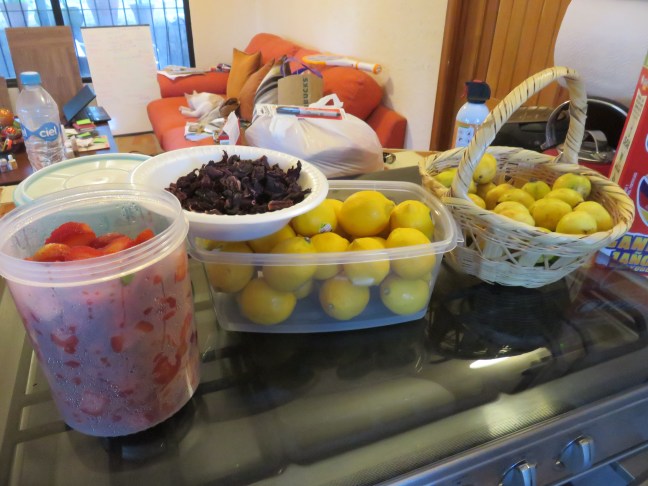
Here are the raw materials I started with last week. From left to right: strawberries, jamaica petals, lemons and guayaba.  To condense the post, I will be concentrating on the preparation of the lemons and guayaba. First the lemons:

The first thing to do is to obtain lemon zest by grating the rind to obtain the proper amount for the batch of paletas.
IMG_4314

Then mix water, sugar and the zest into a pan and heat, simmering for 3 minutes after it comes to a boil.

Slice the lemons and squeeze out the proper amount of juice for the batch, then pour the juice plus more water into the sauce pan and mix.  The recipe I found on the internet calls for the fluid to then be strained, but I do not strain the liquid and only take care to pick out any stray seeds that might have found their way into the liquid. I do this because the Mexicans seem to like a lot of pulp in their paletas.

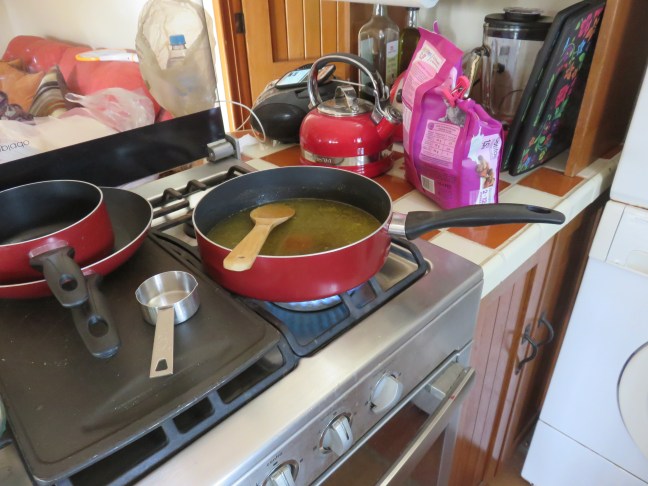
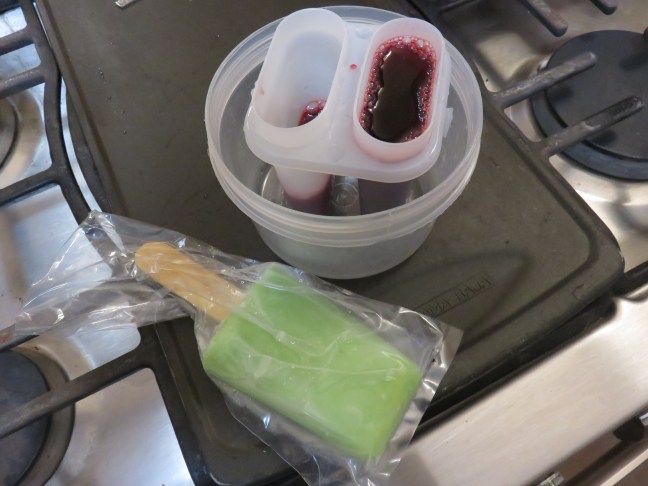
Next, don’t forget to add green food coloring to cater to the Mexican clientele. Pour into the mold and place in the freezer.  I have found that watery solutions such as this take about two hours before it is mushy enough to hold the popsicle stick upright, so after 2 hours I pull them out of the freezer and insert the sticks. Then they go back into the freezer for at least another 4 hours.
IMG_4302

After they are frozen solid, I run hot water over the mold for a few seconds, pull out the paleta, wrap in plastic and Voila! – a nice green lemonade popsicle!!!!!

For the fruit pulp-based paletas, it is a slightly different process. Many of the fruits here have a tremendous amount of seeds, such as the blackberry and guayaba, so it is a little more involved.

First the guayaba is peeled. Now this can be a bit tricky and messy because they are fairly small – maybe the size of a ping pong ball – and get really soft in your hand. I have a very good potato peeler, so the skin comes off pretty easily, but as I said, the fruit gets very soft as it is manipulated and frequently splits open with soft fruit and seeds oozing out as I try desperately to finish peeling off the skin.

Meanwhile, water and sugar is heating on the stove. Once the fruit is peeled, into the blender it goes with some of the warm sugar water, after which you have pureed guayaba with tons of seeds.

Slightly more fun than peeling the fruit is separating the pulp from the seeds. Into the strainer it goes, a few spoonfuls at a time.  Once the seeds are out, you are left with something that has the color and consistency of applesauce.
IMG_4310

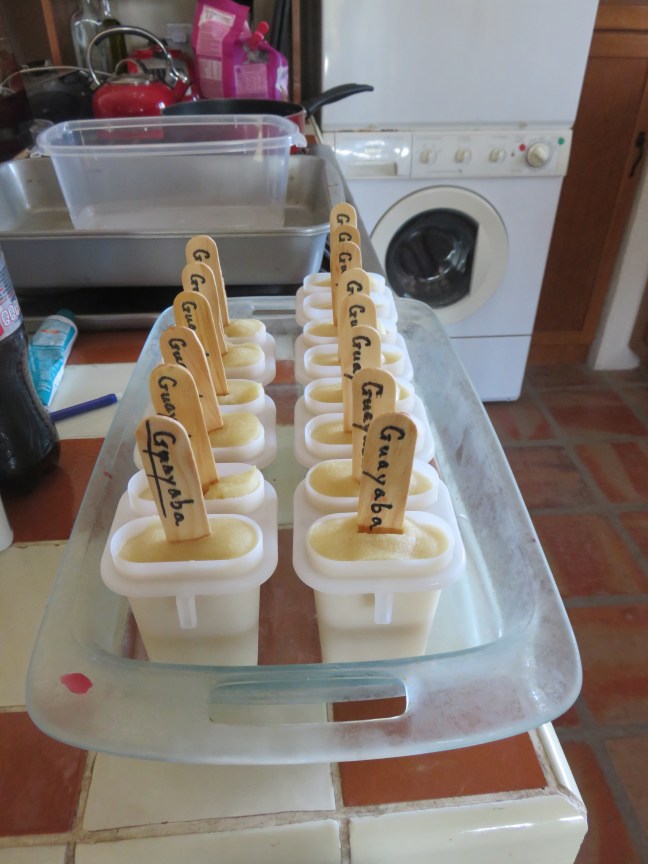
Into the molds they go. For the pulpy fruit paletas, they only need an hour to harden enough to hold the sticks, so at that point they come out of the freezer, the sticks are inserted, and back in they go.

IMG_4311

Several more hours, and we now have a fresh batch of guayaba paletas.

Beginning yesterday, I am now making batches of paletas with sugar and batches with Splenda, due to the high incidence of diabetes in this country. From my experience, Splenda tastes closest to real sugar, and I notice that it is often offered along with real sugar. In fact, many times when I order coffee, I have to ask for real sugar, as only Spenda has been offered.

Here ends the tour of my kitchen and the tastes of Mexico – and so, Dear Reader, I wish you buenas noches/good night until next time….

Still Life, Frida and Alejandro Rangel Hidalgo

Today it will be mostly flowers, specifically the pink lilies in my garden and the vines of tiny pink flowers that are growing behind and around my banana trees. I mainly focus on composition, and while gardening this morning, and cutting down the lily plants that are too weak to stand up straight, I decided to put some of the flowers in a glass of water.

While pruning the dead fronds from my banana trees, I noticed the tiny, bright pink flowers latching onto the leaves of the tree.  Then it hit me that I could make a nice flower arrangement in a glass of water and try photographing still-life photos.

In addition, I had visited the Alejandro Rangel Hidalgo museum in nearby Nogueras. I love his paintings and bought a print. Lying around the house was also a poster advertising a Frida Kahlo exhibition, which I thought would look nice when framed on my wall. So after going to a framing establishment, I now have two very nice framed decorations on my walls. I would have loved to buy every painting of Hidalgo’s, but my space is limited, and now I am beginning to feel that my house is a combination flower shop/art gallery, even though there are only a few things here.

You can read more about Hidalgo here: http://www.mexconnect.com/articles/442-alejandro-rangel-hidalgo-universal-artist-from-colima

and see some of his fabulous paintings here: https://www.bing.com/images/search?q=paintings+of+alejandro+rangel+hidalgo&qpvt=paintings+of+alejandro+rangel+hidalgo&qpvt=paintings+of+alejandro+rangel+hidalgo&qpvt=paintings+of+alejandro+rangel+hidalgo&FORM=IGRE

If anyone visits this area, the Alejandro Rangel Hidalgo museum is one of the places you must visit not only to enjoy his art, but also to see and learn about the history of this area.

Meanwhile, please enjoy my gallery of photos of some flowers in a simple glass of water, taken in automatic and creative shot settings…..

Cats and their prey and Gardening in Cofradía

Where to start? My little quarter acre here in Mexico is so insignificant compared to the vastness of the universe and even compared to the Earth, but it is a whole world of living things requiring much attention and care.

I guess I could start with the creatures whom evolution decided would not be secured to the ground, forcing them to develop defenses that did not require flight from danger. And so – there are my gatitas, my kitten sisters Ginger and Peach. With no parent present in their lives, nor other adult cats from whom to learn, they are nevertheless becoming quite the huntresses.

They have captured several grasshoppers and crickets, and unfortunately several geckos also. While I admire their hunting skills,  since geckos are extremely fast when escaping prey or hunting their own prey, I rue the fact that geckos are also one species of the good guys who eat what we humans here call pests. I noticed that they play dead or stay perfectly still when cornered, so I have been able to rescue a few of them. Recently there was one on my bedroom floor and one on my doorstep who were still alive and intact, so I scooped them up and placed them in the foliage, where hopefully they will continue to live a long gecko life consuming whatever pests they can find.

I also recently found a little dead frog – or maybe it was a toad – on my bathroom floor. I don’t know if it died of starvation or from my cats using it as a play toy. In any case, it was the size of my thumbnail with very strange feet. More like a lizard’s feet than what I would consider the feet of a frog. But then, it was a long way from a body of water, and maybe it used those feet to climb trees. I remember my friend Lourdes had a fright when one day she started to pick up what she thought was a rock, and it turned out to be a very big toad.

Unfortunately for my “girls,” Momma cat has reappeared. Her belly is flat, so she has had her kittens somewhere else, but for 3 days now I have heard sounds of a cat fight early in the morning. This morning, she even got into my house when I left the door cracked open.
I’ve sprayed her with water, with detergent mixed with water, and thrown pebbles at her. She is still getting in the same way – on my neighbor’s roof, walking across my brick wall and climbing down my peach tree. I’m thinking that if I cement broken glass onto the top of my brick wall in a wide enough swath, she will not cross it to get to the tree to get into my yard.

And now onto the gardening. It turns out it is a lot more work than I imagined. Clearing areas of previous vegetation is one thing, but digging up the root systems underneath and the amount of rocks in the soil is quite labor-intensive. No wonder the streets are all cobblestone and the walls are mainly rocks and cement. I remember helping to get my mother’s garden ready on Long Island by sifting loads and loads of dirt to sift out the rocks. I thought about this each time I filled another wheelbarrow full of rocks.

IMG_4130

After the root systems and rocks were removed there remained large holes which needed to be filled. So far, we’ve used 3 bags of dirt for the medicinal plant and herbal beds, but for the area that will be grass under my chayote vines, we’ve emptied 7 bags and my gardener estimates I will need another 8 bags, which he will bring tomorrow.

20170302_182659

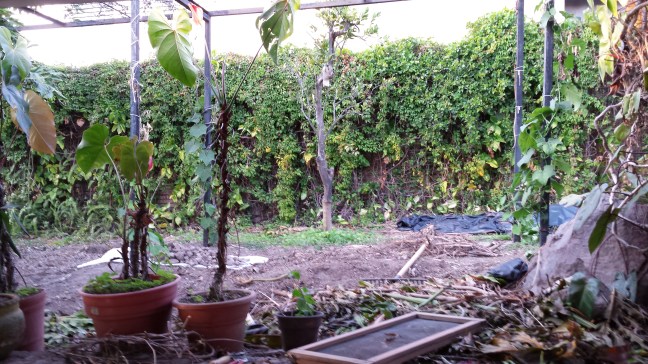
In the meantime, there is something they call here “plaga” which can infect trees and plants, and has already killed two of my smaller trees, necessitating that they be cut down. There is a two-fold answer to this problem:

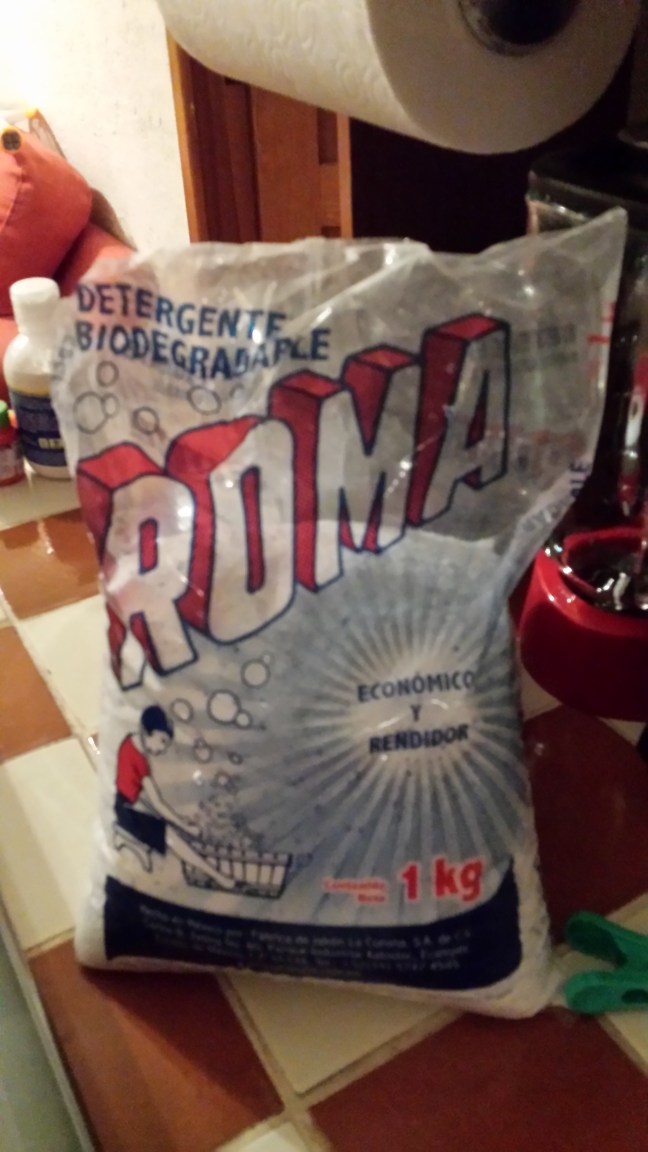
First: for the bark already infected, mix Roma brand powdered laundry detergent with water and spray it on the infected areas. I am doing that and will see how it works. Second, powdered tobacco mixed in with the soil. Every 100 grams needs to be mixed into an area of soil 30 cm in diameter – so I bought 10 bags of one kilogram each and hope it is enough.  I will find out how well that works when I am done planting.

20170312_210735

For some final odds and ends, I found a good equivalent for scrub pants, which will be used for gardening, as it is way too hot for jeans, and my Skechers are now gardening shoes, as they get way too dirty to now be used for anything else.   I am also constantly discovering new fruits and new flowers. I will be including photos of these, one of which is a bright orange daisy that is growing on a vine. Managed to snap a photo of an orange butterfly that perfectly matched the color, but it was so fast going from flower to flower that the photo is not as detailed as other photos I have taken of butterflies.

One last thing has also been added to my to-do list. Above the brick wall above my future plant beds is a triangular-shaped cement wall which is part of a structure belonging to my neighbor. I discovered it after stripping away some foliage. It forms a nice shelf, so my intention is, once it is cleaned up, to paint the cement a nice blue-green color and put little pots of plants or flowers on the shelf.

Well, I think that has been more than enough writing for today, so I will sign off for now and wish you all a good day – stay safe and warm…..


Mardi Gras, Cofradía-Style

Yesterday, I was minding my own business, busily sifting tons of rocks out of a new section of my property to make it ready to receive new plants, and a celebration found me. Not remembering that the next day would be Ash Wednesday, I wondered why I was hearing firecrackers and chanting, and opened my gate to see.

What I saw was a tradition called Los Paspaques. It began as an indigenous celebration of the Nahua people of Mexico, and now is held before Ash Wednesday. One person told me that it goes for 9 days, and I don’t recall hearing the chanting before yesterday, but the firecrackers are so common that it would be hard to remember if I heard them or not before this day.

So, there was a group of men, holding an effigy of a bull, chanting and throwing corn flour at any spectators that happened to be around and waving flags. I’m not sure what they were saying, but they were having a grand time, chasing each other with the bull and one of them came up to me and smeared part of my face and neck with the flour.

It made me think of Diwali – the Indian festival where everyone throws colored flour on each other, but this was just white flour and very amusing. Strange that I don’t remember it from last year, but perhaps I was somewhere else outside the village, or maybe just busy down at the Hacienda and didn’t hear the chanting.

Well, whatever the reason, there really isn’t that much more to say, so I will leave you with a few photographs and two videos which I hope you enjoy….

¡¡¡Bienvenido a Mi Casa!!!

me (Paty), Lourdes and our finished pozole

Well, it’s been two months since my last post and a lot has happened, but I will start with the most recent event. I finally moved into my house on December 6, 2016 and this past Saturday, January 21st, I had a housewarming party – or inauguración as they call it here.

Since I had a gringo meal for my birthday, and then hosted a pre-Christmas traditional Christmas dinner as I would have had in the United States, I decided my housewarming would be completely Mexican.

On the menu was:

pozole

spaghetti (for the vegetarians and the kids who wanted it and any Anglos who couldn’t eat the spicy stuff)

ensalada

pollo a la Mexicana

carne de res a la Mexicana

frijoles

arroz rojo

tortillas

tatemado

and three cartons of cerveza, plus assorted refrescos, tequilla, vino, ponche and assorted licores (liqueurs made from macadamia, rompope, almonds, coffee) – basically lots of alcohol and soda (or “pop” as the Canadians call it).

Lourdes taught me how to make the pozole and I made the spaghetti along with a sauce of vegetables cooked in tomato puree.  Now for those of you who are vegetarian, you might not want to read this, as the soup is very heavy on the pork and didn’t waste anything.

Well, you’ve been warned, so here goes:

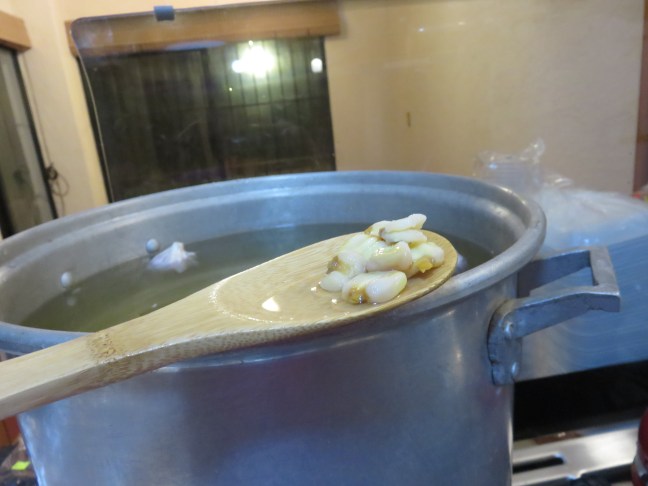
First was the corn, of which there are many types here. What I bought was 4 kilos of very large and hard corn kernels. They had to be soaked overnight, and then ended up being cooked for 7 hours on the stove. This is the same corn that is soaked in lime to break down the protein before it is eventually turned into the flour for making tortillas. However, pozole, which I personally call popcorn soup, only requires that it be boiled to death in water. And by the way, the next day, my tank of cooking gas was empty, so thank goodness I have a backup tank.

img_3885

here is a photo of the corn after soaking overnight

     We had gone to the local butcher to order all the meat for the party. For the pozole this meant: 2 kilos espinazo (the backbone), 2 kilos carne grues pura, 1 kilo bandera and 1 kilo curito.  I am not sure which English word corresponds to the rest of the Spanish words, but the meat was the skin, legs and meat below the ribs.

     At one point, I thought Lourdes had put my white dish towel into the sink, but it turned out to be the pork skin, which did look like a white sheet.

three kinds of hot chile peppers and 19 kilos of meat

         The fire was lit under the corn at 6am and two whole heads of garlic (not cloves of garlic, but the whole head, not even peeled) and some salt were added. Now you can tell when you’re in a gringo house by the salt and pepper shakers. I have never seen a shaker of ground black pepper in a Mexican household, and the salt is large-grained and served in a bowl, so you pick some up with your fingers to sprinkle on your food. I used my mother’s Ukrainian covered dish for the salt, and have my gringo salt and pepper shakers beside it for comparison.

bowl of salt, Mexican style in a Ukrainian dish next to my gringo salt and pepper shakers

     The meat was salted and then rinsed to get rid of any blood. Salt was also added to the broth to add flavor. Over time, the meat and skin were added to the mix to continue to boil for a total of seven hours. The corn kernels did expand and looked like popcorn with a chewy consistency.

Lourdes preparing the meat

adding meat and salt to the soup

adding the skin – you can see why I mistook it for a dish towel

     The garnish was chopped cabbage, limes (which they call limones, pronounced lee-MOH-nez, not LIE-mon as they do in Colorado), and chopped onions. I chopped up the onion just fine, but diced the cabbage instead of shredding it as they usually do here. Oh, well, live and learn and the taste was the same no matter how it was cut.

     Once all the food was ready, it was Party Time!!!!! Volunteer Michael brought the music, Tina brought the rest of the food and everyone else brought themselves…. We all had a wonderful time with way more than enough food for everyone, so everyone got something to take home, and I still have enough to eat for a week, plus froze a lot of it.

     Before moving into my house, I lived in the Project Amigo volunteers’ quarters for a year. The staff, and my future neighbors here were so kind and caring, helping me adjust to the language and customs, and when I was sick, making sure I had food to eat and even taking me to the doctor.  This was my THANK YOU to all of them, and I am so happy in my new home surrounded by honest, caring, hard-working GOOD people…